Some people eat, sleep and chew gum, I do genealogy and write...

Monday, January 31, 2022

Watch for the 1950 U.S. Census Project


https://www.familysearch.org/en/info/us-census/1950-census/

Indexing the 1940 U.S. Census Project involved tens of thousands of volunteers. Here is a description of the project from the FamilySearch 1950 United States Census website. 

FamilySearch and Ancestry, working with genealogy societies, other organizations, and an army of volunteers, will create a searchable index to these records. This index will then enable experiences to help you find your own family members in these records. If you were alive in 1950, you will even be able to find yourself and refresh your memory of this time in history.

Join thousands of volunteers as we all work together to provide a rich and detailed index of every person living in the United States in 1950. Starting with a computer-generated index provided by Ancestry, you can help ensure the index is complete and accurate by reviewing and improving what has been done through automation.

The index will be created by Optical Character Recognition and Handwriting Recognition programs by Ancestry.com.  The volunteers will be spot-checking the results. Both OCR and Handwriting Recognition have advanced to the point where the time spent in indexing is being incredibly compressed. 

From my perspective, this will be the first Census I will appear in. I am not sure that is an honor of any kind. 


3-Time World Champion Boxer Samuel Azumah Nelson featured at RootsTech Virtual 2022


 https://www.familysearch.org/en/newsroom/samuel-azumah-zoom-zoom-nelson-rootstech-2022

3-Time World Champion Boxer Samuel Azumah Nelson has been added to the lineup of Keynote Speakers at the upcoming RootsTech Virtual 2022 Conference from March 3 - 5, 2022. 

Quoting from the above blog post, 
Boxing is a sport that demands grit and determination, but those characteristics don’t appear from nowhere. Just ask Africa’s greatest boxing legend, Samuel Azumah Nelson and a RootsTech 2022 keynote speaker (3–5 March 2022). He credits his ancestors for endowing him with the qualities that carried him to 3 featherweight world championships and a place in the International Boxing Hall of Fame.

“I need to show you where my courage and determination to succeed came from” he declared. “I am a proud Ghanaian with a Tabon DNA, power, and spirit. You must be interested in your family history and to live the values it represents.”

There’s a lot behind the Tabon affiliation that is a major part of Azumah’s story for attendees of RootsTech 2022 (March 3–5, 2022). The Tabon people were former slaves in Brazil. With the abolishment of slavery in the late 1800s, 7 families banded together and made their way back to the homelands from which their ancestors had been taken. The Asuman family, who later changed their name to Nelson, were among the leaders of the group.

 You can register now for free at RootsTech.org. 

Introducing (again) FamilySearch GEDCOM 7.0


Going on for three years, I have been working on a committee that is helping to develop an upgraded version of GEDCOM. The last major release, Version 5.5 of the GEDCOM Standard was in 1996. A modification of the GEDCOM Standard, Version 5.5.1, in November of 2019. After years of work and input from the larger genealogical community, a new Standard, Version 7.0.0 was prepared for release and Version 7.0.2 was officially released in June of 2021. GEDCOM 7.0 is not a program, per se, but a standard way of exchanging data between different genealogy programs and websites. 

We have been preparing videos outlining the changes and additions to the Standard for RootsTech Virtual 2022. There will be a lot of presentations and videos at the conference but there will also be a way to search for specific topics and videos. We will also be holding a live online Q&A session during the Conference. 

You can read about the new GEDCOM Version 7.0 in the blog linked above. 

Thursday, January 27, 2022

Free and unlimited use of MyHeritage Photo Tools for Limited Time


MyHeritage.com is offering free and unlimited use of MyHeritage In Color™, Photo Enhancer, and Photo Repair from January 24 to February 5, 2022! You should take advantage of this opportunity to apply these fabulous tools to your old black and white photos. The results will sometimes astonish you. 

You may also want to read the following blog post about the improved color restoration process in this blog post.

Improved Color Restoration for Photos on MyHeritage


Friday, January 21, 2022

You can't take it with you!


Over the years of being involved in the larger genealogical community, I have found people who are overly protective of their own genealogical research. Sometimes, this protection extends to the extent that they will not allow anyone to copy or in some extreme cases, even view their accumulation of information about their family. They often justify this position by explaining that they are writing a book about their genealogy which some of them actually do. Their relatives soon learn that genealogy in their family is something done by this person and therefore there is no need for them to be interested at all. Of course, when the books are finally published, no one wants to buy or read the book. 

In the now closed Mesa Family History Library in Mesa, Arizona, where I volunteered for about ten years, we had a section of about 1500 or so surname or family books. These books were eventually, for the most part, transferred to the Salt Lake City, Utah Family History Library. Many of these books have now been digitized and are available on the FamilySearch.org website. However, many of the authors of these books extended their protection of their work by adding a copyright notice. In these cases, even though the books are fully digitized and posted online, relatives of the author cannot view the contents unless they can find a paper copy of the book. 

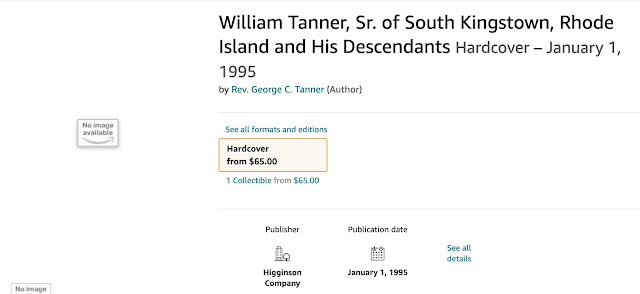
Most of these surname books are self-published. There is even a minor industry of companies that specialize in publishing this type of book. Generally, the cost of publishing a small run of hard-bound books increases the cost of each copy beyond what most relatives are willing to pay. Some of these books are now listed on Amazon and other book sellers with individual volumes in the hundreds of dollars. Here is an example.
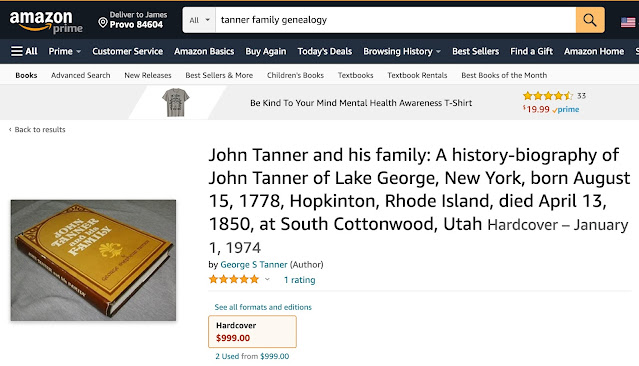

This ad states that there are two used copies available from $999.00. Hmm. Guess what? I have two cases of these books in my basement. How does that happen? The author realizes after a short exploration of the cost of publishing his or her book that it is going to be very expensive. So, the author approaches the more affluent of his or her relatives for a subsidy with the promise that their photo and their story will be prominently displayed in the book. Other relatives are offered the book and told that they can then give copies of the book to their children and grandchildren. What remains unsaid is that the contents of the book are borrowed primarily from earlier family books that are likely already online on some website or another. However, in this particular case, the author or whoever now owns the copyright, can release that copyright claim and allow the book to be not only digitized by made available to anyone who wants to read it. Here is the digital copy of the same book on FamilySearch.org. Notwithstanding the fact that the book is digitized and on the FamilySearch.org website, some viewers may not be able to view the book due to either copyright or other restrictions. 


In addition, much of the genealogical content of this particular book is also available in this book. 


As I have written in the past, there is a tremendous value in searching for and finding such a book, but it is always necessary to spend time checking the sources of information provided. This second book is mostly accurate but contains some problematical conclusions about the family's ancestry that have caused a great deal of confusion and conflict. 

By the way, copies of this second book which is now out of copyright protection sell for amounts such as this online in both original and reprint copies. 


However, hardbound copy can cost more. 


But what about the original book? What would that cost bearing in mind that the book is digitized and freely available online? The answer is that, as far as I could determine, all of the copies of this book for sale were copies of the original. Maybe a collector might be interested in an original copy even when both paper and digital copies are available. 

Now, back to the issue of the protective genealogist. This pattern of protection often includes putting a private family tree online. The excuse for this is often that their work is in progress, and they don't want to publish their findings publicly until they come to a conclusion. 

In all these instances, the overriding fact of life is that these genealogists will die (as we all will) and most, if not all their work, will be lost. The reason for this loss lies in the protected nature of their research. Unless the information is freely shared with all of the relatives who might be even slightly interested, it is likely that no one in the family will value the work that has been done and will simply throw it in the trash when the genealogist dies. 

Sharing the work, especially sharing the work online on a family tree such as the FamilySearch.org Family Tree, at least gives the relatives a chance to become interested. Maybe you are like one of these artists who create works that disappear after a short time and you don't care if all your work is lost, but if you do care, you might want to start making your work generally available for others to copy. Afterall, you are all descendants of the same people. No one owns their ancestors.

If you do have the urge to publish a surname or descendancy book, remember to specifically waive any and all rights to a copyright. You just might end up having more people read your work than you would otherwise. 
Thursday, January 20, 2022

Genealogy on YouTube.com


https://www.youtube.com/c/familysearch

I wrote recently about the Brigham Young University Family History Library YouTube Channel, but I need to point out that there are hundreds of other active genealogy related YouTube channels. Some of us learn through reading while others learn more graphically. I learn best by watching someone explain and then trying what I learn myself. I can also learn from books, but it takes longer, and I lose the ability to immediately try things myself. I use YouTube for everything from fixing my car to solving questions while using a particular program. This applies to genealogy as well as any other subject. 

Now, how do we get started with YouTube? Let's ask a question and put the question in the YouTube search field.

Here is what I get from that search.


I may not want to view the first few videos, but as I scroll down, I find the following. 

Introduction to Scandinavian Genealogy

Everything else on YouTube works the same way. You search to answer a question and then you will likely find someone who has posted a video discussing the answer. 

I could do a long list of YouTube channels that talk about genealogy. Yes, The Family History Guide has a YouTube channel with almost 200 videos. Each of the genealogy companies also seems to have a channel also. You could keep watching for days if you had to recover from some illness or whatever. 

I like YouTube because it has solved so many problems for me, both trivial and serious. Maybe you need to stop watching the news on TV and start watching something that will help you find your ancestors. Just a. suggestion. 

Tuesday, January 18, 2022

Who should use The Family History Guide and why?

thefhguide.com

The Family History Guide has been around for some years now and is firmly established as a go-to genealogical and family history educational website. The entire contents of this still-growing website are free to all users. It is my experience that many of those genealogists and family historians who would use and support the website dismiss it without ever looking at its content for a variety of reasons. I thought I would write about some of the perceptions I have observed from people when I mention the website. 

First, the website really is free. It is not a freemium website that is trying to get you to pay for advanced or premium services. The Family History Guide is fully staffed by unpaid volunteers and is funded by donations. See The Family History Guide Association. We encourage donations because without them we cannot participate in conferences such as RootsTech 2022 Virtual which is coming up shortly after the date of this post. One way you can donate is to use Smile.Amazon.com when you order items on Amazon. This is exactly the same website as Amazon but a small percentage of your purchases goes to the charity of your choice. This is a painless way of donating to The Family History Guide but we also appreciate direct donations. 

Another common misconception about the website is that it is just for beginners. This is most commonly a perception among established and professional level genealogists. This belief is one of the most obvious indicators that the genealogist has not yet looked or explored the website. One of the basic research helps that aspiring genealogists are encouraged to accumulate by the professional genealogical community is a research outline of the basic resources for the geographic areas of the world where the new genealogist will be doing research. These outlines usually appear in the form of three-ring binders full of paper. Guess what? All of that work in compiling an outline is almost completely done by the Countries section of The Family History Guide. Here is a sample page. 


This section on England contains hundreds of links to information about and the location of valuable genealogical records already organized by topic and geographic location. Not only does this particular section and all the other about other countries of the world contain link to general resources, each of the English counties has its own section of links and documents. 


If you happen to be helping someone with their research, you can show them the Country section and they will then have a whole course of references with articles and videos to help them learn how to do their research. Without going into more detail, The Family History Guide website has detailed instructions and finding aids for every major country in the world where genealogical records can be found. It also has specialized section on ethnic and religious groups. 

One of the most useful functions of The Family History Guide website is to provide step-by-step instructions for each of the large online genealogical websites such as FamilySearch, Ancestry, MyHeritage, and Findmypast.There is an inherent tendency for many people to ignore the instructions whether it is for a recent purchase or when trying to learn a now topic. The instructions in The Family History Guide are there to show you how to get started with all of these websites. Anyone who wants to learn how to use these websites will benefit from the step-by-step instructions and videos. 

Some genealogists struggle for hours, days, weeks or even years with research problems when the resources to help them move beyond these difficulties are available on The Family History Guide website. It sometimes seems like spending time learning is time wasted from actually doing genealogy but that is simply not true. We only progress by learning and since The Family History Guide is at the core of learning, we should be using this tool to help us progress. 

There are probably a lot more misconceptions but these are sufficient for now. Please take some time to explore The Family History Guide website.