Some people eat, sleep and chew gum, I do genealogy and write...

Saturday, November 26, 2022

Immigration: The Greatest Genealogical Challenge, Part Two: Understanding the Objective


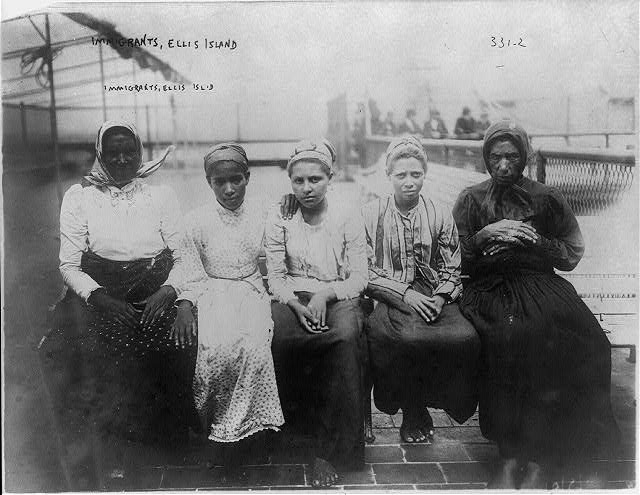
  • Photograph shows five women immigrants sitting on dock at Ellis Island. 
  • Bain, George Grantham, 1865-1944, photographer

  • For about three and half years, I worked on a Federal District Court attorney panel representing the "witnesses" in illegal alien "undocumented immigrant" cases. Over the years I was working for the District Court, I probably represented somewhere near a thousand people. I did not represent the immigrants individually. I was appointed to represent each group of immigrants that were "arrested" detained at the same time. The idea was that the "witnesses" had to remain in jail until the case against the smuggler or "coyote" was settled or went to trial. My representation consisted mainly of explaining to the immigrants why they were being kept in jail without any specific release date. I also interviewed them to see if they really had any useful information. This experience gave me a somewhat unique viewpoint about how the immigration laws worked in the United States. My frustration level was quite high because there was so little I could do for these poor people. 
Perhaps It helps to understand that at the time, I lived in Scottsdale, Arizona. Not the Scottsdale of resorts and high-priced stores, but the Scottsdale next to the Salt River Pima–Maricopa Indian Community. Across our back fence, was government subsidized housing. Now, it might also help to understand that I had lived for two years in Argentina and another two years in the Republic of Panama. I had also graduated with a B.A. degree in Spanish and an M.A degree in Linguistics. I was also a relatively newly graduate of the Arizona State University Law School. From that time, to the present, I have consistently been involved in speaking and teaching in Spanish. I also spent a couple of years teaching English to those who spoke Spanish. 

Let's just say that during some of the time I lived in Arizona, the politics towards immigrants were dominated by Maricopa County Sherrif Joe Arpaio. See “Joe Arpaio.” 2022. In Wikipedia. https://en.wikipedia.org/w/index.php?title=Joe_Arpaio&oldid=1117846249. Sheriff Joe, was the Maricopa County Sheriff from 1993 to 2017. 

You might be able to understand from this description that I could have some strong feelings about immigration. I can only assume that despite the primary subject of genealogical research that some of my feelings might creep into my writing from time to time. That said, I have spent a lot of time trying to understand the immigration process and all the associated documents. 

Although there are rich and well-educated immigrants, most of them from the earliest times were ordinary people who came to America for jobs, land, or to escape war and persecution. My own ancestors came as early as 1620 from the Netherlands on the Mayflower and as recently as 1866 from Denmark. One of my great-grandfathers was an immigrant and additionally, six of the great-great-grandparents were immigrants. 

One of my first seemingly impossible immigrant issues reinforces the basic objective of immigrant research: finding the exact place of an event in the immigrant's place of origin. My Great-great grandfather Samuel Linton was from Northern Ireland. His daughter, who was born in the United States, was a genealogist. See “FamilySearch Catalog: Mary Ann Linton Morgan Documents — FamilySearch.Org.” n.d. Accessed November 26, 2022. https://www.familysearch.org/search/catalog/1222773?availability=Family%20History%20Library.

What happened is that his daughter recorded his birthplace in Ireland, but the name of the place did not exist. I spent about 15 years, off and on, looking at maps, searching for similar place names and generally not making any headway. This scenario is a common genealogical situation. If you happen to have an exact place, not Germany or Ireland, for your immigrant you have likely already traced his or her family in the country of origin. Finally, after years of looking, I found a marriage record where Samuel Linton had signed his name and written his birthplace.

This example summarizes the entire objective: searching for the place of origin. 

Friday, November 25, 2022

Immigration: The Greatest Genealogical Challenge, Part One: The larger picture


During the past almost two years, I have scheduled over 500 consultations online working with the Salt Lake City FamilySearch Library (Family History Library). I estimate that well over 80% of those consultations were questions regarding finding an immigrant ancestor's origin. The most common countries of origin of the ancestors were Italy, Spain, Ireland, and Germany. The popularity of Italy and Spain came from the fact that most of my consultations were and are in Spanish. After you prepare to find this many immigrants, you have a pretty good idea about the issues involved.
 
Here in the United States, we live in a nation of immigrants. If you go far enough back in history, everyone who lives on both American continents are immigrants from somewhere else. Every one of our ancestral lines ultimately disappears into the shadows of the past or reaches an immigrant. 

The most common end-of-line challenge is finding the origin of the immigrant. Everyone involved in their family history will inevitably either be looking for an immigrant or finding that there are no more records to search. 

American history usually focuses on immigrants from Europe and primarily those who came to the eastern part of the country. In every age, the immigrant has been barely tolerated, vilified, or persecuted. From the earliest settlements in North America, immigrants have been blamed for a myriad of national and local ills. As a result, the prejudice against whatever group of people were coming to the United States at the time, creates barriers to research about the immigrant's origin. Name changes and withholding information about the immigrant's place of origin are common responses to prejudice and impede genealogical research. 

[Illus. for article "an alien anti-dumping bill" in The Literary Digest, May 7, 1921, p. 13, reprinting a cartoon by Hallahan for Providence Evening Bulletin, showing funnel bridging Atlantic with top at Europe crammed with emigrants and bottom at U.S. with Uncle Sam permitting immigrants to trickle through]

During to the early years of the immigration to the east coast of the country, it is estimated that as many as one half to two thirds of all the immigrants to the Colonial America arrived as indentured servants. (See Indentured Servants, Apprentices, and Convicts: Finding Family Histories at the Library of Congress) These figures may be disputable, but the number is still large enough to explain why many research efforts to identify the origin of indentured men and women becomes difficult to impossible. Included in the numbers of indentured servants are the numbers of people who were sent to the colonies as convicts. The number of convicts is estimated at about 50 to 60,000. (See Butler, James Davie. 1896. “British Convicts Shipped to American Colonies.” The American Historical Review 2 (1): 12–33. https://doi.org/10.2307/1833611).

Until the first immigration laws were passed in the United States in 1882, (See Chinese Exclusion Act (1882)) all an immigrant had to do to enter the country was to walk across the border or disembark from a ship. There was no consistent, unified effort to identify and record entry into the colonies. The main resources for finding an immigrant are passenger lists. But that only moves the challenge to finding the port of entry. 

Beginning with that first law in 1882, the immigration laws changed and continue to change almost constantly. One of the most useful changes that helps to find the place of origin of an immigrant occurred when the naturalization laws changed in 1906 to move all citizenship and naturalization applications to the Federal Court system. 

Immigration is not a local phenomenon. Every country in the world has some level of emigration or immigration. In the United States, the complex immigration laws passed since 1882 have created the idea of an "illegal immigrant." Immigration law in the United States is second only to the income tax code in legal complexity. See York. September 27, 2021, “15 Myths About Immigration Debunked.” Carnegie Corporation of New York. Accessed November 25, 2022. https://www.carnegie.org/our-work/article/15-myths-about-immigration-debunked/. See also “10 Countries That Take the Most Migrants.” n.d. US News & World Report. Accessed November 25, 2022. https://www.usnews.com/news/best-countries/slideshows/10-countries-that-take-the-most-immigrants.

In 2018, there were 1,096,611 immigrants to the United States. In the same year, there were 396,579 U.S. Border Patrol Apprehensions along the Southwest Border. See “Southwest Border Migration FY2018 | U.S. Customs and Border Protection.” n.d. Accessed November 25, 2022. https://www.cbp.gov/newsroom/stats/sw-border-migration/fy-2018. In contrast, quoting from “Irish-Catholic Immigration to America | Irish | Immigration and Relocation in U.S. History | Classroom Materials at the Library of Congress | Library of Congress.” n.d. Web page. Library of Congress, Washington, D.C. 20540 USA. Accessed November 25, 2022. https://www.loc.gov/classroom-materials/immigration/irish/irish-catholic-immigration-to-america/.

It is estimated that as many as 4.5 million Irish arrived in America between 1820 and 1930.

Between 1820 and 1860, the Irish constituted over one third of all immigrants to the United States. In the 1840s, they comprised nearly half of all immigrants to this nation.
The number of Irish Americans in the United States in 2010 was 34,670,009. See the following from the United States Census Bureau, “American FactFinder - Results.” 2015. Archive.Ph. January 18, 2015. https://archive.ph/CO6cR. This number was only exceeded by the number of German Americans of 47,911,129. With these numbers, you can easily see why I would have questions about German and Irish immigrants.

Argentina is an example of the impact of immigration, 62.5% of the population has Italian ancestry. See “Italian Argentines.” 2022. In Wikipedia. Accessed 25 November 2022, https://en.wikipedia.org/w/index.php?title=Italian_Argentines&oldid=1122434713. The number of Argentines with Spanish ancestry is about 31.4% of the population. The rest came from Germany, the British Isles, France, and other parts of Europe. 

This is a series. I intend to trace not only the history of immigration in the United States, but include information about immigration in many other countries around the world. The goal is to provide a basic understanding to the challenges faced by those who are descendant from immigrants. 

It is also to begin the process of identifying the causes of migration and therefore immigration and emigration. I will also explain the main avenues of research to make some progress in locating the origin of an immigrant. 

Thursday, November 24, 2022

Drought and Genealogy: Don't underestimate nature


https://droughtmonitor.unl.edu/CurrentMap.aspx

When I was in elementary school, we had a class on the history of Arizona. Since we lived in the Salt River Valley (Phoenix), one of the things we studied was the prehistoric inhabitants of the valley who had constructed a vast network of canals to take advantage of the water in the Salt River. Here is a short quote about these people from an article entitled "The Hohokam."

The name Hohokam (pronounced with the accent on the last syllable) comes from the word Hoohoogum, the name given by the contemporary Native Americans in this area to the prehistoric peoples whom they claim as their ancestors. The Hohokam people occupied the valley and much of southern Arizona from A.D. 1 to 1450.

 In the 15th Century, this extensive culture seemed to simply pick up and leave the valley. In essence, they disappeared. There are a number of theories about why they left the valley that mostly center around their water supply. As I grew up in Phoenix, I often speculated at what would happen if we had an extended drought. What would happen to our own city if there was a severely limited water supply? 

Now let's flash forward to the present. Of course, it is obvious that I have been doing genealogical research for a long time. The most prevalent theme of my research has centered on people who left one part of the world for another. The reasons for this movement include drought, but also include wars, persecution, disease, and famine. One example from my own history is the arrival of my ancestors who came to the United States to escape the effects of the Potato Famine in Ireland. See "Great Famine (Ireland)." Another example from our own country is the Great Migration of more than six million African American people from the South to other parts of the country from about 1915 to 1970. These migrations are a challenge to establishing genealogical ancestral continuity i.e. identifying the origin of a specific ancestor or family. 

Today in the United States, the country is preoccupied with politics. But the effect of politics on genealogy will be slight compared to the effect on our country of the background natural conditions of plague and drought. We have all seen the impact of the COVID epidemic, but I am certain that few of the people in the country are even aware of the larger effects of the drought. Deaths from the COVID epidemic in the United States are now over 1.1 million. The effects of the drought such as higher food prices within an overall increase in inflationary costs are usually blamed on the government and politics. Now we get to live during a time of natural disaster that will rival and may exceed those of the past. 

As for the drought, the United States might generally become aware of the impact when the water that supplies the Salt River Valley dries up and the 5th largest city in the United States runs out of power and water. Where will the people go this time?

For going on two years now, I have been helping with online consultations that originate with the Salt Lake City FamilySearch Library (Family History Library). Almost every one of these twenty-minute consultations have centered on finding an immigrant ancestor. Week after week, I get questions about immigrants from one part of the world to another. Recently, I have fielded questions about immigrants from Ireland, Poland, Spain, Italy, the Czech Republic's former incarnations, Germany and its former incarnations, and many other places. 

It is obvious to me that we are about to go through another great migration. One difference is that today, this migration will be painfully and completely documented. Maybe I can summarize with allusion to a quote that is often attributed to the Chinese, that we certainly do live in interesting times. (See "May You Live in Interesting Times."

The past is really just a rehearsal for the present. 

Wednesday, November 23, 2022

A Personal Look at MyHeritage's AI Time Machine™


This is an AI product of a photo series I submitted to MyHeritage.com's AI Time Machine™. This is what I might have looked like if I have let my hair grow from a 1970s look which I might add would not be noticeably different than what many of the people around me look like today in 2022.  Before I give you some further looks from the AI generator, I guess it would be fair to add one of the original photos. 

Hmm. What if I decided that I liked the new look from MyHeritage? 

Here are several renditions of me as a prehistoric hunter.


Actually, my T-shirt would have fit right in. I do notice that I still don't get much of my hair on my head back. 

I notice my T-shirt also made it into Roman History with this collection of me as a Roman Legionary. 


I guess my heritage limited me from some possible historic figures but here is one with me as a Mayan, maybe because I speak Spanish and studied languages. 


What would happen if I showed up at the BYU Family History Library looking like one of these?

As you can see, this could go on indefinitely, but it would be a great way to spend an evening with friends. 

Here is the link to the website. https://www.myheritage.com/ai-time-machine

Escaping the Fire Swamp of genealogical research


Excuse the reference to Princess Bride, but there are only a few terms that adequately describe the difficulties of trying to unravel a mess in the FamilySearch.org Family Tree. This particular mess started with a family where the husband had three listed wives. Unfortunately, the three wives shared all or some of the same children. This is not an isolated or even uncommon issue with research done by several people over many years. This family was located in England and when the marriage dates and other information, including census records was examined, it was obvious that all three of the women could not be the man's wives or the mothers of the listed children. It turned out that there were two separate men and that one of them had been married to two of the wives, one after another and the third wife was married to another man with the same name who lived in the same area. 

The problem with the wives probably came about as a result of the very common same name = same person issue. In the situation above, the key to unraveling the confusion was to focus on the occupations listed in the English census records. One of the men was a pipe fitter and the other was a carpenter. The census records were also the key to separating out which children belonged to which wife. 

One of the areas most prone to tangles is New England (British Colonies) before 1800. I don't usually find this problem with English records because the records generally contain enough information from parish registers to separate families when the focus is on the location of events in the people's lives. In New England, the really helpful records are seldom indexed, and the confusion is endemic. In the FamilySearch.org Family Tree, the issues of tangled families are compounded by would-be genealogists copying old family group records and GEDCOM files thereby creating sometimes dozens of duplicates. By far, the largest number of continual changes come from entries that lack any source references. 

Here is an example of some of the changes for one individual with the names of the contributors removed. 


Multiply these changes by about a million, and you will have some idea of what the general swamp in this part of the Family Tree looks like. However, these issues are not confined to FamilySearch. One challenge I had with working out the multiple wives problem on Ancestry was that the Record Hints (Green Leaves) kept mixing the three families together. The Record Hints are helpful, but caution is imperitive. 

I suggest that when you find yourself in a tangled mess on any of the large family tree websites you retreat and leave the mess to those who actually do research and rely on valid sources. If you want to get into the middle of one of these messes, you can find them more easily now on the FamilySearch.org Family Tree because of a new notice that can be posted. Here is an example. 


The presence of this message is an alert that you are entering the fire swamp and need to exercise extreme caution. You are likely to have an immediate and detailed response to any, and I mean any, changes that are not supported by contemporary, valid, historical source citations. 

Thanks to Family Search for this very small step towards drying up the swamp.

Thursday, November 17, 2022

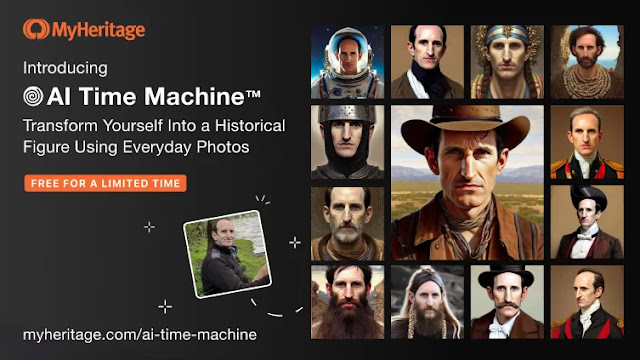
Another Fabulous Photo Development from MyHeritage, AI Time Machine™


How can you possibly believe that this can happen? Watch the video below for a quick look at the results of this new AI development from MyHeritage.com. 


https://youtu.be/swZmSLVfqBs

Here is a link to the MyHeritage blog post that explains more about the process. https://blog.myheritage.com/2022/11/introducing-ai-time-machine-transform-yourself-into-a-historical-figure-using-everyday-photos/

I will have some examples of this with my own photos shortly as soon as I can gather some photos. I am not much for taking photos of myself. 

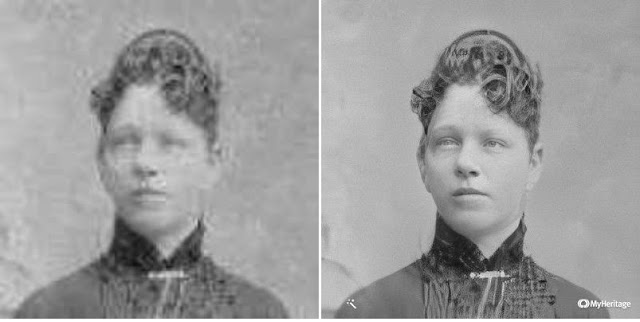
You may also want to explore the other impressive photo tools on MyHeritage.com also. Meanwhile, here is an example of one of the photos we enhanced recently. 


Here's an enhanced photo example. 

More about the process and the results shortly. 


Tuesday, November 15, 2022

Road to RootsTech - Registration and Theme Announcement


 https://youtu.be/CYqFCHuwWQM

This is the official announcement of the theme for RootsTech.org 2023. It is a short video and will help you to understand what is going to happen in the upcoming RootsTech conference.