Some people eat, sleep and chew gum, I do genealogy and write...

Saturday, October 4, 2014

Untangling the String: Examining Records

https://www.flickr.com/photos/theilr/1297320561/
I have recently been confronted with several questions from patrons in the Brigham Young University (BYU) Family History Library about ancestral families where it appears that two or more families have been combined. This usually manifests itself in a tangle of children either because of an unusually large number or ages that overlap. However, you have to allow for incredible possibilities. Apparently, the World's Record for the largest number of children born to one woman is 69 to the wife of Feodor Vassilyev (b. 1707–c.1782), a peasant from Shuya, Russia. In 27 confinements she gave birth to 16 pairs of twins, seven sets of triplets and four sets of quadruplets. See Guinness World Records. The rest of the story also can give the average genealogist pause to consider:
The Gentleman's Magazine (1783, 53, 753) recounts: "In an original letter now before me, dated St Petersburg, Aug 13, 1782, O. S. Feodor Wassilief [sic], aged 75, a peasant, said to be now alive and in perfect health, in the Government of Moscow, has had–
By his first wife:
4 x 4 = 16
7 x 3 = 21
16 x 2 = 32
----------
27 births 69 children
By his second wife:
6 x 2 = 12
2 x 3 = 6
---------
8 births 18 children
"In all, 35 births, 87 children, of which 84 are living and only three buried. . . The above relation, however astonishing, may be depended upon, as it came directly from an English merchant at St Petersburg to his relatives in England, who added that the peasant was to be introduced to the Empress."
In Saint Petersburg Panorama, Bashutski, 1834, the author notes that:
"In the day of 27 February 1782, the list from Nikolskiy monastery came to Moscow containing the information that a peasant of the Shuya district, Feodor Vassilyev, married twice, had 87 children. His first wife in 27 confinements gave birth to 16 pairs of twins, seven sets of triplets and four sets of quadruplets. His second wife in eight confinements gave birth to six pairs of twins and two sets of triplets. F. Vassilyev was 75 at that time with 82 of his children alive."
And the Lancet (1878) refers to a twin study carried out by the French Academy and:
"Apropos of the enquiry, the Committee of the Academy recall an account of a quite extraordinary fecundity that was published by M. Hermann in his "Travaux Statistiques de la Russie," for Fedor Vassilet [sic]. . . who, in 1782, was aged 75 years, had had, by two wives, 87 children."
OK, baring that possibility, most of the time, the tangled children need to be sorted out and the families separated.

This is usually accomplished by careful examination of the place where each child was born.  This challenge is most common in countries with very similar given and surnames, such as the Scandinavian countries and Wales. I also run into this issue in Latin America. I once knew a family in Panama with six boys, all of whom had been given exactly the same name.

Here are some suggestions for avoiding combining children from different families (assuming you don't end up related to Wassilief)

  • Look carefully at the locations of each birth.
  • Do not assume people with the same names are the same people.
  • Look closely at the birth order and dates.
  • Make sure the parents are identified correctly. 
  • Take the time to think about what you are doing.


Friday, October 3, 2014

Blogging: A Conversation with the World

One of the most surprising (to me) statistics from blogging is the number of readers in countries such as France, Germany, the Ukraine, Russia, China and even Poland. It reinforces my feeling that in blogging about genealogy (or any other subject for that matter) I am really having a personal conversation with the entire world. I guess it is hard to understand that I can carry on such a conversation sitting at a computer in Provo, Utah or Mesa, Arizona.

One of the strangest things about blogging, especially about a topic such as genealogy, is that I am always surrounded by people who, (A) have absolutely no interest in the subject of genealogy and (B) have never read a blog and in addition, have no idea what a blog is. The contrast between the semi-unreal online world and the real world surrounding me gets more pronounced every day. In addition, I can't even begin to speculate how what I say would even sound like in Russian or Polish.

Granted, genealogy is a universal subject and transcends any international or social boundaries. I have spoken Spanish nearly all my life and I cannot imagine translating some of things I say in my blog into Spanish. Even if I were to translate every word perfectly, the cultural and social context of my blog posts would be lost. So how do I explain the popularity of my blog in non-English speaking countries? All I can guess is that genealogy supersedes these limitations and addresses a basic human experience.

The one thing that I think is important about writing a blog, no matter the subject, is that you are totally and completely saturated and immersed in the topic. I eat, sleep and live genealogy, all day, every day. Contrary to the question I am most asked, I do sleep. But I often wake up with an entire blog post planned out in head. I do not either encourage or even suggest that anyone become so involved in a single topic, even if that topic is genealogy. But on the other hand, I certainly can understand how such a fixation is possible.

In analyzing the reason for my interest, I believe that it is based on the complexity and unpredictability of the subject. If genealogy were not so difficult, it would not hold my interest. Law, linguistics, history, weaving, photography, computers and many other subjects have caught my attention, but it only genealogy that has the characteristics that keep my mind fully occupied, day after day, week after week, year after year. If you think the practice of law is unpredictable, then you need try going to court day after day. But law is really a narrow subset of genealogy, as are all the other disciplines. In its broadest sense, genealogy includes practically every other study and learning. Genealogy deals with the entire spectrum of human experience put in the form of the most complicated detective story ever written.

Realizing this, it is not only possible but probable, that passionate writing about genealogy would have an attraction to all who realize the importance and central role of the subject, no matter their cultural or linguistic background. Of all the subjects I have embraced, photography comes the closest to having the attraction of genealogy. Both photography and genealogy are ways of dealing with the details and at the same time, the complexity of the world. Much of the time, I see the world as a discrete series of photographs.

I also find it interesting that both genealogy and photography will never lead to fame, fortune or even notoriety. They are narrow subjects and the only people who achieve a measure of fame are those who are involved in the business of both. I am long past the time of my life when I need to be involved in business. So, I write. I teach and sometimes, I take photographs. It reduces life to a pretty simple regimen. Oh, I almost forgot all the rest of my very complicated life for just a second. I guess I was writing in terms of the unreal world rather than the sometimes harsh reality.

How many genealogy online subscriptions are enough?

Years ago, I had a pile of magazine subscriptions. I slowly began to realize that I wasn't taking time to read them all and they were just piling up with the unread newspapers. Over the years our subscription list has become shorter and shorter. At the same time, many of the various retail establishments I frequent, such as Sam's Club and Costco, began writing magazine length advertisements and sending them out to customers. We also started getting "free" newspapers delivered to our driveway, several times a week so the amount of paper we get is actually seeming to increase.

So the heart of the question in this post's title is the utility and amount of use of each of the subscription sites. This is a highly personal decision. I always suggest that before subscribing to any online service that the potential user investigate the website carefully and, if possible, work with the website at a Family History Center where many websites are available for free.

One important factor in considering any subscription website is whether or not the site has the records supporting your particular area of research. Sometimes determining which records are actually available on any given website is difficult, although, if you persist in investigating the site, you can probably get a list of some kind. There are options with some genealogical websites to "pay as you go." I have found that this is an option only if you are reasonably sure that you will not find more records on that same website. It is not unusual for the fees from "pay as you go" to exceed the amount of a monthly or yearly subscription.

One real-world factor is the amount of money you have to pay for subscriptions of any kind. I frequently hear stories of genealogists who travel great distances to do research and find that the records they are seeking are no longer available because the records have been digitized and are available online either for free or in a subscription website. Even the most expensive annual fee for a subscription website is only a tiny fraction of the cost of traveling across the country or around the world to do research. I would certainly exhaust all of the possible online sites before undertaking an onsite research effort. However, there are some places where visiting the site is less expensive than the alternative. This is true, for example, with the Family History Library in Salt Lake City, Utah and other such centralized genealogical libraries. No subscription is a substitute for a visit to the Family History Library.


How online genealogical database programs operate - Part One

I realized I had hit upon a goldmine of a hypothetical when I came up with the Dreamland of Genealogy (DOG). I needed just such a concept to keep from seeming to pick on any one large online database in the name of fairness and the fact that they all need to improve. So now you, the reader, will have to figure out which of the large online companies I am picking on. Of course, on occasion, it will be necessary to be specific and leave my hypothetical world for a while.

During the past few weeks I have been working at the Brigham Young University (BYU) Family History Library any where from 3 or 4 to 11 hours a day answering questions and teaching classes. By the way, the schedule for the classes during the week of October 6th through 11th are on the Library's Facebook page. Everyone and anyone is invited to attend. The topic will be FamilySearch Family Tree in depth. One result of such intensive teaching and support has been listening to a huge variety of questions and concerns. As a result, there are certain patterns emerging.

One of the most common problems, not surprisingly, is the need for logins and passwords for online database websites. By coming to a library, the patrons and missionaries are leaving their own computers at home and forced to remember logins and passwords that their browsers remember for them at home. Many of them come with pieces of paper covered with writing and have to search for the tiny scratchy note they made when they registered for the website. I am well aware that there are programs that will organize passwords and remember them from one master password or using some other type of technology. But the challenge in the BYU library is that the users need a password to get into the BYU computers before they ever get to their own set of passwords. Since it is up to the individuals to remember all these passwords, I guess I don't have a ready solution to the problem, other than helping them restore the passwords when forgotten.

But there is a more serious underlying problem. This is the need to interact with an online genealogical database. For this reason, I started to think about these websites in a general way. What do they all have in common?  How do they operate? Why do they exist? Here are some of my thoughts on those, and other, questions.

There is a universal need to communicate and store information. You might recall that writing was developed just for those purposes. Storing and communicating online is just the illogical and surprising extension of the Babylonian Cuneiform Tablet. The evolution of the Internet probably made email, social networking, online advertising, streaming movies and databases inevitable developments. Genealogical databases are just a sideshow to the vast amounts of information being poured online in the name of preservation and even entertainment. Centralization of these online resources is also a natural consequence.

But how do DOG and its real-world counterparts become so big? A little history always helps to clarify any such question.

Back when the Internet was just beginning and the World Wide Web was just an idea in the head of Tim Berners-Lee, two recent graduates from Brigham Young University, Paul B. Allen and Dan Taggart, had the idea to offer copies of publications from The Church of Jesus Christ of Latter-day Saints on floppy disks. They developed the idea and began selling the disks out of their car. The company they founded, Infobases, Inc., ultimately became Ancestry.com through a lot of growth and some changes in ownership. In 1997, the website, Ancestry.com, had first appeared.

Being first had its advantages although maintaining the lead took a lot of money and effort. If you read about the history of Ancestry.com, you will see that even in those early days, the amounts of money involved were into the millions of dollars. The key idea was coupling an online database with the time-honored concept of a subscription. As they say, the rest is history. People can easily understand the concept that periodic payments are a useful way to obtain products. Our whole society is built around the concept of payments over time from salaries to taxes. Key to the development genealogical databases was the lightning speed at which the needed technology was developing especially the ability to create digital images and display them across the Internet.

This was only the beginning. We need to move a little bit further down the road in another post about the operation of the online genealogical database programs. Stay tuned.

Thursday, October 2, 2014

Redundancy in Genealogical Databases -- Good or Bad?

I received the following very thought provoking question from a reader:
I was curious if there is a way to figure how many records are redundant among the databases and which records are exclusive to a database?
The issues raised by this seemingly simple question go to the heart of the concept of maintaining a genealogical database online. The basic idea of collecting genealogical source records is that a researcher can "search" the records for information about his or her ancestors. The implication is that the information will lead to the extension of the researcher's pedigree. The researcher must make the assumption that there is something of value in the online collection and that the searches will produce the expected results, i.e. information on the researcher's family.

As the researcher uses the online database, he or she must experience some level of satisfaction with the initial searches or the search will be abandoned. Depending on the level of sophistication and the research skills of the researcher, the initial impressions of the searches will usually determine the researcher's overall impression of the online database. Put is a more direct way, the searches must produce information of value to the researcher or the database will be abandoned. One indicator of the level of sophistication, experience and skill of any researcher is the ability to continue searching when there are no positive results.

Let me give a hypothetical situation for an example, rather than pick on any one real database program. My hypothetical online database is called "The Dreamland of Genealogy" or (DOG). It's advertisements claim it is "where all your genealogical dreams come true." It claims billions, upon billions of records from every corner of the world. OK, now what is reality here? If a potential researcher simply looks at a list of the source documents, what will he or she find?

DOG knows from observation or experience with other databases online, that the first thing a researcher wants is almost instant gratification. So DOG begins by supplying extremely common genealogical resources such as the U.S. Census records, the Social Security Death Index etc. DOG further realizes that these common database components are redundant, that is that every other online database has the same records. But DOG also knows that if a researcher comes to its website and does not find the milk and potatoes of genealogy, the research will not stay to buy anything else. Why do you think that every supermarket in the U.S. sells milk, vegetables, meat etc? A retailer could fashion a "boutique" store that sold only high end products to a select clientele but usually it is only the major retailers that can afford to maintain these "boutique" type stores. We had an experience with this in the Mesa/Phoenix area when a company came in an started a lot of "Fresh and Easy" stores. My wife and I made one visit to one store and that was our last visit. After a couple years, the stores all disappeared at once. Why? Because Walmart started their small "Neighborhood Stores" and positioned them all around the city. The same sort of market forces drive the smaller database companies out of business. Either they end up selling to the larger companies or they disappear.

Now, if you had gone into the smaller, boutique-type store, would you have found milk, vegetables, meat and other "redundant" products? Yes. But the price of those products would have been higher than the larger supermarket chains. In this analogy, the same databases would have been harder to search.

Now to the question presented at the beginning of this post. Can you determine the level of redundancy between databases? Yes, you could if you had access to a way to compare the two websites. But the companies know that if this were something easy to do, then any online competition would devolve into the same level as the supermarkets with their specials on milk and other essential products. So, the online databases have made that job nearly impossible. They do this by the way they count and advertise their product, i.e. genealogy records. They use a number of meaningless terms such as record count, people, profiles, collections, etc. to make it impossible to determine whether the records are the same or different. In some cases, they also make it nearly impossible to tell where the records originated. For example, go onto a large online genealogy company and try and find out where the records came from. You will see what I mean. By this I mean which library, repository, archive etc. supplied the records?

So you can see that the answer to the question above is yes, there is a way to determine the level of redundancy, but the more realistic answer is no, there is really no way to determine the level of redundancy because we do not have access to the necessary information and the program are not about to let us know that information without a struggle.

Wednesday, October 1, 2014

Strange Encounter with FamilySearch Family Tree Merge Function

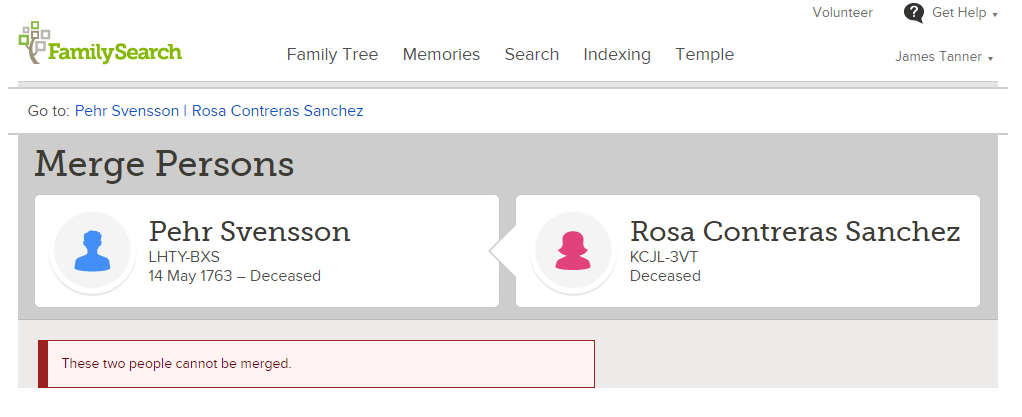
I had the strangest thing I have yet seen happen on FamilySearch.org's Family Tree program. I was helping patrons at the Brigham Young University (BYU) Family History Library and had the same thing happen twice in one night. In each case, there was an obvious duplicate. Here are the two duplicate individuals from Family Tree:

  • Pehr Svensson LHTY-BXS
  • Pehr Svensson 9HHP-INQ

When I put in the first number, I got this individual's detail page.


You can see the ID number just below the name marked in yellow.

The second Pehr Svensson came from a printed ordinance card. When I tried to merge the two individuals using the second ID number, I got a completely different individual. First, the search for duplicates of the LHTY-BXS person did not find any. Then I searched by number and this is what happened. This is the search screen showing the two duplicate individual's by ID number:


When I clicked on the Continue button, this what happened:


The ID number that was on the printed ordinance card came up as Rosa Contreras Sanchez with an entirely different ID number.

This happened to two different patrons, both with obvious duplicates. Now, I am used to the merge function not working but never quite this strangely.The problem is that I cannot imagine any set of circumstances that would produce this error, especially twice in one evening.

Which countries have online genealogy records?

Sometimes it helps to get an overview of what is and what is not available online in the way of genealogical records. If you live in the United States or the United Kingdom, you are swimming in online records. However, as genealogists we are realistic enough to realize that there are still huge numbers of records left to digitize. But what about those records available for other countries? How do they stack up?

Answering this question can be complicated because there may be local online sources in the local language that don't show up in any of my Google searches. It is easy for genealogists to become fixed on a particular area of the world because because of our ancestral connections. For example, if I have no ancestors from Germany then why would I be concerned about the number of records from Germany? On the other hand, those of us who spend a great deal of time teaching and assisting others in their research to find the necessity of knowing what records are available in a huge variety of countries.

It is also interesting to note the progress of adding worldwide genealogical records to the online databases. If you examine the record lists, sometimes called collections, from each of the major online genealogical database programs, you should get a good idea of the availability of records from any given country. I thought it would be interesting to choose some examples. Obviously listing every country in the world would be way beyond the scope of the blog post.

For this particular example, I decided to look at FamilySearch.org, MyHeritage.com, Ancestry.com and findmypast.com. For this illustration, I decided to choose the same countries from each of the large databases. Here are my findings from examining each programs. Each website has a list of countries with a number following. In each case, I found it necessary to explain what I thought was the comparable method of numbering records.

 One complication of trying to determine these numbers is that the countries have a tendency to have changed boundaries and identities over the years. For example, do I rely on the number of records available for "Germany" when all of the various countries that have been formed over the years and called Germany should probably be included? Do I include the Austro-Hungarian Empire in Germany? Nevertheless, choosing some of the countries can illustrate the relative availability of records.  In addition, comparing findmypast.com and to some extent MyHeritage.com with the other two databases is somewhat unrealistic. Each of the large databases have their own unique records in the number of records do not specifically relate to any particular users experience.

FamilySearch.org

 FamilySearch.org has a total of 1837 collections. There is no practical way of determining the number of records because the column that lists record numbers records rather than the total number of records in any particular collection. However recently, FamilySearch.org has implemented a feature linked to the map on the records page that gives the number of records both indexed and unindexed.

  • United States, indexed records 3,161,326,075, record images 465,222,043 in 845 collections.
  • England, indexed records 687,347,166, record images 252,856,175, in 79 collections.
  • Denmark,Indexed records 14,561,774, record images 14,070,366, in 7 collections.
  • Russia, indexed records 10,389,774, record images 18,540,881, in 16 collections.
  • Argentina, indexed records 20,057,795, record images 13,606,189, in 29 collections.
  • Ghana, indexed records 243,908, record images 1,177,156, in 2 collections.
  • New Zealand, indexed records 16,465,909, record images of 12,056,202, in 5 collections.

Ancestry.com

Ancestry.com also gives a number of collections. The total number of collections presently listed is 32,409. The number of records in each collection is listed in the Card Catalog. However, ascertaining the number of records in any given area or country would require adding up each of the numbers of records from each of the collections in the list.

  • United States, collections 25,693, number of records; way over 1 billion.
  • England, collections 1428, number of records; in way over 1 billion.
  • Denmark, collections 56, number of records; probably less than 100 million if you exclude public member photos and scan documents, public member stories and private member photos and stories.
  • Russia, collections 36, number of records; probably around 2 to 3 million.
  • Argentina, collections 9, number of records; around 20 million.
  • Ghana, collections 3, number of records; less than 300,000 if you exclude records from FindAGrave.com that are not specifically identified to Ghana.
  • New Zealand, collections 41, number of records; more than 30 million.

MyHeritage.com

MyHeritage.com also has a method of searching records by place. The exact number of records must also be approximate.

  • United States,well over 100 collections with billions of records.
  • England, 10 collections with over 300 million records.
  • Denmark, 4 collections with approximately 5,000,000 records.
  • Russia, 4 collections with more than 1 million records.
  • Argentina, 6 collections with approximately 9,000,000 records.
  • Ghana, no records.
  • New Zealand, no specific records.

Findmypast.com

There does not appear to be an easy way to determine the number of collections or records in any particular geographic area. But, it is easy to determine that most of their records come from the United States, United Kingdom, Australia, New Zealand, and Ireland. There appear to be no records from Denmark, only one set of records from Russia, no records from Argentina, and no records from Ghana. As I stated above, there really is no way to compare the number of records on findmypast.com with the other websites because of this specialized nature of the entire database.

It is interesting to speculate whether or not the drop-off in records relates directly to the actual existence of records or merely the availability of digitized records to this point in time. I would suspect that many countries that appear to have limited records actually have very detailed records that have yet to be digitized. It will be interesting to see what happens in the future.