Some people eat, sleep and chew gum, I do genealogy and write...

Friday, March 9, 2018

The Impact of the MyHeritage Family Tree Study on Genealogical Research

https://blog.myheritage.com/2018/03/myheritage-science-teams-research-featured-in-the-prestigious-journal-science/
One of the common challenges of doing genealogical research is differentiating people with the same or very similar names. This problem is directly addressed by my Rule Nine: There are patterns everywhere. See "New Rules Added to the Old: The Rules of Genealogy Revisited." As the explanation for this rule indicates, computers are very good at looking for and finding these patterns. MyHeritage.com recently posted about the following scientific article.

Kaplanis, Joanna, Assaf Gordon, Tal Shor, Omer Weissbrod, Dan Geiger, Mary Wahl, Michael Gershovits, et al. “Quantitative Analysis of Population-Scale Family Trees with Millions of Relatives.” Science, March 1, 2018, eaam9309. https://doi.org/10.1126/science.aam9309.

This article is a masterpiece that fully supports Rule 9. The problem addressed by the findings of the study reported in the article and by Rule 9 is that many researchers focus on names to the exclusion of other important information about ancestral families. For example, I commonly find English families with children born in different locations around the country in the early 1700s. Here is one example.


In this family, the parents are shown to have been born and married in Sussex, England. Incidentally, the first three children lack birth information. The last child is said to have been born in Tenterden, Kent, England.

Thomas Byant, 1702-1770 christened in Beckley, Sussex, Kent.
Elizabeth Hovenden, 1700-1734 christened in Northiam, Sussex
daughter May Bryant, 1724 christened in Northiam, Sussex
daughter Elizabeth Bryant, 1727 christened in Tenterden, Kent
son John Bryant, 1730-1762 christened in Tenterden, Kent
daughter Rebecca Bryant, 1734-1801 christened in Tenterden, Kent

There is always an argument, that this was possible. But what about the sources? There is a marriage record for Thomas Bryant marrying Elizabeth Hovenden in Northiam, Sussex. There are also christening records for each of the four children in Tenterden with parents named Thomas and Elizabeth.

Here is a map of England showing where these two places are located.


Could the places in this family be possible? Possible yes, likely no. Why? Now, back to the MyHeritage study. Here is a quote from the MyHeritage.com blog about the study.
The team found that industrialization profoundly altered family life. Before 1750, most Americans found a spouse within six miles of their birthplace, but for those born in 1950,  [1850?] that distance had stretched to about 60 miles. Before 1850, marrying in the family was common — on average, fourth cousins married each other, compared to seventh cousins today. Curiously, they found that between 1800 and 1850, people traveled farther than ever to find a mate — nearly 12 miles on average — but were more likely to marry a fourth cousin or closer. Their hypothesis is that changing social norms, rather than rising mobility, may have led people to shun close kin as marriage partners. In a related observation, they found that women in Europe and North America have migrated more than men over the last 300 years, but when men did migrate, they traveled significantly farther on average.
Apparently, no problem here. Both the parents were supposedly born and married in Northiam. But what about the children? Would it help to know that this husband and wife were likely related? Let's see how likely it is that the children have the right parents.

Using another program, Findmypast.com, I can see how many Bryants there are in the millions of records on this huge website. Searches on Findmypast.com show that during the time period of 1702 plus or minus two years, there were 52,027 records of Bryants in England. By editing the search, I find that there are only about 503 records of Bryants in Sussex during that same time period and of those only 41 were named Thomas. Interestingly, none of these records show any births. However, there is a Thomas Bryant who dies in Northiam in 1762. However, the records on FamilySearch.org do show a marriage for Thomas and Elizabeth in Northiam in 1724.

Is this the same Thomas and Elizabeth that are shown as the parents in Tenterden? That is the question. The MyHeritage.com study would tend to make me consider the conclusion as unlikely.

Ignoring for the moment that we do not have a source for Thomas Bryant's birth, let's look at the Bryants in Tenterden, Kent about nine miles away. Back to Findmypast.com.

There are 1.106 records listed for Bryants in Kent in around 1702 and 68 of them are named Thomas. There are again no christening records for a Thomas Bryant but there is one death record in Tenterden. So, we have a Thomas in this time period who dies in Tenterden and another one who dies in Northiam, where Thomas and Elizabeth are married. A search in Ancestry.com shows that there are no marriage records for a Thomas and Elizabeth in that time period in Tenterden. Ancestry.com only has a death record.

Do we have the right parents for these four children? How does the information provided by the MyHeritage.com study impact your opinion as to whether or not we have found the right parents? Does the fact that we have no birth information for the father in either location and that there is a Thomas Bryant who dies in Northiam have any bearing on your conclusion?

I think that the study done by MyHeritage.com et al. is going to become an important factor in determining the reasonableness of many conclusions. 

Thursday, March 8, 2018

New Digital Public Library of America Website


The Digital Public Library of America, or the DP.LA is a rapidly growing nationwide website. Here is a description from that website.
DPLA connects people to the riches held within America’s libraries, archives, museums, and other cultural heritage institutions. All of the materials found through DPLA—photographs, books, maps, news footage, oral histories, personal letters, museum objects, artwork, government documents, and so much more—are free and immediately available in digital format. The cultural institutions participating in DPLA represent the richness and diversity of America itself, from the smallest local history museum to our nation’s largest cultural institutions. To learn more about DPLA as an organization, our partners, and the communities we serve, please visit DPLA Pro.
As the DPLA accumulates a vast collection of resources it necessarily includes many genealogical important resources. As shown above, in the image, there are over 20 million images, texts, videos, and sounds from across the United States. Take some time to explore the new website.

Wednesday, March 7, 2018

The Impact of 23andMe DNA Cancer Testing.


23andme.com, one of the major suppliers of DNA kits for testing your ancestry, has just recently announced Federal Drug Administration (FDA) approval for a limited type of testing for genetic risks for cancer. Here is a quote from their press release.
Authorization allows 23andMe to report on BRCA1- and BRCA2-related genetic risk for breast, ovarian and prostate cancer 
Mountain View, California – March 6, 2018 – 23andMe, Inc., the leading personal genetics company, today received the first-ever FDA authorization for a direct-to-consumer genetic test for cancer risk. The authorization allows 23andMe to provide customers, without a prescription, information on three genetic variants found on the BRCA1 and BRCA2 genes known to be associated with higher risk for breast, ovarian and prostate cancer.

“Being the first and only direct-to-consumer genetics company to receive FDA authorization to test for cancer risk without a prescription is a major milestone for 23andMe and for the consumer,” said Anne Wojcicki, 23andMe CEO and co-founder. “We believe it’s important for consumers to have direct and affordable access to this potentially life-saving information. We will continue pioneering a path for greater access to health information, and promoting a more consumer-driven, preventative approach to health care.”
Quoting from the International Society of Genetic Genealogy Wiki (ISOGG:
23andMe is a privately held personal genomics and biotechnology company based in Mountain View, California, that claims to be developing new methods and technologies that will enable consumers to understand their own genetic information. The company is named for the 23 pairs of chromosomes in a human cell.
Some years ago, 23andMe was doing extensive genetic screening for a variety of health issues including cancer. In 2013 the FDA shut down further sales of the saliva home-test kit, citing the “potential health consequences that could result from false positive or false negative assessments for high-risk indications. Apparently, now 23andMe has overcome that initial set back and gotten into the genetic health risk assessment market.

I have been watching the large online genealogy database companies as some of the companies began supporting their family tree programs with DNA testing. I thought it was significant that Ancestry.com began subsidiary companies with the names of AncestryDNA and AncestryHealth. Here is a quote from TechCrunch.com from back in 2015 about the launch of AncestryHealth company:
The company saw an opportunity in consumer genetic testing similar to 23andMe three years ago and launched AncestryDNA as a subsidiary of Ancestry.com. Ancestry’s patented algorithm began matching users to relatives as well as DNA matches to ancestors as far back as the 1700’s. 
The company is now taking those family connections a step further with the introduction of generational health information.

https://health.ancestry.com/

Let's face it, the health industry is immeasurably larger than the genealogy industry. Once these companies get involved in DNA testing, it is a natural step to extend their testing services and then become involved in other aspects of health care. In the case of Ancestry.com, we haven't heard much about AncestryHealth since its introduction. At this point, I can only speculate that the siren call of the health industry may pull some of the genealogy companies away from providing only genealogically interesting products and that raises the question of how they will allocate their resources if they are making a lot of their profits from health-related products.

Monday, March 5, 2018

Please Find the Babies!

The reverberations of the recently announced study conducted by MyHeritage.com staff and others will continue to affect the way we do genealogical research for a long time. Here is the citation to the article.

Kaplanis, Joanna, Assaf Gordon, Tal Shor, Omer Weissbrod, Dan Geiger, Mary Wahl, Michael Gershovits, et al. “Quantitative Analysis of Population-Scale Family Trees with Millions of Relatives.” Science, March 1, 2018, eaam9309. https://doi.org/10.1126/science.aam9309.

One of the most shocking findings of the study involves the number of babies missed in doing research. My son Jared Tanner, a neuropsychology professor at the University of Florida, has been reading the publication and we have been writing back and forth about some of the startling conclusions that can be drawn from the data supplied with the article. Here is a comment he recently sent to me about the babies missing from our genealogical research. 
For every 100 people born in the U.S. in 1900, there should be (on average) 10 who died before age 1. Of those 10, based on this article, we expect only 6-7 are listed in a family tree. The other 3-4 are missing.

If there are higher infant mortality rates (e.g., in 1800 [there are not great records]), there are more missing babies but at the same rate (50%). So if infant mortality was 20%, there would be 20 deaths for every 100 babies born. 6-8 of them would not be listed in a family tree.

Infant mortality rates could be much higher or a little lower in any given location and race/ethnicity. In the U.S. black babies died at higher rates than white, on average. So there are more unknown black than white babies.

At a minimum, family trees on average are missing 3% of infants born around the year 1900. That percent is higher (up to 10% or even more) for other times and locations.

My interpretation of the statistics could be wrong but, as you said, there are many missing babies. Someone is watching over these fallen sparrows.
Here is an earlier statement Jared made:
One interesting finding is the Geni.com predicted mortality for infants dying < age 1 is 50% lower than expected. This means the number of included names of infants who died before age 1 is about 50% lower than it should be. If we use a conservative estimate of 10% of children dying before age 1 (in the U.S. in 1900; https://www.cdc.gov/mmwr/preview/mmwrhtml/mm4838a2.htm), for every 7 included names of children dying before age 1, there are at least 3 missing. It's likely quite a bit higher (1700 and 1800 mortality rates were likely higher). There are a lot of missing babies in the family trees.
For me, this is a very emotional issue having just gotten back from taking care of a newborn grandbaby. But also because of my effort to digitize the Mesa, Arizona Cemetery Records. This collection, now on FamilySearch.org, has records of hundreds of babies who died in the early years of the settlement of Mesa, Arizona. While I was digitizing the records, I had to avoid reading them because I got too sad and could not work. If you want to see the images of the records, here is the link and citation.

"Arizona, Maricopa, Mesa City Cemetery Records, 1885-1960." Database with images. FamilySearch. http://FamilySearch.org: 27 January 2017. Mesa City Cemetery.

https://www.familysearch.org/search/collection/1929533?collectionNameFilter=false 

This study, sponsored by MyHeritage.com will eventually have a tremendous impact on how and possibly why we continue to do genealogical research. 

English Freedom of the City Records

London, England, Freedom of the City Admission Papers, 1681-1930

This is a Freedom of the City Admission Paper for my ancestor Joseph George DeFriez. From this document, I learned the following on Ancestry.com, About London, England, Freedom of the City Admission Papers, 1681-1930:
Freedom admission papers can record many biographical details about the individual to whom Freemen status is awarded making this collection of particular interest to genealogists. Many of the documents in this collection are "indentures" or sealed agreements for things like apprenticeship agreements. The original document was made with all copies on the same page of parchment. An "indented" or wavy line was drawn between these copies, which were then cut apart straight through the wavy line. When brought together later these copies could be realigned or "tallied" by matching the indented lines. 
The word "indenture" comes from the Late Middle English word endenture, via Anglo-Norman French from medieval Latin indentura, from indentatus, past participle of indentare. Consistent with the description the word has come to be applied to a deed or agreement executed in two or more copies with edges correspondingly indented as a means of identification. Here is an image of an indentured document:


So, an indentured servant is one who subject to a contract or an agreement. Anciently, the documents were validated by the wavy line. 

The Freedom of the City document above is described by the City of London website as follows:
Freedom of the City
One of the oldest surviving traditional ceremonies still in existence today, is believed to have been first presented in 1237. 
History and origins
The medieval term 'freeman' meant someone who was not the property of a feudal lord but enjoyed privileges such as the right to earn money and own land. Town dwellers who were protected by the charter of their town or city were often free – hence the term 'freedom' of the City. 
From the Middle Ages and the Victorian era, the Freedom was the right to trade, enabling members of a Guild or Livery to carry out their trade or craft in the Square Mile. 
A fee or fine would be charged and in return the Livery Companies would ensure that the goods and services provided would be of the highest possible standards. In 1835, the Freedom was widened to incorporate not just members of Livery Companies but also people living or working in the City or those with a strong London connection. 
Modern Freedom
Today most of the practical reasons for obtaining the Freedom of the City have disappeared. It nevertheless remains as a unique part of London’s history to which many people who have lived or worked in the City have been proud to be admitted. 
Prior to 1996, the Freedom was only open to British or Commonwealth Citizens. Now, however, it has been extended globally and persons of any nationality may be admitted either through nomination or by being presented by a Livery Company. There is a long standing tradition of admitting women. 
The City of London is keen to maintain the Freedom as a living tradition. The Freedom is open to all who are genuinely interested and invited or born to it. The City Freemen are a very broad cross-section of the population. 
The Freedom in the City today is still closely associated with membership of the City Livery Companies.
In a real sense, the Freedom of the City guaranteed that the person was not an indentured servant.

Sunday, March 4, 2018

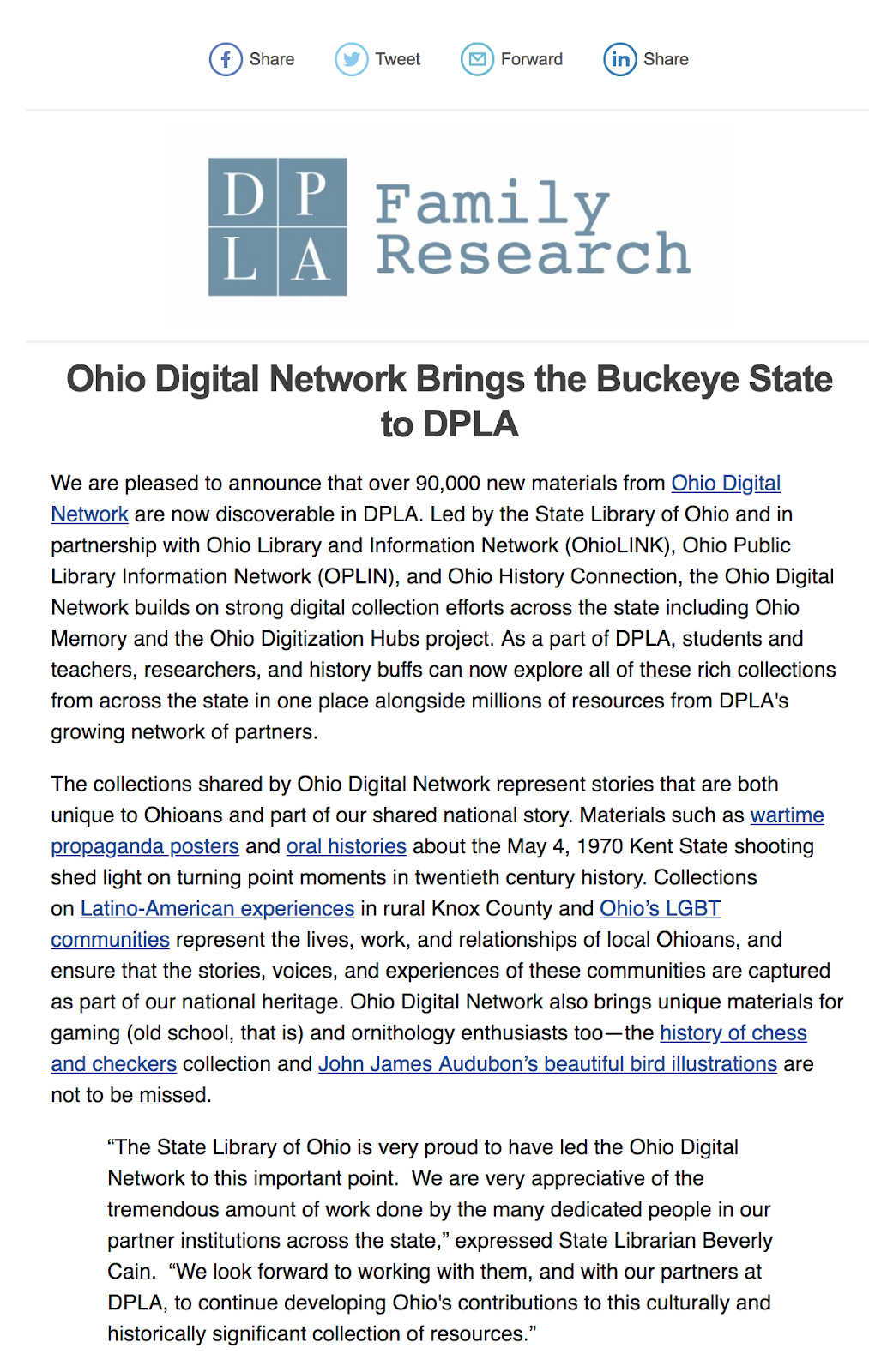
Digital Public Library of America adds Ohio Digital Network


The Digital Public Library of America or DP.LA has added 90,000 new items from the Ohio Digital Network. These are apparently items that have not been online previously. Everything on the DP.LA is free. You can see the new DP.LA website in this screenshot.


You can view all of the items on the DP.LA by viewing the collections by Partner. Here is what is on the Ohio page.


New York Catholic Church Records from Findmypast


As the image above indicates, Findmypast.com has added over 1 million New York Roman Catholic Parish Baptisms to the Findmypast.com website. These records have never before been available online. Here is the description of the records:
Transcripts of the original parish registers make up this collection. There are 163 parishes included. You can explore the full parish list with years covered in the parish list located in the Useful links and resources. There is a 100-year cut-off for baptisms included.
In each transcript, you can learn all or some of the following information:
  • First name(s)
  • Last name
  • Birth year
  • Birth date
  • Birth place
  • Baptism year
  • Baptism date
  • Baptism location
  • Father’s first name(s)
  • Father’s last name
  • Mother’s first name(s)
  • Mother’s last name
  • Language
  • Parish
  • County
  • Archdiocese
  • State
  • Country
I can only wish to have such records about my own ancestors. Here is the link that goes directly to the records. Of course, you will need a subscription to Findmypast.com to search the records.