Some people eat, sleep and chew gum, I do genealogy and write...

Tuesday, May 31, 2022

There is a huge wave of genealogy videos (including mine)


Of course, the BYU Family History Library is not the only organization uploading genealogy videos but we do upload up to three or four new videos a week except when the school schedule slows things down. Here is one of my latest videos. 

Tips for Working Collaboratively on the FamilySearch Family Tree

I have also been posting a series of videos with Richard Miller of the GoldieMay.com website on his YouTube Channel. Here is the latest one in the series. 

Unrehearsed Genealogy Research, Episode 9: Irish Immigrant in Utah

We hope to average at least one of these videos a week but may be slowed down during the summer. 

Then there is MyHeritage Live on Facebook.com. Here is one of my recent videos for MyHeritage.com.

https://www.facebook.com/myheritage/videos/3105511106333617

You have to click on the link to see this video. 

Plus, there is always my own YouTube Channel. I am very slowly adding a video explaining each of the Rules of Genealogy. Here is a link to the first one.

https://youtu.be/ZDMAaYquNMU

I have also been making videos for the BYU Family History Library. Here is an example. 


Just in case you think I need to fill up some of my spare time, here is an article I wrote published in the Sons of the Utah Pioneers, Pioneer Magazine Volume 69, Number 1, 2022, page 22.


If you can think of any topic that you need addressed in a video or a written article, I would appreciate any and all suggestions. 


Monday, May 30, 2022

What do I do with my old GEDCOM file?


GEDCOM or Genealogical Data COMmunications is described in this article from the FamilySearch.org Research Wiki entitled GEDCOM

GEDCOM is a data structure created by The Church of Jesus Christ of Latter-day Saints for storing and exchanging genealogical information so that many different computer programs can use it. It is identified by the file type ".ged".

GEDCOM files are text files that contain the information and linkages necessary to exchange genealogical data between two entities. The entities may use the same or different software application.  Examples of these exchanges would include:
  • Between two users of the same application - One family member sending new information from Legacy to another family member using Legacy.
  • Between users of differing applications - A RootsMagic genealogist receiving information from someone using Family Tree Maker.
  • From an Internet site to a local application - Downloading information from an internet site to your genealogical program which supports GEDCOM formatted files.
  • Downloading information from FamilySearch to a genealogical program via third-party software certified by FamilySearch can be found in the FamilySearch Solutions Gallery.
  • Uploading information from a genealogical program to FamilySearch Genealogies by using Upload Your Tree.
As a text-based file, it is easily transmitted as an attachment to e-mails or downloaded from web sites. The recipient then uses the "Import" function of their application to include the GEDCOM file contents in their genealogy. Also, applications may be found on the web to print or manipulate individual GEDCOM files without importing them into applications.

The program was first released as Version 1.0 in 1984. It was subsequently adopted as the standard file transfer program based partly on the success of the Personal Ancestral File program also released in 1984. Because of its almost universal use as a backup program, there are still old GEDCOM file backups floating around in the greater genealogical community. However, the last full revision of the program took place with Version 5.5 in 1996. Subsequently, in 2019, the program was upgraded to Version 5.5.1.  See Wikipedia: GEDCOM

A few years ago, a committee was formed by FamilySearch.org to upgrade the program and take advantage of the new technology. In July, 2021, Version 7.0 was released. There was no official Version 6.0. See gedcom.io

So what do you do if you find an old copy of GEDCOM? First of all, a GEDCOM file can be read by any word processing program or any program that can read a text file. The real challenge is if the GEDCOM file is on an old floppy disk or other abandoned media. If you can find a way to capture the GEDCOM file to a more supported media, then, in the worst case, you could go through the text or even print it out and have all the information that was stored. Finding a way to transfer old format floppy disks is getting harder and harder. I used to be involved in transferring and saving the files but I no longer have that capability. 

There are fairly inexpensive USB floppy disk drives available online from Amazon.com. However, if the GEDCOM file was formatted by an abandoned program, extracting the GEDCOM data my require a program. In addition, there are a few that claim to be Apple compatible. 

But what about the data? It is my experience over the past few years that old GEDCOM files are nearly always a duplicate of what is already available on the FamilySearch.org Family Tree. Uploading a GEDCOM file to the Family Tree almost uniformly results in a massive duplication. Before I even thought about uploading a file, I would spend a considerable amount of time checking to see if the information in the GEDCOM file was not already in the Family Tree website. For example, all the work I did copying thousands of old paper Family Group Records is already on the Family Tree and has been added upon and corrected for years. 

There are still a few of us that look at a GEDCOM file and evaluate the data, but you may find us very hard to locate. 

Saturday, May 28, 2022

MyHeritage Census Helper™ Gets a Major Upgrade


MyHeritage Census Helper™

Quoting from a press release:

Just before the release of the 1950 U.S. Census in April 2022, we released the Census Helper™, a tool that scans your family tree and compiles a list of your relatives who are very likely to be found in census records. In the initial release, the Census Helper™ calculated a list of family members to find in the newly released 1950 U.S. census records as well as all available U.S. census collections. Now, we have expanded the Census Helper™ to include census records from other countries, so people with roots in places outside the U.S. can take advantage of it as well — and we’ve added some handy interface improvements that we’ll expand on below.

Use the Census Helper™ now for free

The Census Helper™ is a powerful free tool that offers help with census research and enables you to focus your research. Armed with the list it creates, you’ll know exactly which family members to search for in census records. 

The scope of the Census Helper has been expanded to include many more census records. Here is another quote that explains the expanded coverage. 

We have now added most census records currently available on MyHeritage to the Census Helper™. This includes the United States, England and Wales, Canada, Ireland, Scotland, Denmark, Norway, and France. Smaller-scale census record collections, for example, those that are limited to a specific region, are not featured in the Census Helper™.

By default, when you enter the Census Helper™, it will display the latest census collection that is available for your country of location, if available.  

I ran the Census Helper™ and had over 400 suggested records.  

Friday, May 27, 2022

Goldie May Unrehearsed Genealogy Research, Episode 9: Irish Immigrant in Utah


https://youtu.be/EJ9e5y8xKvk

Richard and I walk through some research of an ancestor who immigrated from Ireland and discover her sources and facts still need clarification, so it's not quite time to jump over the pond to trace her parents. The main issue in this review became conflicting sources that were attached to the individuals on their FamilySearch Family Tree detail pages. Moving back one generation was dependent on working through the conflicts and determining which of the records applied to the ancestor in question.

We will return to this same person sometime in the future after the sources already attached are sorted out.

This is an ongoing project, and we will do as many of these as we can manage during the coming months. Stay tuned and subscribe to the Goldie May YouTube Channel for notice of all the new videos and thanks for watching.


Friday, May 20, 2022

Goldie May Unrehearsed Genealogy Research, Episode 8: Iowa Probate Records


 https://youtu.be/0_6C5WeT-Wg

In this episode of the Goldie May Unrehearsed Genealogy Research, Richard and I explore an ancestor that disappears from the family at a relatively early age. The goal is to see if he died or simply left. We explore historic Iowa County Atlases, some probate records, searching on Ancestry.com and the Images records on FamilySearch all supported with the Goldie May Research app. Here are links to the Goldie May website and the Goldie May YouTube Channel for further episodes and other information about the Goldie May app. 

Wasting time editing Mayflower Passengers on the FamilySearch Family Tree


The term "fact checking" has been much in the news over the last few years. The main issue is whether the information presented from an online source can be substantiated by reference to a reliable source. Historically, genealogy has been particularly susceptible to false relationship claims. Unless you have specifically spent time exploring the history of genealogy as opposed to family history or actually doing genealogical research, you may be unaware of the less than honorable history of genealogy. Here is one of the few books that explains this often ignored history of genealogy. 

Weil, François. 2013. Family Trees: A History of Genealogy in America. Cambridge, Massachusetts: Harvard University Press.

One thing this book does is to document the extensive genealogical fraud that existed in the latter half of the 19th Century and well into the 20th Century. The existence of this almost wholesale fraud is one of the reasons why genealogists have had such a hard time establishing themselves as serious historians and why so few colleges and universities offer degrees in genealogy. 

How does this affect us today? Well, there is still a sizable reservoir of "false" genealogical information that originates during these early times that is readily available from current genealogical sources. Although the accuracy of some of this information is due to ignorance and negligence, unfortunately, some of it can be traced back to publications connected to the rampant fraud. Because of this unreliable history, current genealogists need to be especially careful when their U.S. research crosses into the 1800s and earlier and make sure the information they copy is substantiated and supported by valid historical documents. 

One excellent example of the proliferation of unreliable genealogical information focuses on the passengers on the Mayflower. It is true that a significant percentage of the people in the United States are decedents of one or more Mayflower passengers and the effect of this is that many people can claim them as ancestors. In the FamilySearch Family Tree, this means that the records inherited by a huge number of people potentially contains unreliable information about the lines extending back to these few people.

Realistically, the identity of the passengers and their families has been extensively researched and documented and is not subject to any controversy. All of the sources and documentation are readily available in a series of books published by the General Society of Mayflower Descendants. Despite these readily available references that include exhaustive documentation about every surviving passenger and up to 5 generations of their descendants, the individual entries in the Family Tree for the passengers and their descendants are subject to constant change with inaccurate information. 

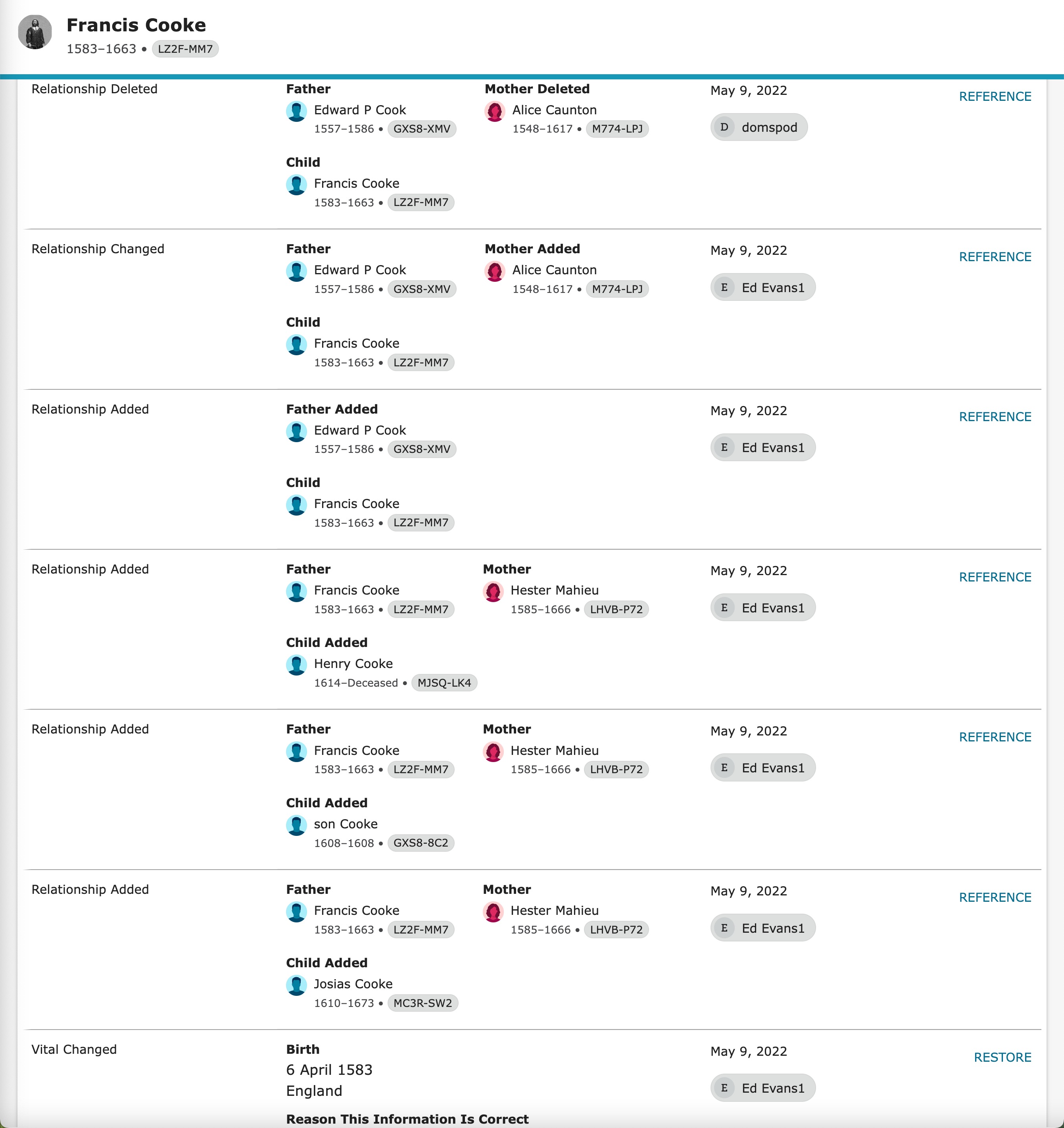
Here is one example of the results of all of this misinformation concerning the Mayflower passengers and their families. This is an example of a list of some of the 73 changes and corrections made to one Mayflower passenger during the past 19 days from the date of this post. 


If you multiply the time wasted on this one person, where accurate, settled information is abundantly available, by all of the 53 surviving passengers, you will likely have a measurable percentage of all the work being done on the Family Tree each month. Every one of those changes was unnecessary and forced someone who was interested to constantly follow these individuals and constantly correct the entries. This has gone on month after month, day after day except for a brief time when Family Search made all of the entries read only during the pandemic and during the 400th anniversary of the sailing of the Mayflower. 

Tragically, this is only one of many such people and groups of people on the Family Tree that I call revolving door ancestors. This is also one of main reasons why many genealogists refuse to seriously consider the Family Tree as a viable alternative to their own family trees in other programs. 

What is interesting is that my Great-grandfather who is not at all subject to extensive changes or controversy has been made read-only in the Family Tree. Not only is he read-only, but so is his wife, my Great-grandmother and her children, including my own Grandfather and then my Grandfather's daughter, my aunt, who recently died. In short, three generations of this one family are read-only when there are few, if any changes going on, while the Mayflower passengers and many other similar ancestors are a free-for-all mess. Strangely, my own mother who is also dead and the sister of the read-only aunt, is not read-only. So even when the simple expedient of making someone who is being constantly changed read-only is available, the process is being applied inconsistently and without any stated reason. 

I have been writing about this issue for years and I and many others, have made suggested solutions. Although the presently constituted Family Tree is remarkably better than it was just a few years ago, it still has this one overriding issue left to be resolved. 

Until the free-for-all changes that occur to people like the Mayflower descendants, there will always be a complete lack of confidence in the reliability of the Family Tree. As a family, we spend an inordinate amount of time merely correcting unsubstantiated and unsourced changes. Isn't it about time this last frontier of reliability is seriously addressed?

Wednesday, May 18, 2022

Video of The Second Rule of Genealogy on YouTube


https://youtu.be/ZDMAaYquNMU

This series of short videos continues with The Second Rule of Genealogy. Ultimately, I hope to have all fourteen rules in this series.  Rule Two is "Absence of an obituary or death record does not mean the person is still alive."

These Rules of Genealogy are not trivial statements. They have deep meaning. This particular rule, which I have called Rule Two, is a good example. It comes from a common circumstance where a genealogical researcher gets hung up looking for a particular document of a particular event to the exclusion of more general research. 

Here is the first video in this series. The First Rule of Genealogy