Some people eat, sleep and chew gum, I do genealogy and write...

Tuesday, March 5, 2019

Using the Soundex Microfilm at a Library or Online

https://www.archives.gov/research/census/microfilm-catalog/1790-1890/part-01
Soundex is an indexing system invented by Robert C. Russell and Margaret K. Odell and was patented in 1918. It is formally known as the Russell Soundex. There is a variation of the system used to index part of the U.S. Federal Census called the American Soundex. A computer-generated version of the of the Soundex cards is called Miracode. American Soundex was used to index parts of the 1880, 1900, 1910, 1920, and 1930 U.S. Federal Censuses.

Soundex is a phonetically coded surname index based on the way a surname sounds when spoken in English rather than the way it is spelled. Surnames that sound the same are coded the same even if they are spelled differently, for example, Smith and Smyth. The system was developed so that researchers could find names that were the same even though they had been spelled differently. Soundex assumes a standard English pronunciation of all of the names. The results of the Soundex coding rules are four characters, a letter, and three numbers. The letter is always the first letter of the surname and the remaining letters are assigned numbers which are assigned by the Soundex Guide. Here is the Soundex Coding Guide from the U.S. National Archives article entitled "Soundex System, The Soundex Indexing System."
Soundex Coding Guide
See also this online Soundex Calculator
Number Represents the Letters
1 B, F, P, V
2 C, G, J, K, Q, S, X, Z
3 D, T
4 L
5 M, N
6 R
Disregard the letters A, E, I, O, U, H, W, and Y.
So my surname, Tanner, would be coded as T-560. The reason this is results is due to a list of Additional Soundex Coding Rules. Here are the additional rules from the U.S. National Archives website:
1.  Names With Double Letters
If the surname has any double letters, they should be treated as one letter. For example:
Gutierrez is coded G-362 (G, 3 for the T, 6 for the first R, second R ignored, 2 for the Z). 
2.  Names with Letters Side-by-Side that have the Same Soundex Code Number
If the surname has different letters side-by-side that have the same number in the soundex coding guide, they should be treated as one letter. Examples:
Pfister is coded as P-236 (P, F ignored, 2 for the S, 3 for the T, 6 for the R).

Jackson is coded as J-250 (J, 2 for the C, K ignored, S ignored, 5 for the N, 0 added).

Tymczak is coded as T-522 (T, 5 for the M, 2 for the C, Z ignored, 2 for the K). Since the vowel "A" separates the Z and K, the K is coded.

3.  Names with Prefixes
If a surname has a prefix, such as Van, Con, De, Di, La, or Le, code both with and without the prefix because the surname might be listed under either code. Note, however, that Mc and Mac are not considered prefixes.
For example, VanDeusen might be coded two ways:
V-532 (V, 5 for N, 3 for D, 2 for S)
or
D-250 (D, 2 for the S, 5 for the N, 0 added). 
4.  Consonant Separators
If a vowel (A, E, I, O, U) separates two consonants that have the same soundex code, the consonant to the right of the vowel is coded. Example:
Tymczak is coded as T-522 (T, 5 for the M, 2 for the C, Z ignored (see "Side-by-Side" rule above), 2 for the K). Since the vowel "A" separates the Z and K, the K is coded.
If "H" or "W" separate two consonants that have the same soundex code, the consonant to the right of the vowel is not coded. Example:
Ashcraft is coded A-261 (A, 2 for the S, C ignored, 6 for the R, 1 for the F). It is not coded A-226.
If this looks complicated, there are a number of free online programs that will take any surname and translate it into the Soundex Code. See Eastman's Online Genealogy Newsletter, Soundex Calculator.

Why do we still need to know about Soundex when we have complete alternative indexes to the U.S. Census Records? Well, the issue of misspelled names in the U.S. Federal Census still exists. One example from my own research was the misspelling of my surname Tanner as Tamer. However, if you look at the Soundex for both spellings, you will see that they are the same. What is my surname was misspelled as Turner? Since this is a completely different name and not merely a misspelling, Soundex doesn't help. By the way, the Soundex for Turner is T-656.

Some additional issues with the Soundex Coding are that there are more rules that pertain to special categories of the index. Here are some additional rules from the U.S. National Archives website.

The first clarification concerns the coding of American Indian and Asian Names. Here is the explanation of how this was handled by the code.
A phonetically spelled American Indian or Asian name was sometimes coded as if it were one name. If a distinguishable surname was given, the name may have been coded in the regular manner. For example, Dances with Wolves might have been coded as Dances (D-522) or as Wolves (W-412), or the name Shinka-Wa-Sa may have been coded as Shinka (S-520) or Sa (S-000).
Another issue with non-English names is that they are more frequently misspelled than English names.

The Soundex indexing system created a card for each family in the Census. Here is a screenshot of some of the cards that were associated with the Soundex Code.


You can barely see the Soundex code at the bottom of the image. All of the Soundex Cards were microfilmed and the original microfilm copies are in the National Archives, the Regional Archive System of the National Archives and at the Family History Library in Salt Lake City, Utah. But now, the films have been digitized. The best source for all of the images is Archive.org. All this makes me thankful for digital images, computers, and string indexing. Here is a drawing of the Soundex Cards from the United States Census Bureau.


Now there are also some complications with the cards. Going back to the U.S. National Archives website, here is the first explanation about the different cards.
The Soundex microfilm rolls for the 1880 census include four different kinds of cards: Family Cards, Other Members of Family Continued Cards, Individual Cards, and Institution Cards. Below the coded surname at the top left of the card, the surname and then first name of the head of the family ordinarily appear as recorded on the schedule. The list at the end of this introduction, Abbreviations and Terms Used in Soundex Cards, is applicable to the 1880, 1900, 1910, and 1920 Soundexes. It can help researchers determine the relationships of persons to the head of the family. The most important information to record is: State or territory; volume, ED, sheet, and line numbers; county, city, and MCD.
This is just the first level of complication. There are other Soundex Cards with more exceptions. Again to the U.S. National Archives website:
Frequently, if families include more than six members, the Family Card is followed by a related card. For very large families, more than one of these cards may appear. Handwritten numbers at the bottom of the cards refer to the first card (e.g., "#2, see #1"). Although the continuation card notes the name of the head of family and name, relationship, age, and birthplace of the other family member, this card excludes other personal information such as color and sex. It also omits most jurisdictional data found on the Family Card such as the county, city, MCD, and ED. Some researchers may need to search for a third kind of Soundex card, an Individual Card. This card contains data only on a child age 10 or under who (1) had a surname different from the head of family, or who (2) was not an immediate member of a family (e.g., stepson or nephew), or who (3) resided in an institution without a family. For the first two purposes, the Individual Card duplicates part of the information on a Family Card; it cross-references a census schedule. The Individual Card ordinarily is the only card referencing a particular child. Institution Cards appear at the end of the last roll of Soundex microfilm for a state or territory. 
The Institution Cards, unlike the three other Soundex cards, are alphabetically arranged, not Soundex coded, by the first name of the institution. The first Institution card to appear in roll 168 names an institution whose name began with A Adams County, PA, Poorhouse. The Institution Cards exclude personal data on individuals and, at most, may note only the number of inhabitants. 
Institution Cards include jurisdictional data necessary to find the correct census schedules (e.g., state, county, city, and ED). Street and house numbers also often appear on the cards. The cards exclude a printed heading for MCDs, but some indexers inserted this information on the line for city. Also, the cards have no caption for line numbers pertinent to the schedules, but some indexers inserted this information near the line for sheet number.
With all these rules and exceptions, I guess it was unusual that I could find anything when I was using the Soundex Index in book format. Finding the Soundex Microfilm and then locating the correct images is another challenge. Here is an explanation from the U.S. National Archives website:
To use the census soundex to locate information about a person, you must know his or her full name and the state or territory in which he or she lived at the time of the census. It is also helpful to know the full name of the head of the household in which the person lived because census takers recorded information under that name.
Another issue with the Soundex Index occurs when the information given to the enumerator was missing or incomplete. The U.S. National Archives explains this issue under the term "Not Reported Data."
Occasionally, some people gave the enumerator only a surname, without any given or middle name, or the indexer may have found this information missing or illegible. Under these circumstances, Not Reported (NR) or a blank can appear on a card after a surname. Cards with this NR feature appear first within a code. On census schedules, after the surname, some enumerators may have recorded only initials for a person or an initial before the middle name. Such cards are arranged alphabetically and may appear after those with the NR-first name. They ordinarily precede cards with full names bearing the same first letter. The indexers may also have encountered an NR surname, with or without a given name and initials. Cards with an NR surname for the head of family are on the last Soundex roll for a state or territory, usually before the Institution Cards. Roll 34 of California's Soundex (T737) states "Not Reported thru Institutions," but most roll listings in this catalog do not reference this feature. 
The NR-surname cards may include enough personal information such as color, sex, age, street, and house number to identify a person. Some cards also list members of the family or household by surname and may include an indexer's remarks about possible relationships.
There is ever more complication. Sometimes the codes on the cards can appear in nonconsecutive order. In this case, the researchers should use the alphabetized given names for searches.

If it is so complicated, why would we use it now? Well, the Soundex system of cataloging data is still being used. Some websites, such as Ancestry.com have an option to use Soundex. Here is a screenshot of the option when searching:


Ancestry.com also has a few collections of Soundex Reports.


There are still uses for Soundex.


Monday, March 4, 2019

Step-by-Step Guide to Using Online Census Indexes: Part Six

By United States Census Bureau - https://www.census.gov/geo/www/us_regdiv.pdf, Public Domain, https://commons.wikimedia.org/w/index.php?curid=13338857
Census records are not limited to those created by the United States government. Of course, many other countries in the world have conducted censuses of their populations. Within the United States, there are many state censuses. There are also a number of local censuses and specialty censuses for particular organizations, occupations, and ethnic groups. An exhaustive listing of all the possible census records available in just the United States is outside the scope of this article. Here is a list of some of the websites that contain lists of censuses or links to censuses in the United States.
There are likely many more websites with links to census records if you search for "lists of census records" on the Internet.

Some limitations of Census Records

Searching census records may be the first real research activity for a beginning genealogical researcher. But it is important to note that census records have several serious limitations. These limitations include spelling of names, designation of place of origin, and other considerations.

Probably the first consideration of a limitation of census records is the fact that most of the records in existence relied on census takers or enumerators who copied down the information provided from the informants. The written entries on the census records are, therefore, in many many cases, merely transcriptions of what the census enumerator heard or understood. Inexperienced researchers often fail to find their ancestors' census entries because they fail to understand that the entries may differ from the way that the names were properly spelled. For this reason, even with a good index and even with a superior website search engine, entries on the censuses may be different from what the researcher is expecting. The only way to remedy the situation is to identify the location where your ancestors may have lived and searched the census records line by line. Unfortunately, if your ancestors lived in a large city, even this method may be ineffective in finding a misspelled or inaccurately represented name.

Some of the census records record the country or state of origin. However, it is not unusual to see a different location recorded in successive censuses. Many of the references to the place of origin are inaccurate because the enumerator assumed a nationality rather than an actual place of origin. For example, the enumerator may have asked, "where did you come from?" and received an answer that was different from the place where the informant was born. One of the most common errors is recording the place of origin or birth as "Germany" long before Germany existed as an entity.

The age of the informants is another opportunity for error. Many people for many reasons lied about their age. Traditionally, references to the year of birth are often off by a year because of the timing of the date the census was taken.

Other information in the census records may also be inaccurate or a multitude of reasons. Anytime information is transmitted and copied there is a possibility of inaccuracy. Census records should always be supported by additional historical records if at all possible. It is extremely likely that anyone appearing in the record will have other records available to researchers.

Census records are clearly one of the most valuable sources for information about people who lived in the United States but researchers should always remember that finding family or individual in the United States census is only a beginning.

Here are links to the previous posts in this series:

Part Four: https://genealogysstar.blogspot.com/2019/02/step-by-step-guide-to-using-online_23.html
Part Five: https://genealogysstar.blogspot.com/2019/02/step-by-step-guide-to-using-online_25.html

Sunday, March 3, 2019

Far-reaching Changes from MyHeritage’s The Theory of Family Relativity and AutoClusters: Part One


This is part one of a multi-part series about MyHeritage's Theory of Family Relativity. 

Background

To appreciate the technological innovations introduced by MyHeritage.com at the RootsTech 2019 Conference in Salt Lake City, Utah, it is necessary to have an understanding of the need for these innovations.

To begin, we need to remember that before the technological innovations presently available, genealogical researchers were faced with contacting relatives by letters, physically visiting record repositories, and manually searching through books, documents and other records to find their ancestral family members. The time and expense of such searches around the world could be enormous.

With the advent of the internet, digitization, and the development of genealogical database programs with family tree hosting, such as MyHeritage.com, FamilySearch.org, Ancestry.com, and Findmypast.com that have accumulated billions of digitized and indexed historical records basic genealogical research has been transformed. However, the holdings of these large websites and many other smaller ones with digital records must still be searched using the search engine capabilities of each website.

To assist these user-initiated searches, each of these large websites has developed automated systems of record hints to aid researchers in compiling their family history by matching suggested historical sources that may assist the researcher in obtaining more information about individuals and families. Record hints are generated by complex programs that search the indexed historical records on the website for matches to the individual and family information in the various family trees supplied by the users.

Meanwhile, for reasons completely unrelated to genealogical or historical research, scientists all over the world have developed other complex methods of identifying individuals called collectively DNA testing. By an extension of the original DNA testing methods and in conjunction with large genealogical databases, scientists have now extended the original uses of DNA testing to include producing information that can assist in genealogical research. Rather than turn this present article into a long discussion of the origins of DNA testing and the various DNA tests that have become available, it is sufficient to note that there are books and online websites now dedicated to explaining the complexities of DNA research and testing. A relatively short time ago, some DNA testing companies began investigating using DNA test results to help identify ancestral lines for genealogists. This line of research was based on the use of DNA tests to identify individual fathers in paternity lawsuits. Genealogical DNA testing rapidly became an adjunct to both traditional and online genealogical research.

Any current discussion of DNA testing rapidly seems to disintegrate into detailed recitals of the complexities of chromosomes and the other components of cells. I compare this fascination with the minutia DNA to the early days of automobiles when the details of engine performance and the workings of manifolds, fuel injection, and other such mechanical complexities were set forth in consumer ads. Today’s automobile ads focus on comfort, luxury, and accessories. The intricacies of the engine and drive train are left to those who are interested in automobiles as automobiles. I suggest that the focus on DNA testing will also change to focus on the results and uses of the test rather than sounding like a beginning course in human biology.

Granted some knowledge of the details of DNA help in understanding the results of the DNA tests but the real issues for genealogists, who are not also biologists, is in the matches made with the websites’ family trees. The idea of taking a genealogical DNA test is finding matches that give insight into familial relationships. The concern is that the matches are based on accurate DNA testing techniques. However, DNA matches by themselves do not solve genealogical brick walls. In fact, without the support of robust, well-documented family trees, the DNA test does not tell you much of anything outside a small circle of very close and known-to-you relatives.

For example, some of the most publicized types of results from taking and submitting a DNA test are when the DNA test results turn up a close relative; mother, father, sister, brother. The reality before MyHeritage was that finding a distant cousin, say a fifth cousin three generations removed, was not helpful because the number of possible common ancestors was too large to hazard a guess as to the path of a relationship through a common ancestor. Additionally, the most common DNA test, the autosomal DNA test, is only accurate back about six generations because the amount of the original ancestor’s DNA transmitted to a child decreases by half in each successive generations. If we start with 100 percent, each child receives only 50% of each parent’s DNA. If you do the math, you will easily see that the possible percentage of DNA transmitted drops below 1% after six generations. This percentage is likely within the possible margin of error of the DNA companies. As a side note, the idea of assigning ethnicities to the DNA test results is no more than a novelty, much larger data sets, i.e. more people contributing to the target ethnicity will have to be obtained and the geographic target areas will have to be much more closely defined, i.e. smaller.

Genealogists have evolved some tactics for attempting to establish relationships to a possible common ancestor. There are two types of DNA tests that are more stable than autosomal DNA testing. They are the Y-DNA test for the direct paternal lines and mitochondrial DNA tests for the direct maternal lines. There are some other DNA tests, but they are not generally used for genealogical research. Using a combination of all three tests, it is possible to establish relationships using some ancestral lines.

The Holy Grail of DNA testing is the ability to somehow match two separate DNA test subjects and calculate or otherwise determine a common ancestor and a relationship path. Now we come to MyHeritage’s The Theory of Family Relativity.

The Theory of Family Relativity

The idea behind the MyHeritage’s The Theory of Family Relativity (hereinafter “the Theory) is that if you combine the relationships shown in family trees, with the relationships show in DNA test results and validly selected historical sources, you will be able to determine the most reasonable path of relationship between the two DNA matching individuals. This process assumes that the DNA test results are accurate and fall within acceptable lines. The problem is that the calculations necessary to determine those relationships with any degree of accuracy requires massive computational ability. Only recently has such massive computational ability been practical or reasonably available. The top of the line desktop computers today can be networked to operate as one massive supercomputer so the cost of constructing a supercomputer for research is far less than the huge cost just a few years ago. Of course, if you were serious about using a present-day supercomputer, you could buy one for a fraction of the cost of a much less capable machine just a few years ago. Some supercomputers start at about the cost of a mid-range car.

Another issue with developing such a huge database is the need of having access to one or more massive online family trees and millions of individual family trees. It would also be necessary to have a huge number of individual DNA testing subjects and a robust set of original historical genealogical data sources. All of these necessary elements are abundantly present for MyHeritage to begin the process of programming such a database.

Here is the description from MyHeritage of the new program from the Press Release:


TEL AVIV, Israel & LEHI, Utah--(BUSINESS WIRE)--MyHeritage, the leading global service for family history and DNA testing, revealed today its latest innovation in genetic genealogy — the Theory of Family Relativity™. This technology offers users, for the first time ever, theories that utilize nearly 10 billion historical records and family tree profiles to explain DNA connections. Until now, family history enthusiasts used two distinct domains for making discoveries: the paper-trail world of records and trees, and the biological world of DNA connections. Now, MyHeritage has combined these two domains and integrated them seamlessly.

The Theory of Family Relativity™ is based on a big data graph that connects billions of data points drawn from thousands of databases on MyHeritage, in real time. Every node on this graph represents a person, and every edge depicts a blood relationship between two individuals that is described in a family tree or a historical record; or a match between two tree profiles that are likely to be the same person; or two records that are likely to be about the same person. These connections between people and records are established by MyHeritage’s industry-leading matching technologies. MyHeritage engineers and algorithm experts led by the company’s CTO, Sagi Bashari, developed a unique approach that allows the big data graph to instantly compute all paths between millions of blood relatives. The Theory of Family Relativity™ draws upon this resource to construct the most plausible theories explaining how pairs of people linked by a DNA Match on MyHeritage are related, using family trees and historical records.

Previously, users who took a DNA test looking to find relatives were faced with puzzling lists of thousands of distant relatives, without many clues explaining the DNA connections. Now, for a growing percentage of these DNA Matches, theories are provided by MyHeritage that explain the precise relationship paths using trees and records. In these theories, not only does genealogy illuminate DNA connections, but DNA also helps separate fact from fiction in the genealogy and shows which tree and record connections appear to be correct.

This technology uses millions of family trees on MyHeritage, as well as the World Family Tree on Geni, which is replicated daily to MyHeritage, and the single family tree of FamilySearch, which is also replicated daily to MyHeritage under license. This combination results in the most comprehensive family tree traversal available today. Additionally, the technology utilizes billions of historical records on MyHeritage, including all census records, as well as the MyHeritage Record Detective™ technology that indicates whenever two records are about the same person. For example: a theory that explains a DNA Match between two users can begin in the family tree of the first user, traverse through a series of matching trees into a census record, continue to a household relative, who then matches into another tree, until the path completes with the family tree of the second user. MyHeritage displays the complete path of every theory, and explains every step along the way, allowing the user to verify its accuracy. Each theory is presented with a confidence level that is based on the confidence of the matches used to construct it.

“Our new technology is a game changer in its scope and power and is a tribute to our passion for developing the best genetic genealogy tools for our users,” said Gilad Japhet, Founder, and CEO of MyHeritage. “Using genealogy to explain DNA Matches, and using DNA to validate genealogy matches, combines the best of both worlds. We expect this technology to help people make new discoveries in their family history. With every day that goes by, this technology grows even more powerful as more tree profiles, historical records, and DNA kits are added to our global database.”

The Theory of Family Relativity™ feature is included for free with all Premium, PremiumPlus, and Complete subscriptions on MyHeritage. Individuals who upload their raw DNA data from other testing services to MyHeritage who do not have a subscription can pay a one-time fee of $29 per DNA kit to unlock the Theory of Family Relativity™ and the full range of advanced DNA features offered by MyHeritage.

Findmypast Announces Project to Digitize and Publish the 1921 Census of England & Wales

https://www.findmypast.co.uk/1921-census
You can be sure that with all my English and Wales, I will be watching and publishing about the upcoming release of the 1921 England and Wales that will take place in January 2022. Here is a quote from the first announcement of this monumental event.
In the most anticipated family history development since the online publication of the 1939 Register, Findmypast has been selected as The National Archives’ commercial partner to make the 1921 Census of England & Wales available online. 
The census, which was the first to be conducted following the introduction of the Census Act of 1920, will be published online by Findmypast in January 2022.
Here is a description of the Project from an email notice I received.
The project will see Findmypast capture digital images and transcribe the records in a way that will enable family historians across the globe to conduct meaningful searches of these important records when they are opened for the very first time. 
Taken on 19th June 1921, the census consists of more than 28,000 bound volumes of original household returns containing detailed information on close to 38 million individuals. 
It provides greater detail than any previous census as, in addition to the questions asked in 1911, the 1921 returns also asked householders to reveal their place of employment, the industry they worked in and the materials they worked with as well as their employer’s name. Those aged 15 and older were required to provide information about their marital status, including if divorced, while for those under 15 the census recorded whether both parents were alive or if either or both had died. 
The 1921 Census also included detailed questions on education, and was the first in which individual householders could submit separate confidential returns.

Saturday, March 2, 2019

MyHeritage Completes Digitizing All of Israel's Cemeteries

ID 119866764 © Publicdomainphotos | Dreamstime.com
Probably one the most massive cemetery documentation efforts ever undertaken has now been completed. MyHeritage.com has fully digitized every cemetery in Israel. Here is a quote from the MyHeritage Blog about the project.
We’re very happy to announce that, after five years of dedicated efforts, we’ve completed our ambitious goal of digitizing every cemetery in Israel. It is now the first country in the world to have almost all of its gravestones preserved and searchable online, with images, locations, and fully transcribed records. We’ve put up all this content for free, too!
The Blog post goes on to explain the background of this monumental achievement.
Back in February 2014, we teamed up with BillionGraves to launch a global crowdsourcing initiative to digitally preserve the world’s cemeteries. It is essential to digitize cemeteries, by photographing the gravestones and transcribing them, because of the key role that gravestones play in family history. They provide vital information such as a person’s name, the names of close relatives and dates of birth and death. Sometimes they even describe the deceased’s character and personality. Most of the world’s cemeteries have never been systematically documented or made available online; MyHeritage and BillionGraves sought to change this. 
Age and exposure to the elements are causing the gravestones to fade, rendering them illegible. It is becoming harder, and sometimes impossible, to read them and know who has been buried there. This adds to the urgency of the project. Even as gravestones continue to wither away, we can ensure that the footprints of our ancestors do not. 
Our generation is blessed with the necessary tools available, and so it is up to us to preserve this valuable information. BillionGraves is a unique application, available for both iOS and Android, which allows users to volunteer and photograph gravestones. Photographs are then transcribed by additional volunteers on the BillionGraves website, resulting in searchable digital data. Besides being very easy to use, BillionGraves automatically captures the exact GPS coordinates of every gravestone when photographed. This allows others to locate, visit or re-photograph any gravestone of interest and reduces duplication by allowing volunteers to focus on parts of cemeteries not handled before. 
MyHeritage employees kickstarted the effort by first digitizing Segula Cemetery, one of the oldest cemeteries in Israel. In a single day, we took 73,000 photos in order to index them shortly afterwards. A few months later, we brought friends and genealogy organizations along with our employees to digitize Holon cemetery, the largest cemetery in Israel, with over 200,000 graves. It was one of the largest events of its kind ever organized – in the world!
 You can read the rest of the post about this remarkable project by clicking here.

Monday, February 25, 2019

Off to Salt Lake City, Utah, for RootsTech 2019

https://www.rootstech.org/why-attend?cid=tp-rt-6517
Well, as I get older time passes more quickly and here we are at another week for RootsTech 2019. it will be a little bit strange for me to go back after missing a whole year while I was in Annapolis, Maryland digitizing records for FamilySearch at the Maryland State Archives. It seems like even though time passes quickly, I have been thinking about and planning for the year's RootsTech Conference for a long time.  I will be just as busy as usual. I will be doing two presentations for the BYU Family History Library on Thursday and Friday, and a presentation for MyHeritage.com on Friday. You can check at the booths for the schedule of presentations including mine at both the BYU Family History Library booth and the MyHeritage.com booth. I will also be helping out at the booth for The Family History Guide #217. You may also find me at the Media Hub with the other RootsTech Ambassadors.

The rest of the time, I will either be in meetings or wandering around the exhibit floor renewing acquaintanceships and finding out about the latest changes and technologies. Please stop me or stop by the booths and say hello.

The weather reports for Salt Lake City don't look too good. As I write this post, it is supposed to be snowing here in Provo but it isn't but it is still cold. Be prepared for cold weather and possible rain or snow. There is a very good video series called the "Road to RootsTech Video Series. " I would strongly recommend watching these videos in preparation for the conference especially if you haven't attended before. If you have attended before, particularly last year, you may wish to watch the series to see all the changes that were made because of difficulties experienced last year.

Hope to see you there. Since I will be at RootsTech, I doubt I will get any blog posts written until after the conference.

Step-by-Step Guide to Using Online Census Indexes: Part Five


The history of indexes for the U.S. Federal Census continued with the development of what was called the Soundex system. However, that system requires its own series of articles in other posts. Eventually, all of the paper-based indexing systems were replaced by the internet and online programs that either reproduced the paper indexes or developed systems where manual indexes were supplemented by computer programs that searched every word in the index list.

Due to the fact that until quite recently all of the entries on the census schedules were handwritten producing an index of those entries still requires human manual indexing.  Computer programs for reading handwriting are now being developed but the technology is still in its infancy. Fortunately, all of that manual indexing work has now been done and online indexes exist for all of the U.S. Federal Censuses that have been released to date through 1940.

Searching online especially of indexes requires a certain amount of experience and strategy. Over time, you'll begin to realize that indexes are not always complete or accurate. The person compiling the index may have misread the handwriting and the information recorded is either inaccurate or incomplete. Despite the existence of a searchable index to the records, manual searching through the census schedules may be necessary if the indexing was incomplete or inaccurate. In this case, a search can be made of a small geographic area such as a town or village fairly quickly by looking at the digital copies of the census schedules for that location. It is also a good idea to search for all possible variations of the names being searched. There is always the remote possibility that the particular person you're searching for was missed by the enumerators for the US Federal Census but this is quite uncommon and usually the reason that a person or family is missing is due to the fact that the person or family moved. The combination of misread records and people who moved makes searching census records a learned skill rather than following a straightforward set of instructions.

As mentioned previously, there are various fully indexed copies of the entire US Federal Census records available on several websites. In addition, partial copies of the censuses are available on additional websites. Some of these are also indexed. Each website will have its particular way of storing and searching its own census records. Successful searching on any particular website usually requires some instruction or experimentation with using the particular website in question. The following is an overview of how to access the various indexes available online.

FamilySearch.org

FamilySearch.org Historical Record Collections
FamilySearch.org is a free website and has a complete set of the US Federal Census records from 1790 to 1940. The records are completely searchable. FamilySearch.org does require a free registration. You can search all of the records on the website which will include a search of the census records if applicable or you can search each of the census years individually. Here is a search screen for searching the 1880 US Census:


Of course, you always have the option of browsing through millions of images looking for your ancestors.

Ancestry.com


Ancestry.com is a subscription website however free access to the program is available in FamilySearch Family History Centers around the world. There are 5000+ search Family History Centers available for free public use. For the location of the nearest Family History Center go to the Help section of FamilySearch.org. The free Family History Center version of the website does not allow you to develop or maintain a personal family tree.

 As with FamilySearch.org, Ancestry.com also provides a way to search individual censuses or do a global search which will include all of the census records. Here is a screenshot of part of the website's search form for the 1880 US Federal Census.


 With so many options for searching, the most efficient strategy mandates that you begin your searches with a minimal amount of information and keep adding information until you begin to see usable results from your searches. Of course, this method of searching implies that you know more than a name or a name and the date. Since census records are geographically compiled knowing the location where your ancestors lived is close to absolutely necessary in order to identify the right person or family.

Findmypast.com

Findmypast.com is primarily a website with records from the British Isles and the former British Empire however during the past few years the website has been accumulating millions of records from the United States (technically a former colony of Great Britain). Subsequently, the website has a very useful and complete collection of the US Federal Census as well as many state censuses from around the United States.


 Findmypast.com is also a subscription website. Many genealogists hesitate to subscribe to more than one large online website, however, even though the records would seem to be cumulative in the case of US censuses the other records on the website certainly merit the price of the subscription. Here is a screenshot of the website's form for searching the 1880 US Census:


As mentioned previously, knowing the general location is helpful in any genealogical search but in many cases, accurate information can only be obtained by knowing the exact location where the ancestors lived.

Findmypast.com is also available for free at FamilySearch Family History Centers around the world. Again, the free Family History Center version of the website does not allow you to develop or maintain a personal family tree.

MyHeritage.com

MyHeritage.com has a technologically advanced search capability called SuperSearch™. Although it is possible to do a manual search on this website, MyHeritage.com works best when the user allows the website's SuperSearch™ technology to search for records in a family tree maintained by the user. With a family tree, the program will provide links to all of the census records available. However, if you choose to do a manual search there are search forms available.

MyHeritage.com is also a subscription website and searching requires a membership. However, it is also available for free at FamilySearch Family History Centers around the world, of course, with the limitation that the free Family History Center version of the website does not allow you to develop or maintain a personal family tree.

MyHeritage.com also has an extensive set of US state census records that are completely searchable.

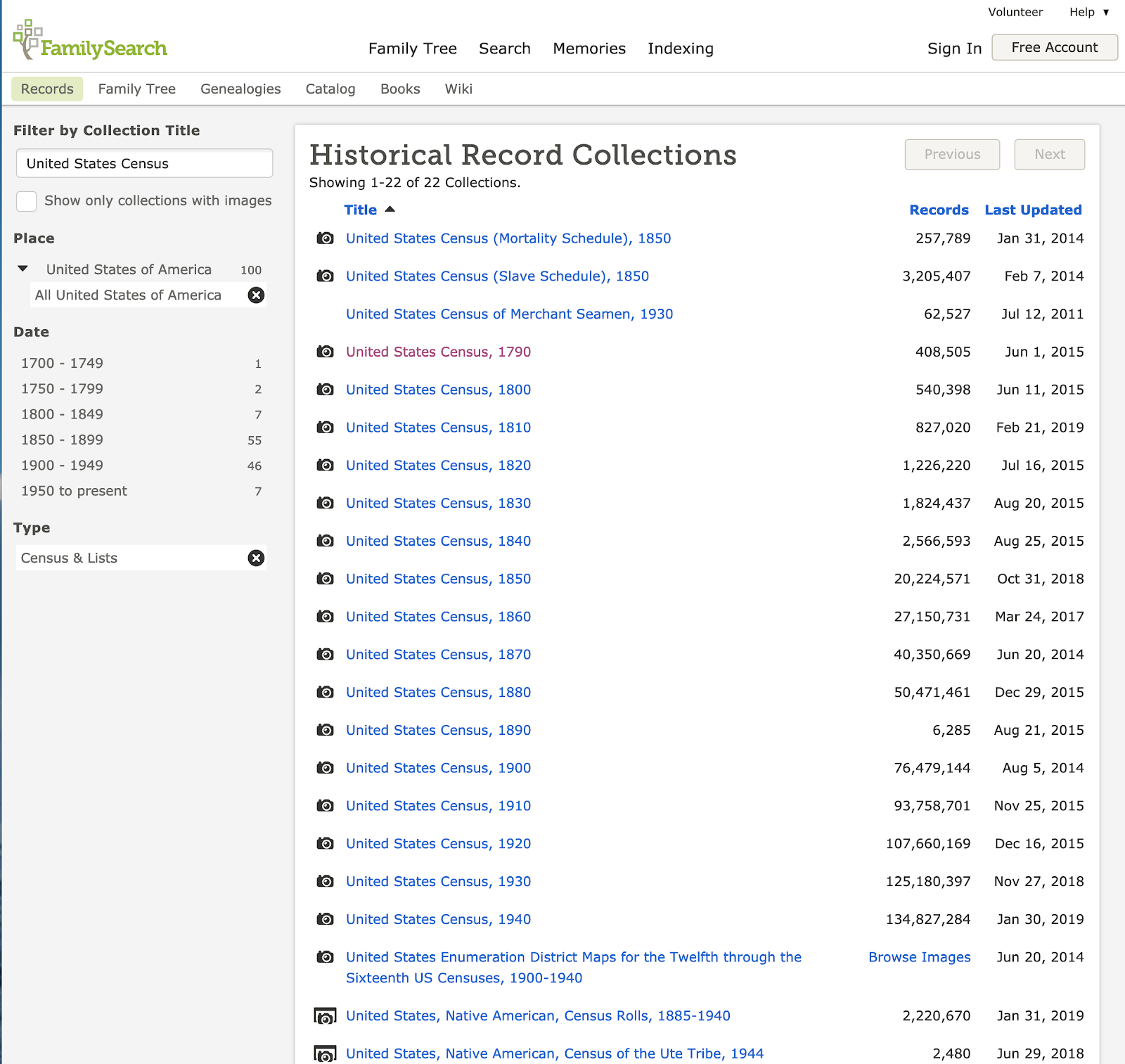
Each of these four websites has an index list of the census collections available. On FamilySearch.org, the list of available collections is contained in the Historical Record Collections. There is an option to view all collections and search for individual categories of record collections. On the Ancestry.com website, there is a link under the search menu for the Card Catalog which contains filters that allow you to view different sets of collections including census records. On the Findmypast.com website, there is a provision under the search menu item to view the A-to-Z of record sets which can also be filtered to show census records. On the MyHeritage.com website, There is presently a Research tab at the top of the startup page that contains a link to search all recordsAnd there is a way to filter the list to search for census records.

 There are a lot more census records online so stay tuned for the next part of this particular series.

Here are links to the previous posts in this series:

Part Four: https://genealogysstar.blogspot.com/2019/02/step-by-step-guide-to-using-online_23.html