Some people eat, sleep and chew gum, I do genealogy and write...

Sunday, March 10, 2019

Sons and Daughters of the United States Middle Passage

https://sdusmp.org/New2/
It was my great privilege to talk to representatives of the Sons and Daughters of the United States Middle Passage, Quoting from their website:
Sons and Daughters of the United States Middle Passage (SDUSMP) is a lineage society dedicated to the memory of our freed and enslaved ancestors and to the education and historic preservation of the artifacts and landmarks of slavery in the United States of America and its economic, psychological, and cultural impact on today’s society. Lest we forget.  SDUSMP is a non-profit, charitable 501(c)3 organization. 
The website also answers the question about what is the "middle passage." Here is the answer.
The Middle Passage was the stage of the triangular trade in which millions of people from Africa were shipped to the New World as part of the Atlantic slave trade. “The triangular trade system was so named because of the route it took.  The ships embarked from European ports, and stopped in Africa to gather captives.  After this, they set out for the “New World” (North America, South America, and the Caribbean) to deliver their kidnapped victims, and then returned to the point of origin. The transport conditions were horrendous and millions of enslaved people died on these voyages. 
Membership in the National Society is open to those eighteen years or older who are of African descent and can direct lineal descent from a man, woman, or child who was forced into slavery in the United States of America. See Membership for more information. 

Although I cannot qualify as a member, I am anxious to promote and help in any way I can. After my experience in Annapolis digitizing probate records beginning in 1764, I have seen thousands of pages of estate inventories that list Black enslaved people along with household goods and livestock as assets of the estates. That experience had a profound effect on me.

Saturday, March 9, 2019

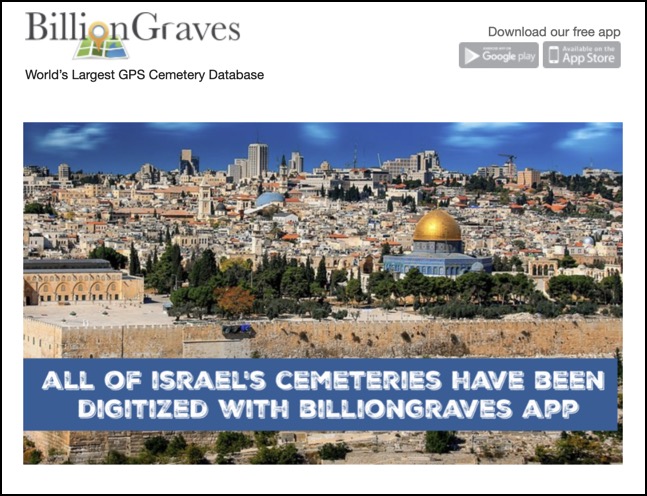
All of Israel's Cemeteries are on BillionGraves

https://billiongraves.com/
You may have seen my post about the project undertaken by MyHeritage.com to digitize all of the gravestones in Israel, but perhaps were wondering where all these images were online. As shown above, all of that massive project is on BillionGraves.com. Here is the announcement from BillionGraves.com'w email to me.
All of Israel’s cemeteries have now been documented! This announcement was made by BillionGraves’ partner, MyHeritage late last week. BillionGraves and MyHeritage teamed up in February 2014 to complete the project. After five years of hard work and dedication, the gravestones of Israel are now photographed and transcribed to preserve the memories of those buried there. 
You can learn all about this announcement - as well as see some beautiful photos taken in Israel - in BillionGraves’ latest blog post titled Israel’s Cemeteries Completely Digitized with the BillionGraves App!
This announcement was made at RootsTech 2019. Here is another quote from the email.
This announcement was made to coincide with RootsTech, the world’s largest genealogical conference held in Salt Lake City, Utah last week. The opening Keynote Speaker at RootsTech was Steve Rockwood, CEO of FamilySearch. He invited the tens of thousands in attendance and those viewing via broadcasts to download the BillionGraves app and use it to document cemeteries. Rockwood said, “We actually could capture every single gravestone in the United States … and the world. Are you with me?” We encourage you to accept his challenge and start using the BillionGraves app to document cemeteries! 
Rockwood suggested that we invite others to join us in the effort to take photos of gravestones. He specifically mentioned including children and grandchildren. BillionGraves cemetery documentation is a great project for church groups and service organizations. For those of you who are planning a BillionGraves project that will include more than 100 people, send an email to Volunteer@BillionGraves.com and we will help you plan your event!
One of the top BillionGraves volunteers is a member of my family and as soon as the weather improves and the snow melts, I plan on helping finish all of the gravemarkers in the Provo City Cemetery here in Utah. By the way, if you live in Provo think about this: How many genealogists do we have in Provo? Did you know that the Provo City Cemetery has not been completed added to BillionGraves?

Friday, March 8, 2019

The Afro-American Historical and Genealogical Society or AAHGS

https://www.aahgs.org/
There are times in your life when something that has been around you for a while finally becomes so important that it cannot be ignored. During the past year as my wife and I were working at the Maryland State Archives digitizing documents for FamilySearch, the issue of our country's history of enslavement hit me squarely in the face. Day after day, I digitized property schedules from Maryland's Orphan Court files that contained lists of property being sold from the estates of Maryland residents who died during the 19th Century. I saw page after page of property lists that contained references to enslaved people. Every time I stopped to look at a list, I had a feeling of profound sadness at the lack of humanity these lists recorded. During part of the time I was digitizing these records, I listened to the audio version of the three-volume work by Shelby Foote on the narrative history of the Civil War. See the following:

Foote, Shelby, George Annand, and Jon Meacham. 2011. The Civil War: a narrative. New York: Random House.

Each of these volumes has over 1000 pages. I lived with the Civil War and the paper evidence of the enslavement of an entire race of people and was frequently overcome with emotion. One thing I know I can do is to help in some way to restore their ancestral heritage. During RootsTech 2019, I had the pleasure of meeting some of the leaders of the National and Local organizations of The  Afro-American Historical and Genealogical Society. I offered to help them with some of my resources and hopefully, I will get that chance.

Now about the Afro-American Historical and Genealogical Society, here is part of the history of the organization from their website.
Early in 1977, a small group of historians and genealogists met informally to explore problems of mutual interest. Among the concerns discussed was the possible need for an organization that would focus largely, but not exclusively, on the family history and genealogy of minority groups in the belief that these groups had been largely overlooked over the years. No definite plans were made to form such an organization at this time, but it was agreed that those interested would give further thought to the idea, would discuss it with their colleagues, and would meet at a later date to pursue the possibility and desirability of establishing such an organization. This initial, informal meeting proved ultimately to mark the actual beginning of the Afro-American Historical and Genealogical Society (AAHGS), the broad purposes of which would be to foster and encourage historical and genealogical studies of families of all ethnic groups, with special emphasis upon Afro-Americans since the greatest deficiency was to be found in this area.
From my perception, Afro-American genealogy is just in its beginnings. The records we were digitizing at the Maryland State Archives contained an enormous amount of information about the enslaved people living at that time. I can only think that there are other records out there that are waiting to be digitized and/or made available.

There are local state chapters of the AAHGS in quite a few states. There is a state chapter here in Utah and I met the president of the Utah State Chapter, Robert Burch, at RootsTech 2019. Hopefully, something will come from our meeting. I did notice that the website linked from the National organization's page went to an unrelated website but they do have a Facebook page.

Additions to Findmypast's Exclusive Catholic Heritage Archive

https://www.findmypast.com/catholicrecords

  • Findmypast.com adds indexes containing over 1.2 million records from the Dioceses of Cincinnati and Archdioceses Liverpool to its exclusive Catholic Heritage Archive
  • Published online for the first time, family historians from around the world can now search for Catholic ancestors in these significant regions
  • New records date back to 1800, span more than 130 years of Catholic history and cover 150 parishes across both regions.
The new index to the sacramental records in partnership with the Archdioceses of Cincinnati and the Diocese of Liverpool constitute significant additions to the rapidly growing collections of Catholic Church records from Findmypast.com. As noted above, this is the first time these records have become available. Here is a further explanation of the collections from an email from Findmypast dated March1, 2019.
Findmypast is today releasing indexes of baptism, marriage burial and congregational records covering 103 Catholic Parishes across the Archdioceses of Cincinnati and 47 in Dioceses Liverpool.  
The records shed new light on the history of Catholics on both sides of the Atlantic and will provide researchers all over the world with the opportunity to discover early American immigrants. 
Between 1830 and 1930 about forty million people left Europe in search of a better life and roughly nine million of them sailed from Liverpool, then the largest emigration port in the world. These people were mostly travelling to North America, Australia and New Zealand - the ‘New World’ - and the millions of Irish, English, Scottish, Italians, Germans, Polish and many others who settled in or passed through the city are captured in the Diocese of Liverpool’s registers. 
In 1850, Cincinnati was the 5th largest city in the United States. Its location on the Ohio River made it a popular stopping off point for immigrants and pioneers traveling west, many of whom stopped long enough to create a sacramental record. Early in the history of the Archdiocese there were large numbers of German and Irish immigrants spread throughout its counties and, by the end of the 19th century, there were joined by increasing numbers of Italians and Eastern Europeans. 
The Catholic Church holds some of the oldest and best-preserved genealogical records in existence. However, as many of these documents memorialize important religious sacraments, their privacy has long been protected and access to original copies has, until now, been hard to come by. 
In collaboration with the Diocese of Liverpool and the Archdiocese Cincinnati, Findmypast is helping to digitize these records and make them widely accessible for the first time. 
Today’s release marks just the latest update to a collection that will continue to grow throughout 2019 as additional updates from a variety of British, Irish, US and Canadian Dioceses will be added to the Roman Catholic Heritage Archive throughout the year. The millions of new records will complement Findmypast’s massive collection of British and Irish data, providing many more connections and a more comprehensive experience to family historians in North America, Britain and all over the world.


5000 Free DNA Testing Kits from MyHeritage for Qualifying Adoptees


MyHeritage.com is repeating its DNA Quest initiative and offering 5000 free DNA Testing Kits to qualifying adoptees. Here is the explanation from the DNAQuest.org website:
Participation in this project is open to adoptees seeking to find their biological family members, and to parents and other family members looking for a child they had placed in adoption years ago. Preference will be given to people who are not able to afford genetic testing. Leveraging the power of genetic genealogy opens new doors in the search for relatives, and we believe everyone should be able to access this valuable technology.
Here are some additional details of the offer from a Press Release dated March 1, 2019:
TEL AVIV, Israel & LEHI, Utah--(BUSINESS WIRE)--MyHeritage, the leading global service for family history and DNA testing, announced today that it is extending DNA Quest, its pro bono initiative to reunite adoptees with their birth families through at-home DNA testing. The first phase of DNA Quest was launched in March 2018 and offered 15,000 free DNA kits to adoptees and those seeking to reunite with family members who were placed for adoption. This resulted in many successful reunions. Due to the large number of applicants, a waiting list of several thousand people was established after registration closed in May 2018. The next phase of DNA Quest announced today re-opens applications on the project website (www.dnaquest.org) and will offer an additional 5,000 free DNA kits to eligible applicants from all countries. Preference is given to applicants who are unable to afford genetic testing.
 To find out if you qualify, Click Here.

Thursday, March 7, 2019

Far-reaching Changes from MyHeritage’s The Theory of Family Relativity and AutoClusters: Part Two


Given the fact that two DNA matches provide only the information contained in the matches themselves that is that the two individuals are related by DNA segments, additional analysis is definitely necessary to establish the relationship through a common ancestor. Granted, some DNA matches are obvious because the match is a known close relative. However, in the case of intermediate or more distant relationships, the identity of the match person and the possible common ancestral are a complete mystery.

For some years now, MyHeritage.com and a very few other large genealogical database websites have been providing ways to match other contributors to the websites’ online family trees. The MyHeritage.com method of providing these connections to shared relatives in other users’ family trees, called Smart Matches, has been spectacularly successful. In my case, for example, I have over 100,000 shared relatives. I do think that this number is somewhat overwhelming, but if I can narrow down that number through an extension of the DNA matching, such as the one offered by The Theory of Family Relativity™ by MyHeritage, then the total number is irrelevant. In effect, The Theory of Family Relativity™ program makes that entire pool of SmartMatch contacts a valuable resource rather than something to be dreaded and ignored.

Let’s suppose that you have done some genealogical research and have reached an impasse on one of your lines. You could call such an impasse a “brick wall” but that term is misleading. Using the term implies that some external force is stopping you from finding information about an individual or family. Brick walls or end-of-line situations are inevitable. Even the impossible lines back to Adam end at Adam. However, genealogists are perpetual optimists. They seem to believe that any end-of-line or brick wall can be breached by sustained effort. If there really are no more records, such as in the case of an ancestor who lived where or when no records were kept, finding the next generation may be beyond the reach of even the most meticulous or skilled researcher. However, there are lots of cases where researchers believe that a brick wall exists when there is merely a lack of effort or knowledge of where to look. In these situations, The Theory of Family Relatively becomes a key that may unlock these breachable cases.

As I have previously written in a quote from MyHeritage:

This technology uses millions of family trees on MyHeritage, as well as the World Family Tree on Geni, which is replicated daily to MyHeritage, and the single-family tree of FamilySearch, which is also replicated daily to MyHeritage under license. This combination results in the most comprehensive family tree traversal available today. Additionally, the technology utilizes billions of historical records on MyHeritage, including all census records, as well as the MyHeritage Record Detective™ technology that indicates whenever two records are about the same person.

MyHeritage uses its superior technology to search records that would take a lifetime of searching without the applicable technology. Genealogists who do not take advantage of this technology and the additional searches and technology available for the other large online genealogy database programs are simply wasting their time. Granted, there are a lot of records that are waiting to be digitized. Visiting record repositories to search paper records will be necessary for a long time, but right now, we need to recognize that there are billions upon billions of fully indexed and fully searchable records online. Failure to adequately search these records before spending time and money in paper searches ignores reality.

The announcement of The Theory of Family Relativity adds an important resource to these online and paper-based searches. From my perspective, obtaining a full data subscription to MyHeritage, taking a DNA test either from MyHeritage or uploading the results of another test to MyHeritage and then analyzing the results using the new Theory of Family Relativity should be the very first step in any investigation of an end-of-line or brick wall inquiry. The alternative is both much more expensive and less sure of positive results.

Before the introduction of the MyHeritage technology, using DNA tests to discover a common ancestor involved determining the existence of a possible common ancestor by research. In the absence of records conclusively identifying the ancestor’s relationship, the researcher would have to search out potential descendants of the proposed common ancestor and try to obtain DNA tests from each of the potential relatives. If the tests were obtained, it was then necessary to apply advanced DNA analysis techniques to see if matches indicated a common ancestor. One complication of this process was that the potential relatives could be related through a different common ancestor, so this procedure was only helpful if each of the potential test subjects had also done extensive research on the same line as the possible common ancestor.

Although this description of the existing process of determining the identity of a common ancestor without The Theory of Family Relatively is a generalization of the process, it is evident that MyHeritage has made a significant advance in finding an elusive common ancestor. At the very least, obtaining a MyHeritage subscription would help to find potential relatives for DNA tests through the huge pool of SmartMatches.

My very short experience in using The Theory of Family Relatively on the MyHeritage.com website has shown me that the system works. Of course, there are basic limitations on the accuracy of DNA tests used for determining ancestral relationships. These limitations are inevitable and immutable but over time as the pool of DNA tests on MyHeritage continues to grow and as the family trees become more reliable and more source documents are added to the website, the entire process will become more reliable. But there is one more tool from MyHeritage that helps to clarify relationships and identify elusive remote ancestors; those are the additional DNA Tools available now and the promise of more such DNA tools in the future.

Here is a screenshot of the three presently available DNA tools:

All three of these will improve over time and I am sure additional tools will be added. The new AutoCluster tool can be used to identify a cluster of people who share DNA markers which could provide a pool for identification of a common remote ancestor.

Stay tuned.

Here is the first installment of this series:

Part One: https://genealogysstar.blogspot.com/2019/03/far-reaching-changes-from-myheritages.html

Wednesday, March 6, 2019

To see all my Posts, follow my Facebook Page

https://www.facebook.com/Genealogysstar/?ref=bookmarks
During the past few years, many of the reader or aggregator programs have disappeared. There are only a few free aggregator websites that will let you receive notice of postings particularly from blogs. To remedy the situation, I have started posting all of my posts from all three blogs on my Genealogy's Star Facebook page. If you subscribe to this Facebook page you will see all of the postings from all three blogs. I invite you to follow this page. Here is the link.

https://www.facebook.com/Genealogysstar/?ref=bookmarks