Some people eat, sleep and chew gum, I do genealogy and write...

Monday, May 16, 2022

Unrehearsed Genealogy Research, Episode 7: New York, early 1800s


https://youtu.be/S6YsYOlLgHY

We are on YouTube again with another episode of Unrehearsed Genealogy Research, Episode 7: New York, early 1800s. In this episode, we look at an end of line in my own part of the FamilySearch.org Family Tree. A land record provides the best evidence for the presence of a husband and wife in the given county of New York. We also discuss the complexities of researching a very thoroughly researched line on the FamilySearch tree.

You can see and view all the previous episodes on the Goldie May YouTube Channel or on a play list on my own YouTube Channel.

Saturday, May 14, 2022

What is a source and why do we care?

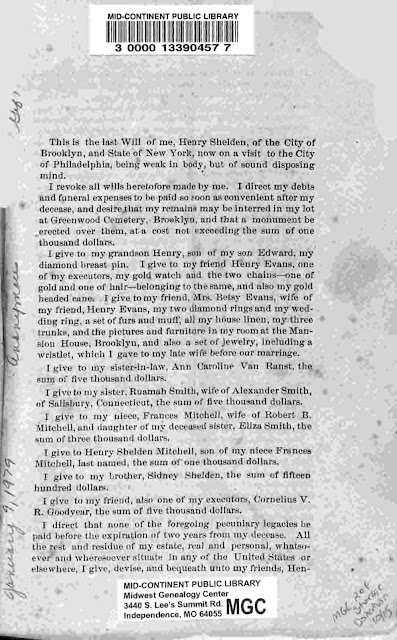
 This is a genealogically significant historical document. 


A genealogically significant historical document is one that contains information about an individual or a family. A genealogist is a person who searches historical documents for information about individuals and families and then analyzes, organizes, and records the information. A genealogist should identify the historical document using a citation. A citation is a formal, consistent way of identifying the document or record so that other genealogists can find the record or document. The genealogist may also explain the thought process used to come to a conclusion about the reliability of the historical document or record. Once a document or record has been processed by a genealogist, we refer to that document or record as a source of the genealogist's opinion about the accuracy of the genealogist's compiled family history. 

Here is the citation to the document above:

Shelden, Henry. 1870. Exemplified copy of last will and testament of Henry Shelden: late of the city of Brooklyn, deceased, and of the probate thereof, made under act of Congress of the 26th, May, 1780. https://www.worldcat.org/title/exemplified-copy-of-last-will-and-testament-of-henry-shelden-late-of-the-city-of-brooklyn-deceased-and-of-the-probate-thereof-made-under-act-of-congress-of-the-26th-may-1780/oclc/936575375&referer=brief_resultsviewed 4 May 2022.

Finding these genealogically significant documents, analyzing the information contained in the documents and then recording that information in way that can enhance the abilities of others to also view the documents in context, are all part of the core work of being a genealogist. Accuracy and persistence are absolutely essential to making any progress as a genealogist. 

When any entry lacks a source, this immediately implies inaccuracy and unreliability. But what about personal knowledge or oral history? Both of these are valid sources, and they still require a citation so someone reviewing the entries can tell where the information came from. 

What about books? Well, if the author has footnotes or the equivalent and identifies the historical source, then you should record both the citation and the book. However, if the author simply lists all the information without further source citations, you have to discount the accuracy and if you decided to include any of the information you would cite the book as the source. 

If you want a complete explanation of citations, you can refer to the following book. 

Mills, Elizabeth Shown. 2007. Evidence Explained: Citing History Sources from Artifacts to Cyberspace. Baltimore, Md.: Genealogical Pub. Co.

You don't have to worry about genealogy books going out of date unless they are written about some technological subject such as online resources or DNA.

Of course, discovering genealogically relevant documents and records is the initial and most time consuming part of genealogical research and it is obvious, once the records or documents are finally discovered, they need to be searched. By the way, it is unwise to rely solely upon online resources. Granted, there is a lot of information online, but there is still a huge number of records waiting to be digitized, indexed, and/or cataloged. 

To summarize, if you add any information to the FamilySearch Family Tree (excluding correcting existent information) you need to add a source with a citation to where that source can be found. 

Friday, May 13, 2022

When will the FamilySearch Family Tree be finished?


The simple answer to the question of when the FamilySearch.org Family Tree will be "finished" is never as long as technology continues to advance, and people continue to be born. A more realistic question involves setting some arbitrary goal for the Family Tree and then declaring that it is finished. I also guess that yet another question could revolve around the proposition that the current Family Tree will be replaced by some other program just as happened with new.FamilySearch.org. In that case, the present form of the Family Tree could be considered to be finished because it would disappear. 

Presently, the FamilySearch.org Family Tree contains entries for about 1.4 billion people (not taking allowance for duplicates). It is estimated that 117 billion people have lived on the earth. See "How Many People Have Ever Lived on Earth?" Obviously, a very high percentage of those people died without any record of their lives. However, the current population of the earth is about 7.7 billion people so we can see that the number of people in the Family Tree, that is mainly dead people, is far from complete. 

What do we mean by finished? Will the Family Tree program itself ever be finished? As I have already mentioned, technology continues to change and as technology changes so will computer programs and websites such as FamilySearch.org

My conclusion is that you should not hold your breath waiting for the Family Tree to be complete. But this is a very good reason for getting involved and doing family history research. 


Tuesday, May 10, 2022

Goldie May Subway Map now works with Ancestry.com


https://youtu.be/9K2E6ZPWxfY

Goldie May's timeline tool, called the Subway Map, now works with Ancestry. You can watch the short demo above to see how this works. You can also view all of the current and future videos from GoldieMay.com on the Goldie May YouTube Channel. See https://www.youtube.com/channel/UCDuk8GVz6D_jiyvEFSGJnKw/featured


New videos are being posted regularly, including the new Live & Unrehearsed Genealogy Research series. 

Friday, May 6, 2022

Live & Unrehearsed Genealogy Research, Episode 6: Examining a Danish family line


 https://youtu.be/ra4HaCoMCC0

Can you believe it? Here is another episode in the Live & Unrehearsed Genealogy Research series. This is Episode 6 where we examine a Danish family line. The discussion applies universally to all genealogical research. 

Wednesday, May 4, 2022

Thoughts about genealogy, as a pursuit and profession


Although most genealogists are not involved in genealogy as a profession, there are some professional genealogists. 

Fifty years ago, I went to law school to become a lawyer or an attorney (in the United States, the terms are mostly interchangeable). I spent about two and half years in law school. I took an exam and began practicing as an attorney and representing clients in court actions. There is no all-encompassing definition of lawyers or attorneys because they are involved in a lot of different activities. During my time as a lawyer, I did not feel compelled to try to get people to become lawyers. I did not think about having "fun" activities for my children so they would become interested in becoming a lawyer. None of my children are lawyers. I did not and do not worry about my children not becoming lawyers. People usually become lawyers to make money. Some do make money. Some don't make money. 

About the time I began law school, I became interested in growing a garden. Eventually, I spent a great deal of time studying and reading about gardening in Maricopa County, where I lived. I wrote about gardening and taught many classes about gardening. I did not think I needed to be employed as a gardener nor did I ever make any money as a gardener, although we ate a lot of fruit and vegetables from our garden. I did not teach my children to become gardeners and felt no compulsion to do so. However, some of my children have huge productive gardens and some of them do not garden at all. 

In its complexity and the amount of training needed, genealogy is more like studying law than becoming a master gardener, although both require a great deal of time and effort. 

Because of the nature of genealogy and its focus on historical records, it is a subject that requires certain specific skills such as the ability to read and do intensive research.  I might ask a question. De we consider someone who watches court TV to be a lawyer? Do we consider someone who purchases flowers from the local supermarket a gardener? So why do we consider people who dabble in learning about their family to be genealogists? 

Genealogy is a complex pursuit. It can take years of study and practice to acquire even a basic competency. I have spent the last forty years learning about and studying genealogy and I have barely scratched the surface of the information I could still learn. It is common among genealogists to agonize and stress over the fact that their children and other family members are not "interested" in genealogy. Do we have a shortage of genealogists? Do we need to recruit more people to the profession? As of the date of this post, The State Bar of Arizona lists about 18,000 active lawyers in the state. The number of professional level genealogists in any one state is not recorded but the national Association of Professional Genealogists or APG (apg.gen) lists 31 genealogists who specialize in Arizona genealogy. Only six of them are listed as living in Arizona out of 1669 total genealogists in the entire United States.  

The average professional genealogist in Utah makes about $42,000 a year which by the way is slightly less than it takes to earn enough to afford an apartment in Utah. See Professional Genealogist Salary in Utah. See also, "You need to earn $20.21 an hour to afford a 2-bedroom apartment in Utah, report says."

Can anyone be a genealogist? Is anyone who is interested in their family automatically become a genealogist? It is commonly stated that genealogy is the second most popular hobby in the United States. Here are some short quotes from Paul Allen, FUGA Founder, Ancestry.com, FamilyLink.com Director of Funium, LLC, in an article from 2011 entitled, "The Gamification of Genealogy: Potential Impact on Participation in Family History."
The myth that genealogy is the #1 or #2 hobby on the internet should be dispelled. No data has ever been presented that confirms this often-heard claim. Based on industry traffic data to various types of websites, genealogy is probably a top 50 activity. It is primarily engaged in by a modest percentage of the older population. Young people rarely get involved in online genealogy research...

The first definitive published study of interest in family history was by American Demographics magazine in December 1995 [1]. Based on nationwide surveys conducted by Maritz Marketing, it was discovered that approximately 7% of the adult population in the U.S. was involved at least somewhat in family history research. However, a much larger audience, close to half of U.S. adults is interested (but not involved) in family history.  

[1] “Climbing the Family Tree,” in American Demographics magazine, December 1995. 
The expectation that a huge number of people from any part of the world would be interested enough in genealogy to acquire the skills necessary to pursue valid genealogical research is unfounded and unwarranted. Why then do we wring our hands and worry about the younger generation becoming genealogists when there is no demand for their services? 
Monday, May 2, 2022

The Goldie May Subway Map timeline tool now works with Ancestry.com


https://youtu.be/hXdm_ULhru4

Quoting from the GoldieMay.com YouTube Channel, 

You can now use the Subway Map timeline tool to analyze your research on Ancestry.com. You can even compare Ancestry lines to FamilySearch lines and/or multiple Ancestry lines against each other.

It is much easier to understand when you see what it does rather than reading what I would have to write to explain this new feature. Here is the website: https://www.goldiemay.com/