Some people eat, sleep and chew gum, I do genealogy and write...

Monday, March 20, 2023

The real limitations of Artificial Intelligence: Incomplete, Inaccurate, Misleading, and Flat Out Wrong


Artificial Intelligence (AI) is getting a lot of online commentary lately. Some of the pundits are wringing their hands about how many jobs will be lost when AI goes mainstream. See "23+ Artificial Intelligence and Job Loss Statistics [2023]: How Job Automation Impacts the workforce." and many other such articles. It is interesting that all the statistics cited seem to be speculation since the only reference to any kind of study is one statement that says, "Artificial intelligence and job loss statistics,,," without referring to any specific statistical studies. I am not intending to pick on any one article, but this type of response to technological change has been occurring steadily since 1811 in England with the luddite movement objected to mechanized looms and knitting frames. 

A short time ago, I wrote a blog post entitled, “How will Artificial Intelligence affect Genealogy?” where I pointed out several inaccurate statements made by a ChatGPT response about one of my ancestors. I decided to try another response, this time, using a general request to write about doing genealogical research in Portugal. I spent some time recently reviewing genealogical research in Portugal for a Sunday Class from the BYU Family History Library. A recording of the class will shortly be posted on the BYU Family History Library YouTube Channel. 

Here is the description I used to elicit the response below.
“Describe the availability of genealogical records in Portuguese and archives in Portugal with citations to useful websites”

Genealogical records in Portugal are typically held by the Portuguese Civil Registration Offices, the National Archives of Portugal, and the Catholic Church. These records include birth, marriage, and death records, as well as census records, military records, and property records.

The Portuguese Civil Registration Offices hold records from 1911 to the present day. [This is not correct, Portuguese civil registration records go back to 1832 and These records are available to the public, but access is restricted to those who can prove a direct relationship to the individual(s) named in the records. The records can be requested online through the website of the Portuguese Ministry of Justice: https://www.justica.gov.pt/Servicos/Registos/

The National Archives of Portugal hold a variety of genealogical records, including parish registers, notarial records, and other documents related to Portuguese history. These records are available to the public and can be accessed in person at the National Archives building in Lisbon or online through their website: https://digitarq.arquivos.pt/

The Catholic Church in Portugal also holds a significant number of genealogical records, including baptismal, marriage, and death records dating back to the 16th century. These records are typically stored at the parish level, and access is often restricted to researchers who can prove a direct relationship to the individual(s) named in the records. The website of the Portuguese Episcopal Conference provides information on how to contact individual parishes to request access to these records: https://www.conferenciaepiscopal.pt/

In addition to these sources, there are also a number of online databases and websites that can be useful for researching Portuguese genealogy. Some of these include:

FamilySearch (https://www.familysearch.org/en/): a free online genealogy database that includes a variety of Portuguese records
MyHeritage (https://www.myheritage.com/): a subscription-based genealogy website that includes a large collection of Portuguese records
Genea Portugal (https://genea-portugal.com/): a website dedicated to Portuguese genealogy research, with resources and databases for researchers.
https://www.familysearch.org/en/wiki/Portugal_Genealogy 
It's important to note that the availability and accessibility of genealogical records in Portugal can vary depending on the region and the specific records being searched. It may be necessary to consult multiple sources and organizations in order to find the information you are looking for.

On its face, this seems to be adequate and helpful. However, I am reminded of a book published about my family line. Here is the citation to this book. 

Tanner, Maurice, and George C Tanner. 1923. Descendants of John Tanner; Born August 15, 1778, at Hopkintown, R.I., Died April 15, 1850, at South Cottonwood, Salt Lake County, Utah; [Place of publication not identified.

The conclusions contained in this book about the “original” Tanner immigrant ancestor to Rhode Island are inaccurate, incomplete, unsupported by sources, misleading, and have caused many people to be lead away from doing accurate and complete research. I have to say the same thing about ChatGPT response. 

Here are just a few of the problems presented by the seemingly innocuous ChatGPT response about Portuguese genealogical research. 

1. The best places to find instructions about genealogical records in Portugal are the FamilySearch Research Wike article that begins with Portugal Genealogy and The Family History Guide article on Portugal
2. The ChatGPT article points to both FamilySearch and MyHeritage as sources for researching Portuguese genealogy. The statement is correct but previous statements about the location and availability of both Catholic church records and Civil Registration Records are contradictory and misleading. FamilySearch has huge numbers digitized records of both Civil Registration records and Catholic Church records online for free. In addition, the Portuguese National Archives, correctly identified as Torre do Tombo National Archives, also has accessible parish and civil registration records. The ChatGPT statements about the availability of both the parish registers and civil registrations records are misleading and wrong. In addition, MyHeritage has 14 collections of indexes to Portuguese Church records, but these are mostly indexes and have relatively few copies of the original records. 
3. The link provided to Genea-Portugal.com does not exist. Although, Geneall.net is a Portuguese public internet database on family history and genealogy, mainly concerning Royalty and Aristocracy around the world.
4. The link to the Justice Department is for current records and as it the case with most recent government records around the world there are privacy limitations for access to these records. 
5. It ends up that huge numbers of Portuguese Catholic Church records, Civil Registration records, and other records are available on the FamilySearch.org website. Many of these records are accessible through the FamilySearch catalog and others are accessible in the Images section. 

In short, there are one or two links in the ChatGPT article that are helpful, but the rest of the explanation is either wrong or misleading. Finding and researching Portuguese genealogy records is far easier than portrayed by the ChatGPT article. 

If you decide to use ChatGPT or any other artificial intelligence source, I suggest that you become aware of the limitations and possible issues from text generated by anyone artificial or real that misstates facts. Before you jump off into the current trend of artificial intelligence, try using some of your own. 

Thursday, March 16, 2023

1931 Census of Canada to Be Released on June 1, 2023


Quoting from an email announcement:

“Library and Archives Canada is very excited to announce that it will be making the eagerly awaited 1931 Census of Canada available to the public in just a few months. Our partnership with Ancestry and FamilySearch will give us the opportunity to provide our users with an improved experience when searching and browsing the 1931 Census. This is directly in line with our goal to provide online, reliable and trusted access to Canada’s documentary heritage.” —Leslie Weir, Librarian and Archivist of Canada

quoting further: 

After the legislated 92 years in the vault, the highly anticipated 1931 Census of Canada will be made available to the public. Collected during the Great Depression and at a time of significant immigration, the census provides a snapshot of the more than 10 million people living in Canada in 1931. On June 1, 2023, Canadians can expect to browse the digitized census images by geographic districts and sub-districts on the Library and Archives Canada (LAC) website. Following the initial release, LAC will work collaboratively with Ancestry® and FamilySearch International to create an advanced searchable database for Canadians, and those with Canadian heritage who wish to look for their ancestors.

My own research will be impacted by the release of the 1931 Census due to the number of people that I assist who are doing research in Canada.  

Saturday, March 11, 2023

Color Coding Added to MyHeritage Family Trees


From the MyHeritage blog post, "Introducing Color Coding for Family Trees"

Adding color coding to your family tree can make it easier to navigate. At MyHeritage, we previously implemented color coding in Fan view of the family tree, as well as in the Family Tree Timeline. Today, we’re happy to announce the addition of color coding for family trees across the two main views of the tree: Family view and Pedigree view. This addition is both visually appealing and makes it incredibly easy to understand your family tree at a glance.

Here is an explanation about how color coding works from the same blog post. 

Color coding displays each branch of the family tree in a different color by painting all direct ancestors in a given branch in a particular color. Direct ancestors on your paternal grandfather’s side are colored blue, your paternal grandmother’s side is green, your maternal grandfather’s side is red, and your maternal grandmother’s side is yellow. Your descendants, if you have any, appear in purple. As part of this product update, we’ve switched the order of the colors in Fan view and the Family Tree Timeline to follow the same pattern of blue-green-red-yellow, making the use of color coding consistent across the website and aligned with the industry convention.

Once color coding is enabled for Family view or Pedigree view, it’s applied to the family tree you are associated with, in all family sites in your MyHeritage account. Color coding is automatic — there’s no manual work involved to color code the branches of a family tree (but the colors cannot be customized). Color coding is available on the MyHeritage website when you visit it using a desktop browser or a mobile web browser. It will be added to the family tree on the MyHeritage mobile app later on.

When I applied color coding to my family tree, I immediately saw that it marks lines in the tree where that show shared ancestry. Here is an example.


 Where the yellow/orange part of the pedigree shows up in two different family lines that indicates a common ancestor. 

RootsTech 2023 Days #1 and #2: Back to in-person visits with old friends and people from around the world


 It took us a while to recover from being mostly on our feet and talking from three and half days. I am just now catching up from processing all the new information learned during RootsTech 2023. I ended up presenting 10 times and talking to hundreds of people. 

My wife worked at The Family History Guide booth the entire time and on Saturday, neither of us had time to stop or eat until everyone was leaving. 

I would have written more during the conference except that the Wi-Fi did not work and even the hotspot on my phone would not connect. 

I really enjoyed talking with old and new friends and seeing people after such a long time away. I am presenting a class this week on some of the most noteworthy genealogical innovations this week and I will post a link as soon as it is uploaded to YouTube.com. Both my wife, Ann and I were featured in the RootsTech Thank You video on the startup page of the RootsTech.org website along with several of my friends. 


Remember you have hundreds of videos to watch on the website. Take some time to learn something new. 

Friday, March 3, 2023

RootsTech 2023 Day #1 ; MyHeritage Releases cM Explainer™ to Predict Familial Relationships Between DNA Matches with Greater Accuracy


MyHeritaage.com takes a huge step towards to de-mystify genealogical DNA testing and results. Here is content of the announcement made today at RootsTech 2023 in Salt Lake City, Utah. 

TEL AVIV, Israel & LEHI, Utah, March 2, 2023 — MyHeritage, the leading global service for family history and DNA testing, announced today the release of cM Explainer™, an innovative, free new feature that accurately estimates familial relationships between DNA Matches. For every DNA Match, cM Explainer™ offers a detailed prediction of the possible relationships between the two people and the respective probabilities of each relationship, determines their most recent common ancestor, and displays a diagram showing their relationship path. cM Explainer™ is fully integrated into the MyHeritage platform to shed light on any DNA Match found on MyHeritage, and is also available as a standalone tool to benefit consumers who have tested with other DNA services.

MyHeritage is home to one of the world’s most robust and fastest-growing DNA databases, with 6.5 million customers. With outstanding support for 42 languages, MyHeritage has become the leading consumer DNA test in Europe. One key feature of at-home DNA tests like MyHeritage is matching to find relatives based on shared DNA inherited from common ancestors. Matches are characterized by the amount of DNA shared between two individuals, measured using a unit of genetic distance called centimorgans (cM). cM Explainer™ is unique in the way it uses both the centimorgan value as well as the ages of the two individuals (if known) to fine-tune its predictions, making MyHeritage the only major genealogy company to offer relationship prediction at this level of granularity and accuracy.

Other relationship prediction tools typically suggest a range of possible relationships that is too broad to be useful, such as “3rd to 5th cousin”, or list many relationships with the same probability, leaving the user confused. MyHeritage’s cM Explainer™ simplifies the predictions considerably and reduces ambiguity by taking into account the age of each match and assigning a unique probability to every relationship. MyHeritage further reduces confusion by avoiding ambiguous relationship terms used by other tools, such as “first cousin once removed” (sometimes written in excessively technical codes such as “1C1R”), and instead replaces them with clear relationships such as “parent’s first cousin” or “first cousin’s child”, as the case may be. For example, in a DNA Match where there are 1,600 cM of shared DNA between two people who are age 35 and 40, MyHeritage will tell the user simply that the match is most likely a half-sibling with 90.4% probability, whereas a popular alternative tool states a 100% probability for the match to have any of the following possible relationships: grandparent, aunt or uncle, half sibling, niece or nephew, or grandchild, leaving the user baffled. This makes MyHeritage’s cM Explainer™ the most useful tool for relationship prediction of DNA Matches on the market, for novices as well as experienced genetic genealogy professionals.

cM Explainer™ was developed by MyHeritage in collaboration with Larry Jones, developer of the cM Solver technology. MyHeritage exclusively licensed this technology from Jones, and the company’s science team enhanced it further over a period of five months. Among the enhancements are an age algorithm that more accurately pinpoints specific relationships and calculates their probability, and a slick user interface that displays possible relationships and their probabilities. cM Explainer™ includes useful features such as the ability to filter the predictions by full and half relationships, and to display the probable most recent common ancestor(s) (MRCA) of a match, making it a force multiplier for genetic genealogy.

“Millions of customers rely on MyHeritage DNA to discover their family history and find relatives. cM Explainer™ makes it easier by removing much of the guesswork that was previously needed to analyze possible relationships to your DNA Matches,” said Gilad Japhet, Founder and CEO of MyHeritage. “Together with Larry Jones, we’ve created an industry-leading solution for genetic genealogy that is only available on MyHeritage. cM Explainer™ joins our suite of innovative tools to help users better understand how they’re related to their DNA Matches.”

“Collaborating with MyHeritage on the development of cM Explainer™ has been thrilling,” said Larry Jones, inventor of the cM Solver technology. “I’m excited that millions of people will be able to use this feature to gain deeper insights into their matches. MyHeritage has a great product and a brilliant founder who is an inspiration to everyone around him. Brainstorming ideas with him was among the most enjoyable experiences I’ve had in recent years.”

cM Explainer™ is a free feature and is available to anyone with DNA results on MyHeritage. It is also available as a free standalone tool for non-MyHeritage customers on myheritage.com/cm. MyHeritage DNA kits are available for purchase at myheritage.com/DNA.

I am looking forward, as soon as I get home from RootsTech 2023 to investigating this exciting new tool.  

Wednesday, March 1, 2023

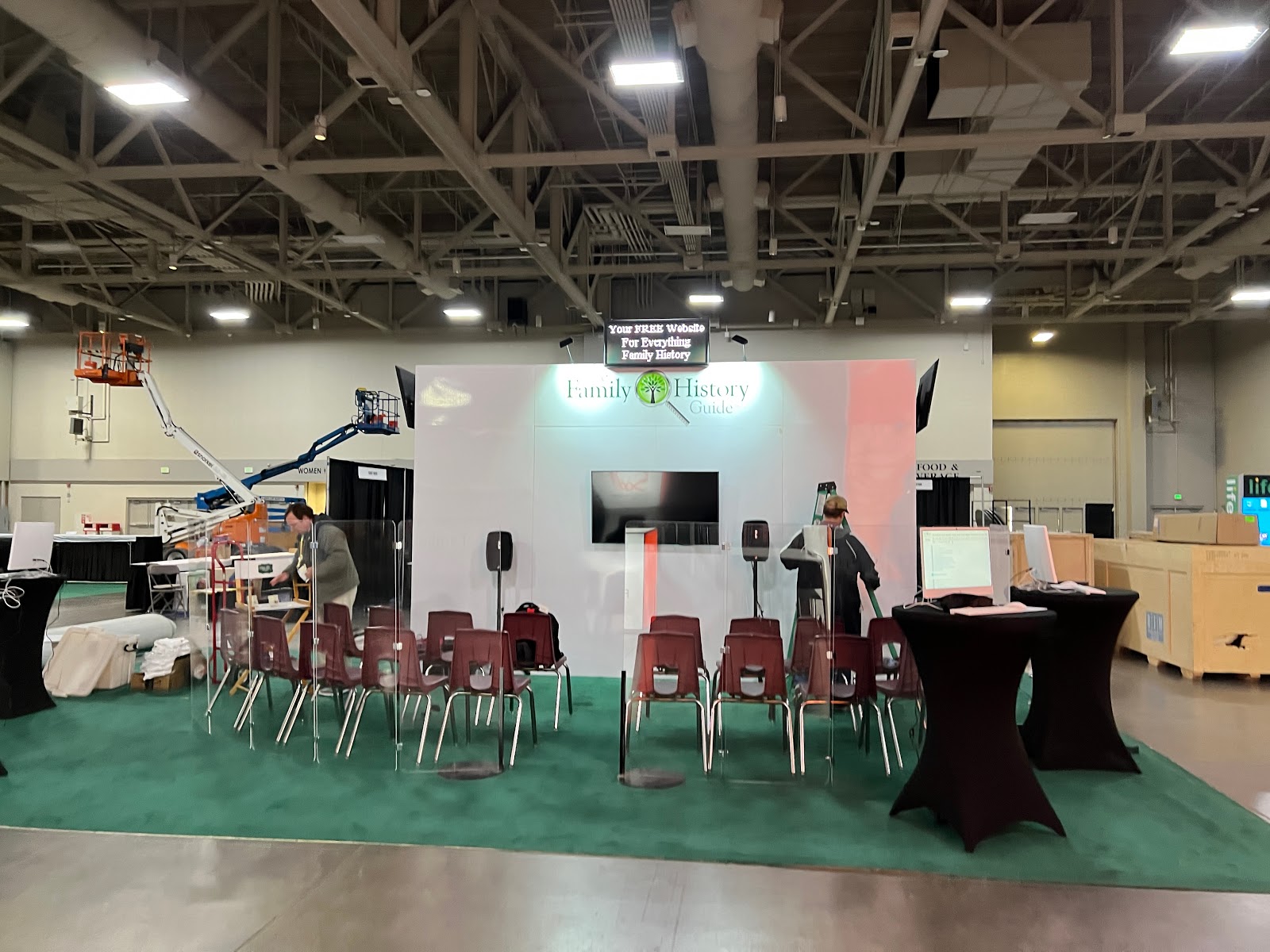
The Day Before RootsTech: Setting Up The Family History Guide Booth


 We get to RootsTech 2023 the day before it opens to help setup The Family History Guide Booth. The Expo floor is being assembled in all the booths. I spend time saying hello to people I haven't seen since before the pandemic. We have the booth all ready for the opening day 

Ancestry.com is here and their booth is starting to take shape. 

You can see the MyHeritage.com booth and many others. Unfortunately, because it is open to outside, the temperature in this part of the Salt Palace is near freezing. It will warm up by tomorrow when we open for the first in-person RootsTech in too long. 

This is the main entrance where they are printing the badges. I will try to take a lot of photos. I have already had a nice visit with Daniel Horowitz of MyHeritage.com, Bruce Buzbee of RootsMagic.com, and a visit with Tina LaFreniere of RelatedFaces.com, Richard Miller of GoldieMay.com, and a lot of people from FamilySearch.org Nice to see everybody. 


Findmypast at RootsTech: new features and expert hints for tracing British and Irish ancestry


 FindmyPast.com has several new features to be announced at RootsTech. They also have some expert presenters to highlight the new developments. Here is a list of their representatives at RootsTech.

Jen Baldwin, Research Specialist & North American Content Manager, 

Mary McKee, Head of Content Publishing Ops & Data Protection, 

Philly Malicka, Head of Content Acquisition, Strategy and Advocacy,

Brian Donovan, Strategic Business Initiatives and Licensing,

From an email, here are the highlights of the new features. 

More than one in five Americans have British or Irish ancestry, so whether you’re at
RootsTech to begin your research or dig deeper into your family stories, make sure
to join Findmypast’s expert talks for insider tips on exploring their unrivalled
collection of British and Irish records and Trees. With the new Tree Search, offering
instant access to the UK’s richest tree network and an ever-expanding collection of
over 14 billion digitised records and historical newspaper pages, you’ll find your
British and Irish family stories right at your fingertips. 
New features on the site make it easier than ever to trace your tree back to medieval
ancestors in Britain and Ireland – and maybe even trace long lost cousins across the
pond. With Tree Search, you’ll have access to a network of over 4.5m member trees,
including nearly a third of all trees connecting to US nodes. Instantly discover new
connections through more accurate hints and progress your research quicker than
ever as you add major new branches and flood your tree with the events and stories
of your ancestors’ lives. When you find an ancestor in common, the new user profile
feature allows you to spark up a conversation with those members directly. 
Plus, with Findmypast’s ever-expanding collection of over 14 billion digitised records
and historical newspaper pages, your tree with be enriched with unique details about
your past you won't find anywhere else. The site contains the most comprehensive
collection of British and Irish records, including the largest online collection of both
Irish and Catholic records in the world, so you can explore connections to England,
Northern Ireland, Scotland and beyond. Travel and migration records track life-
changing journeys across oceans, and military records mark the service and
sacrifice of ancestors around the world. With access to over 50 million historical
newspaper pages, you can discover the colourful stories behind the headlines that
connect to each family member on your tree – and perhaps spot your ancestor right
there in black and white. Findmypast is the only site that adds thousands of new records and newspapers every single week, so there’s always a new story to uncover to bring richness and detail to your ancestors’ lives.
Our experts will be offering virtual sessions during the RootsTech event to bring
these features and records to life: 
Tools to connect with Findmypast exclusive data – get to grips with the
tools available on Findmypast to progress your research and dig deeper into
your British and Irish roots with Head of Data Products, Chris Brake,
including searching member trees, newspaper collections, and addresses. 
Introducing the 1921 Census of England and Wales - Mary McKee, Head
of Publishing Operations, will be offering tips to discover your not-so-distant
ancestors from across the UK, Commonwealth, the US and beyond in the
1921 Census of England and Wales – available exclusively online at
Findmypast. 
Irish Family History is Easy! Seriously – those with Irish roots can get
insights into simple research methods and useful records from Findmypast’s
Irish history expert, Brian Donovan. Recordings of previous talks from
Findmypast experts are also available on the event site, for those wishing to
dig even deeper.

“We’re very excited that RootsTech is back in full force this year so that more people
can progress their family history research,” says Tamsin Todd, CEO at Findmypast.
“Every family story is unique, and at Findmypast our huge range of British and Irish
records allow members to delve into their ancestors’ lives in more detail than ever
before. And, with a free trial, you can try out the helpful features on the site and
discover the friendly community of family history enthusiasts that make Findmypast
so special before you commit.”

Find more information about Findmypast at RootsTech here:

https://www.findmypast.com/page/rootstech