Some people eat, sleep and chew gum, I do genealogy and write...

Friday, September 15, 2023

FamilySearch Chat: Talking with Users in Real Time


https://www.familysearch.org/en/blog/new-familysearch-chat

This is an interesting blog post from the FamilySearch Blog. I don't think it is necessary for me to restate the blog but I would note that perhaps the people who developed this "new tool" and wrote the blog have a limited experience interacting with other FamilySearch Family Tree users. We frequently get written messages from people who are irate, using expletives, threatening, otherwise being rude and unreasonable. I don't really have any reason why I would want to talk to such people in real-time. I guess this does give families an alternative method of texting back and forth, but I don't see it replacing our existing text message groups on our phones or other text message programs such as Marco Polo. 

Speaking at RootsTech Early


https://www.youtube.com/live/bw28BSGqCyY?si=TsVOYOYgmHzEpzGO

You might get a surprise if you watch the video I did for RootsTech.org on 13 September 2023. The presentation was part of an all-day live broadcast with presenters every hour. The videos are now up on the FamilySearch.org YouTube Channel. The BYU Library Family History Center also broadcast the video on the same day. It was an interesting experience and think this is the first time one of my presentations has be broadcast by FamilySearch for a long time, if ever. 

The RootsTech.org 2024 website will open officially for registration on 18 September 2023. I will be presenting a series of three live classes at RootsTech 2024 with the title of "Using Artificial Intelligence Tools to Expand Your Genealogical Research Universe." I don't yet know if all or any one of them will be broadcast online, but meanwhile I will be writing about the impact of AI and probably will have a few videos on the subject on the BYU Library Family History YouTube Channel. 

If you want to start now learning about what I think about the impact of all the new AI programs and how it is changing genealogical research, see this recent video. 


https://youtu.be/PlQK78VmpXE?si=hJli-qj9HVWyiiFd

Thursday, September 14, 2023

Announcing Heredis 2024


https://www.heredis.com/en/

For many years, Heredis has been a family tree software company that helps people discover their ancestors and create family trees. The software is used by genealogy enthusiasts and professionals worldwide. The newly released, Heredis 24 is a major European-based, desktop genealogy program that runs on both Apple and PC computers. The company is based in Montpellier, in the south of France. 

In 2014 the founder of the company sold his shares to the employees, who then took over the company and became each other's partners. It is owned by a SCOP, or Participative Cooperative Society. SCOPs are a type of worker cooperative where employees become partners and make decisions together. 

I have been acquainted with Heredis and had it on my computers for years. Each year, the company has been kind to offer me a free version of the updates. It has always been innovative and a program I often suggest it to those who want control over their own desktop programs as opposed to the online websites. Heredis is a visually lovely program compared to most. It offers a free demo version that allows you to create as many family trees as you like, with up to 50 members each. To create an extensive family tree, you'll need to upgrade to the full version.

The program has over 200 features so you can spend quite some time learning about all of them. One feature of the program that might surprise you is the ability to download a huge desktop family tree from the FamilySearch.org Family Tree. I would be careful going overboard with this feature due to the time the download may take and the amount of memory it may take up on your computer. You will also find that the program incorporates LDS ordinance information where available. 

If you have been working with genealogy programs for a while, you will appreciate some of the features such as the ability to directly search many online genealogy websites with on click for each individual in your database. 

The 2024 version also includes access to input census grids to enter everything while reading the Census, create ancestors and descendants' wheels up to 12 generations and now mixed wheel, a new feature 2024, create a family chronology, another new feature in 2024, and the ability to rename your media.

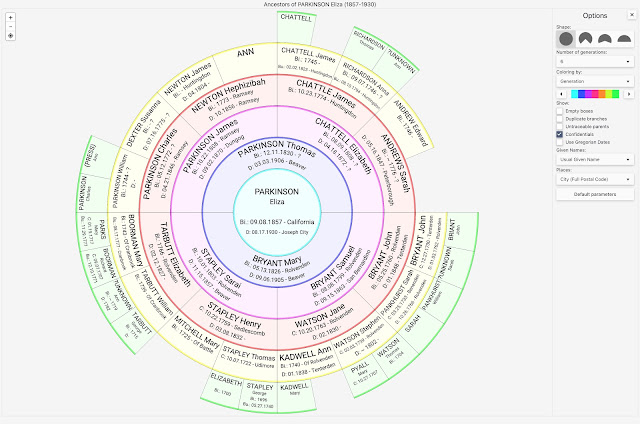
The Heredis Wheel feature is a visualization tool that allows you to display both the ancestors and descendants of a primary person in a circular chart1. Here are some key aspects of this feature:

Mixed Wheel: The mixed wheel lets you display both the ancestors and descendants of the primary person.

Zoom: You can zoom in and out using the + and – buttons. You can also hold down the CTRL key (Windows) or Cmd key (Mac) on your keyboard and zoom in/out using the mouse wheel.

Color Coding: The wheel displays a different color for each Ancestor and Descendant generation. You can select the desired starting color. It also allows you to show the male/female breakdown by selecting the color for men, women, and persons of unknown gender.

Export: You can export the wheel to PDF format for printing.

This feature provides a 360° representation of your family tree, making it easier to visualize and understand your genealogical data. Here is a screenshot of a family wheel. 


I could go on and on, but I suggest looking at the website https://www.heredis.com/ and downloading the free version to see what it can do for you. 

I might also add that the company offers a partnership to genealogy associations.

Monday, September 11, 2023

Growing Old in Genealogy


Once you get to a certain part of your life, you realize that there are no rationalizations that you are still in middle age or anything remotely resembling middle age; you are definitely old. When I started doing genealogical research about 41 years ago, I thought that everyone who did genealogy was "old." Now I realize that many of the people who are doing genealogical research are not old but there are quite a few of us who qualify for my early impression. When you get to this stage, you must admit that no excuses exist that a qualify you for any other category. 

Here are a few of symptoms of what it is like to be old and trying to do genealogical research. 

First of all, I realize that I can no longer work for 10 to 12 hours straight without a nap. There are also other physical reasons that long duration work does not happen so much any more. I also find that after working all day writing, creating presentations, answering questions, and either presenting the same presentations I create or acting as a consultant for the Salt Lake City, Utah FamilySearch Library all make me useless after about 8:00 pm. 

I also have come to depend on an extra pair of glasses for computer use. 

I find that my hearing aids must be in use all day, every day. 

I also seemed to have joined the pain-of-the day club. 

All this leads to a prioritizing of projects and an overall decrease in productivity. It also answers the question I am frequently asked about whether I ever sleep. Yes, I do. 

From time to time, I might comment on my experiences in growing old as a genealogist. Fortunately, I have access to a lot of electronic devices that me writing easier. Here is a short explanation about what it is like to grow old from our friend ChatGPT. 

Growing old as a genealogist can be a unique and rewarding experience, but it also comes with its own set of challenges and considerations. Here's a glimpse into what it might be like:

Accumulated Knowledge: One advantage of growing old as a genealogist is the accumulation of extensive knowledge and expertise in family history research. Years of experience can make you an invaluable resource for younger generations interested in their roots.

Family Legacy: Being a genealogist allows you to create a rich family legacy for your descendants. You can leave behind meticulously researched family trees and detailed histories that future generations can cherish.

Technology Changes: As you age, you may witness significant changes in genealogy research techniques and technology. Staying up-to-date with new tools and digital resources can be a challenge, but it's essential for the field's continued growth.

Preservation: Preserving historical documents, photographs, and artifacts becomes more critical as you age. You might dedicate more time to organizing and digitizing your collections to ensure they are accessible to future genealogists.

Community Involvement: Growing old as a genealogist can provide a strong sense of community. You may belong to genealogy societies or online forums where you can share your knowledge and connect with others who share your passion.

Health Considerations: Like anyone else, aging can bring health challenges. It's important to maintain your physical and mental health to continue your genealogy work. You might adapt your research methods to accommodate any physical limitations.

Teaching and Mentoring: Many older genealogists find joy in mentoring younger enthusiasts. Passing down your knowledge and skills to the next generation can be a fulfilling way to ensure your legacy lives on.

Reflecting on Ancestry: As you age, you may find yourself reflecting more on your own ancestry and family history. This introspection can add depth to your genealogical research and provide a personal connection to the past.

Legacy Planning: Planning for the future of your genealogy research is crucial. Consider documenting your methods, organizing your research materials, and designating a successor to carry on your work when you're no longer able.

In summary, growing old as a genealogist offers the opportunity to leave a lasting legacy, share your knowledge, and connect with a vibrant community. However, it also requires adapting to technological changes, preserving your research, and planning for the future to ensure your work continues to benefit future generations.

Well, I have to agree with the entire list. It is about as good a summary as I could write in less than a minute. 


You Need to Register for RootsTech 2024 Beginning September 18th


RootsTech.org 2024

I have been writing about RootsTech since 2011 and have attended every year since either in person or online. I started out as a Blogger which became an Ambassador and then an Influencer and finally today as Media person. I think the one most significant benefit from all those years has been the opportunity to associate with fellow genealogists. There is something about talking in person and sharing information and experiences that can't adequately be replaced by an online experience. RootsTech 2024 gives us all another opportunity to gather together. I realize that living in Provo does not present the planning and expense of coming from another country of a distant part of the United States, but this opportunity is worth the effort. 

Granted, RootsTech 2024 is going to be both in-person and online. You can certainly enjoy much of what goes on in the classrooms and on the large stage presentations from the comfort of your own home, but when I go to RootsTech, I go mainly to interact with people I would never see otherwise. At RootsTech 2023, both my wife and I spent every practical minute talking to people and sharing information and experiences. I might add that we were both exhausted at the end of the week and it took an entire week or so to recover. But we are ready to do it all over again. 

The full catalog of videos on the RootsTech.org website has 4346 results. That is 4346 videos to view when you register. The videos vary in length from under 20 minutes to almost an hour or more. The tech part of RootsTech is changing almost weekly and attending the conference in person or online will give you an opportunity to see what is really going on the greater world of international genealogy. 

Time is passing quickly. Think about attending in person and start getting ready to be there and when you come, make sure you say hello to me as I wander around the expo floor or teach a class or two or three. 

Reclaim the Records: The Connecticut Genealogy Index


 Reclaim the Records has an impressive success rate for liberating records from unresponsive government agencies. This is the latest effort. Here is a quote from an email message about the new liberated collection. 

Introducing ConnecticutGenealogy.org! It's a FREE searchable database of 576,638 births, 2,180,700 marriages, 2,086 civil unions, and 2,772,116 deaths from the state of Connecticut, spanning three centuries. Some of this data had been online before, scattered across several other websites, but with fewer years, in non-downloadable and non-shareable formats, locked behind paywalls, and/or with tools that couldn't handle searching the quirks and oddities in the data very well. Well, now it's all in one place, and we think we've got better data and better tools, and we're here to tell you all about it!

The story behind the acquisition of this collection and the remaining records that still have not been released is described as "Kafkaesque."

Please take the time to read the entire notice at https://www.reclaimtherecords.org/records-request/30/.

Tuesday, September 5, 2023

Heads up! RootsTech 2024 Live Classes September 13, 2023 and Registration Opens on September 18, 2023


https://www.familysearch.org/rootstech/events/genealogy-for-beginners

RootTech 2024 is ramping up. In preparation for the live and online conference February 29th to March 2nd, 2024. The live conference will be held in the Salt Palace in Salt Lake City, Utah. Online classes will be available at the beginning of the conference. 

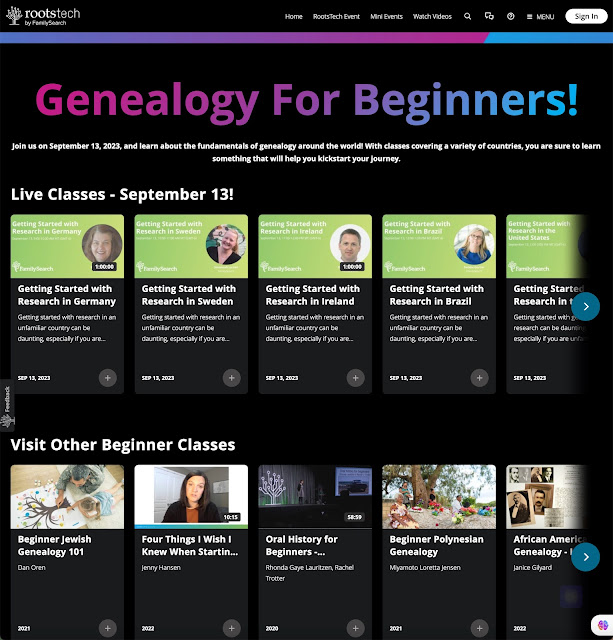
I will be speaking live on September 13th. You can see the schedule above of all the classes being offered live on that date. My class, Help for the Absolute Genealogy Beginner, will be at 3:50 pm Mountain Daylight Time or GMT-6. You can click on the link to each class from the RootsTech website. 

Just in case you get confused about time, GMT-6 is six hours behind Greenwich Mean Time (GMT). It's also known as Central Standard Time (CST) during the winter months. During the summer months, it's called Central Daylight Time (CDT).

GMT-6 is used in the Central Standard Time Zone in the United States. It's also used when states in the Mountain Time Zone operate Daylight Saving Time.

Some of us who are online all the time have to think about time zones continually. 

https://www.familysearch.org/rootstech/session/help-for-the-absolute-genealogy-beginner

Here is a list of all the speakers and their presentations include the following. All times are MDT/GMT-6 time.

Getting Started with Research in Germany, Wednesday, September 13th, 2023 at 9:00 am

Getting started with research in an unfamiliar country can be daunting, especially if you are unfamiliar with the language, records, and resources available. In this class, we will introduce key records, resources, strategies, and tools for researching in Germany 

Baerbel Johnson, AG

Baerbel works as a German Research Specialist at the FamilySearch Library in Salt Lake City, Utah. Baerbel was born in Germany and started her family history journey after she immigrated to the United States. Baerbel is accredited in Germany and has worked for FamilySearch for more than 20 years.

Getting Started with Research in Sweden Wednesday, September 13th, 2023 at 10:00 AM

Getting started with research in an unfamiliar country can be daunting, especially if you are unfamiliar with the language, records, and resources available. In this class, we will introduce key records, resources, strategies, and tools for researching in Sweden.

Savannah Larson, AG

Savannah Larson has always been fascinated by stories of heritage and connection. With fluency in Swedish and proficiency in Danish and Norwegian, Savannah is accredited in Swedish research and works as a Nordic Research Specialist at the FamilySearch Library in Salt Lake City. In her free time, she enjoys volunteering with a youth leadership organization called HOBY, painting, reading, and spending time with her growing family. 

Getting Started with Research in Ireland Wednesday, September 13th, 2023 at 11:00 AM

Getting started with research in an unfamiliar country can be daunting, especially if you are unfamiliar with the records and resources available. In this class, we will introduce key records, resources, strategies, and tools for researching in Ireland.

Dan Poffenberger, AG

Dan Poffenberger, AG® is a Senior British and Irish Research Specialist for FamilySearch at the FamilySearch. He is accredited by the International Commission for the Accreditation of Professional Genealogists (ICAPGen) in England research. He has been a professional genealogist for 34 years specializing in England, Ireland and United States research. He received a Bachelor of Arts Degree from Brigham Young University in Political Science, with a minor in Family and Community History. He and his wife Keirstin have been married for 35 years and have 5 children. Dan has presented at numerous conferences around the United States and internationally.

Getting Started with Research in Brazil Wednesday, September 13th, 2023 at 12:00 PM

Getting started with research in an unfamiliar country can be daunting, especially if you are unfamiliar with the language, records, and resources available. In this class, we will introduce key records, resources, strategies, and tools for researching in Brazil.

Debbie Gurtler, AG

Debbie Gurtler is the Assistant Director of the FamilySearch Library in Salt Lake City. With a BA in Family History from Brigham Young University, she holds five Accredited Genealogist® credentials for the United States Mid-South, Spain, Mexico, Portugal, and Chile. Fluent in Spanish from living over five years in South America. A frequent speaker on Hispanic research topics at local and national conferences. She is the mother of three and the grandmother of five. 

Getting Started with Research in the United States Wednesday, September 13th, 2023 at 1:00 PM

Getting started with genealogy research can be daunting, especially if you are unfamiliar with the records and resources available. In this class, we will introduce key records, resources, strategies, and tools for researching in the United States.

Beth Taylor, CG 

Getting Started with Research in Mexico Wednesday, September 13th, 2023 at 2:00 PM

Getting started with research in an unfamiliar country can be daunting, especially if you are unfamiliar with the language, records, and resources available. In this class, we will introduce key records, resources, strategies, and tools for researching in Mexico.

Debbie Gurtler, AG

Getting Started with Research in New Zealand Wednesday, September 13th, 2023 at 3:00 PM

Getting started with research in an unfamiliar country can be daunting, especially if you are unfamiliar with the records and resources available. In this class, we will introduce key records, resources, strategies, and tools for researching in New Zealand.

Raymon Naisbitt, AG 

Help for the Absolute Genealogy Beginner Wednesday, September 13th, 2023 at 3:50 PM

Beginning with how to spell genealogy, this class walks through the process of starting your genealogical journey. Start by talking to your relatives, getting a genealogical DNA test, or just getting online with one of the major genealogy programs, all this is explained in a way to get you going on your family history.

James L. Tanner B.A; Spanish, M.A.; Linguistics, U of Utah, J.D. Degree; Law, ASU. 2 years, Intelligence Analyst, U.S. Army. 39 years Arizona trial attorney. 41+ years of genealogical research. Blogger of Genealogy’s Star blog. Ten years missionary at Mesa FSL. Presently serving at the BYU Family History Library. Member of FamilySearch GEDCOM Steering Committee. Chairman of the Board of Directors of The Family History Guide Association. Presenter at Expos and Conferences around the U.S. Canada and Europe. Presenter of over 400 genealogy videos on YouTube.

 Fostering Genealogical Enthusiasm: Engaging the Next Generation Wednesday, September 13th, 2023 at 5:00 PM

Listen as Jana teaches how to engage the younger generations in genealogy work.

Jana Greenhalgh, Accredited Genealogist® specializing in England research. She graduated from BYU in 2003 with a BA degree in Genealogy & Family History, and now teaches family history there as adjunct faculty. She has also been an instructor for BYU-Idaho’s online family history degree program, served on the Board of Directors for the Utah Genealogical Association, and as the Level 1 Chair for ICAPGen’s Testing Committee. She currently serves on the Conferences & Education Committee for ICAPGen. She has presented at various genealogy conferences. Jana and her husband Brent live in Lehi, Utah with their seven children, and just for fun, they share their family history adventures via social media and online at www.TheGenealogyKids.com.

Tune in for these free live presentations. Look for other dates for additional RootsTech activities and presentations with a monthly theme. September's themes is Beginners in Genealogy.

https://www.familysearch.org/rootstech/home

I will be posting more information when it is announced on September 18th,