Some people eat, sleep and chew gum, I do genealogy and write...

Tuesday, March 22, 2016

Successfully Using BillionGraves.com


There are quite a few large, online database programs that list cemeteries. In addition, there are an even larger number of online lists, books and other publications that have lists of burials. In a few of the publications, the cemeteries are both clearly identified and have specific directions for determining the location. Even a fewer number of the publications and websites contain maps of the locations of the graves. The very large and rapidly growing website, BillionGraves.com, addresses the main issue in locating graves. All of the graves are marked and mapped with their exact geographical coordinates and by using a GPS equipped mobile device, you can navigate directly to any of the graves listed.

All of the cemeteries identified in the program are located on an interactive map. Here is an example of a screenshot showing the cemeteries in Utah Valley around the town of Provo, Utah.


The map shows cemeteries as follows:

MAP LEGEND

Cemetery with 1000+ BillionGraves Images
Cemetery with BillionGraves Images
Cemetery with less than 20 BillionGraves Images
Cemetery without BillionGraves Images (Zoom in to see)

You can zoom in to accurately locate any marked cemetery. Here is a screenshot of the page for the Provo City Cemetery.


You might note that there are 21,472 images of graves and every singe grave is marked on a map and located with its geographical coordinates. This information comes from the fact that entries into the BillionGraves.com website are made by using smartphones or tablets that are GPS enabled. As photos are made by the website contributors, the images are automatically uploaded to the website where the images can be transcribed. Here is a screenshot of a map of the Provo City Cemetery showing the gravemarker groups with the number of markers in each group.


By zooming in on the map, you can see the markers for individual graves.


If you continue to zoom in, you can ultimately see individual graves. If you search for a specific grave or select an individual grave marker, you can see the information available about that grave. Here is a screenshot showing one individual grave.


The website is free to search and view the maps and grave information. There is a subscription-based Plus version that adds some extremely valuable features including identifying family plots within the cemetery, showing the identity of nearby graves, a map locating everyone with your same family names sorted by city, county, state or country. Here is a screenshot of the BG+ feature page.


When visiting a large cemetery, you may find it quite difficult to locate a specific grave even with a map supplied by the cemetery's sexton, if such a map is available. Using a smartphone with GPS enabled, you can walk directly to a grave. Here is a screenshot of the search page.


Here is the grave of my Great-grandfather, Henry Martin Tanner.


I have the BillionGraves+ version of the program, so I can see a list of all of the 133 people with the Tanner surname buried in cemeteries in Arizona.


In searching through the list, I find the grave of my Great-Grandmother, Eliza Ellen Parkinson Tanner.


I examined some of the other very interesting features of the BillionGraves.com website in a recent blog post entitled, "BillionGraves Plus adds powerful new analytic tools."

Monday, March 21, 2016

Thoughts on Updates and Obsolescence

Personal Ancestral File (aka PAF), the popular genealogy database program, once again became the topic of conversation in classes I taught this past week. In checking on GenSoftReviews.com, I find that PAF is still rated at 4.5 overall with 50 reviews. There is a note that says, "The final version is 5.2.18.0 (2005) and is still available at Parowan Software." Here is a screenshot of the Review.


The entire quote from the review is as follows:
Personal Ancestral File (PAF) 
by The Church of Jesus Christ of Latter-day Saints
Personal Ancestral File has been available free for many years and has a large following. The LDS stopped offering PAF downloads or support on July 15, 2013. The final version is 5.2.18.0 (2005) and is still available at Parowan Software
Unsupported • Windows • Full Featured
http://www.familysearch.org/eng/paf/
 The key word here is "unsupported" and actually, the last full upgrade of the program was in 2002. It is now over 14 years since the program was last upgraded and going on 3 years since all support was terminated.

I began to think more about this situation when March 21, 2016 became one of Apple's new product introduction days. The new products being introduced and yet to come are based on a major upgrade in the Intel Chipsets now into the 6th generation and code named Skylake microarchitecture.

The discussion about PAF centered around a recent memo from the technology support section of the Brigham Young University, Harold B. Lee Library concerning devices and processes that they would no longer support. In short, the days when a person can walk in and have a file recovered from a 3.5 inch floppy disk are quickly ending. I was also essentially in the middle of a support situation for a friend who is trying to work with a computer running Windows XP and at the same time losing his Internet connection with an old tablet mobile device. These situations always remind me of years ago when I was trying to buy parts to keep an old Jaguar automobile running.

Perhaps you can get a feel for the situation by reading some of the comments in the reviews of PAF on GenSoftReviews.com. I have edited some slightly to remove references to individuals etc. Many of these comments are heart rending and I wish I could help solve some of the situations.
  • I would like to download PAF 5 I used it 5 years ago as I had lung cancer, but I survived! Can I do this still to save all my family history there’s so much work I would lose if I can’t download then go to Family Search
  • I really need help… I used PAF from back in the 90s and now I guess there are replacements I should try …. So far the ones I downloaded have been completely different and at 82 I’m struggling…I’m still running my PAF but should I really change???
  • Like many of you I have been using it since version 2.x many years ago. Yes it is still available from the link given at the start of this web page and it is virus and malware free. You may like to know it works on my PC using WINDOWS 10. It does most of what you want and may not be perfect but I haven’t found one that is yet
I could go on and on with the comments but they are making my stomach hurt. Here is a long comment that summarizes some of the issues involved in this technological conundrum.
This software was, is and remain the best of all genealogical products.
I used PAF during 15 years, without problem on Windows 95 to Windows 7.
But when my file reached 40′000 persons, I lost data (mainly a mother, why ?).
This problem was solved with a computer at 32 Go RAM on Windows 8 (instead 8 Go).
Now I have more than 90′000 persons on my main PAF file, without lost of data.
But other problems come with Windows 8.1 :
a) the program shut down suddainly (without lost of data)
b) I can display only date and place of birth on the Individual list.
If I add columns for other events, all columns remain blank, execpt RIN & Full Name-
=> This is the only reason for me to search an other software.
(maybe with others bad surprise…)
I regrets - but understand - the decision of LDS to stop devlopment for PAF.
Microsoft was the killer of the excellent WordPerfect for Windos.
Wy LDS will not give the source code of PAF to an Open Source organization ?
This comment opens up a whole long list of issues which I can hardly begin to address. Can you imagine the amount of work that must be involved that is totally dependent, apparently, on 14 year old code that may stop working at any time. 

I am presently working on a computer that is in the last stages of dependability. I have been waiting for the new product announcements to make a final decision on upgrading my hardware. I thought PAF was good program for many years, but today, genealogy has moved on to online connections and programs that help manage large files. I cannot imagine what must be in that file of 90,000 individuals, but the mere fact of its existence illustrates one of most serious gulfs in genealogical world today. 

Saturday, March 19, 2016

Preparing to Search a Graveyard -- Part Three


There is a significant difference between a casual memorial visit to a cemetery to view the grave of a departed family member and a research visit by a genealogist. Although both visits may have an emotional impact on the visitor, the researcher needs to do quite a bit of preparation. Cemeteries can have the appearance of a beautiful, well-maintained garden or an abandoned and weedy lot. Here is an example of an abandoned cemetery in Rhode Island.


Stories of cemetery visits from genealogists abound with encounters with snakes and other wild animals as well as problems with brambles and poisonous plants. Here is a photo of the results of one such encounter.


I suggest the following check list of items you may wish to consider when planning a cemetery visit.

1. Locate the cemetery.

I will be writing more about this later, but if at all possible, the location of the cemetery should be determined before you start exploring. Even with a map and a description of the cemetery, actually locating the plot may be a real challenge.

2. Determine any local rules, laws, social customs, religious restrictions, and availability issues that need to be resolved either before or during the visit.

Almost all cemeteries, even abandoned ones, may have legal or other restrictions on their access. If the cemetery is a public one, it may be open only during certain hours of the day or days of the week. If is a private cemetery, located on private property, the owners may not allow access except by previously arranged appointment, if at all. Do as much research as possible about the cemetery and its location as possible before your visit. Be aware of any local customs or beliefs concerning cemeteries and cemetery visits. Even with adequate preparation, locating the cemetery and gaining access may be an adventure. You need to be aware of the weather conditions and whether or not you will need to walk or climb to reach the cemetery. Some burial grounds are located on church properties and access may be limited by the requirements of religious observances.

4. Arrive prepared to record your visit with a camera and notebook. 

It is a tragedy to arrive at a location for research only to find your camera's battery has expired. Be sure all recording equipment is available and in operating order. Here is a link to a good introduction to this subject that talks about some of the limitations on taking photographs that may exist. See "Cemetery photos: permission required?" from The Legal Genealogist.

5. Avoid doing damage to the cemetery grounds or the graves. 

Over the years, genealogists have employed a number of methods to enhance or record grave markers. These include rubbings with paper and chalk or charcoal, applying a variety of substances to the marker to enhance the visibility of the markings such as shaving cream and chalk. Using a brush or other tool to "clean" the marker so it can be viewed and so forth. All of these are very bad ideas and may cause permanent damage to the grave marker. I suggest this article from the New Hanover County, North Carolina GenWeb entitled "Safe Solutions for hard to read tombstones" for a good summary of the best methods of preserving grave markers from additional damage.

The cardinal rule should always be to do no damage in your efforts to view and record the contents of the cemetery or burial ground. Here are some websites with information about the language of cemeteries with definitions of some of the more common terms. The most complete list I found was an article entitled, "Terms used to Describe Cemeteries and Grave Markers" from the Indiana State Government.

“Cemetery.” Wikipedia, the Free Encyclopedia, February 12, 2016. https://en.wikipedia.org/w/index.php?title=Cemetery&oldid=704614532.

“Cemetery Tip: Vocabulary Lesson.” Accessed March 19, 2016. http://www.historicrockcastle.com/blog/october_2013/cemetery_tip__vocabulary_lesson.

“Cemetery Tip: Vocabulary Lesson.” Accessed March 19, 2016. http://www.historicrockcastle.com/blog/october_2013/cemetery_tip__vocabulary_lesson.

“Cem_glossary.pdf.” Accessed March 19, 2016. http://www.in.gov/dnr/historic/files/cem_glossary.pdf.

Knight, Rebecca. “Research Guides: Genealogy: Cemeteries.” Accessed March 19, 2016. http://guides.lib.udel.edu/c.php?g=85348&p=548043.


This is a series. Here is the previous installment.

http://genealogysstar.blogspot.com/2016/03/preparing-to-search-graveyard-part-two.html
http://genealogysstar.blogspot.com/2016/03/preparing-to-search-graveyard-part-one.html

Friday, March 18, 2016

4 - 1 hour webinars in one day

As I have mentioned in some of my recent posts, I am working more at recording webinars and that is cutting into the time I have to write. Today was a classic example. I have four 1 hour webinars. That takes most of the day. The good news is that eventually three of them will be up on FamilyHistoryExpos.com and the other one will be uploaded to the BYU Family History Library YouTube Channel. Here are three relatively newly added videos from the YouTube Channel. Don't forget to subscribe.


Proven Ways to Find Your Immigrant Ancestors - James Tanner


Stories from the Past: Finding Kerlin's Well - James Tanner
Y DNA for Genealogists - Paul Dunn

Thursday, March 17, 2016

Preparing to Search a Graveyard -- Part Two


It is common to assume that someone had a formal burial, but this is not always the case. Immigrants who died at sea were likely buried at sea. This does not mean that there is no record of the burial but obviously, there is no gravesite. People do and did wander off and die or die while crossing the plains or any number of ways where the body was never recovered. In all these cases, there may or may not be a record of the death and/or burial. It is not a good idea to focus on records for a single event in an ancestor's or relative's life. If a person was born more than 110 years ago, you can presume that they are dead. But remember the opposite is also true, do not assume that someone is dead if less than 110 years have past since their birth. You may want to kill off your relatives, but it is not a good idea to publish their deaths online before they actually die.

As I have already mentioned, in this day and age, it is a very good idea to do an exhaustive search online for information about a burial before traveling to a remote location and searching around for cemeteries. Many early burials, especially in the rural parts of the United States and some other countries, were done in private, family plots located right on the property where the family lived. In these cases, early maps, diaries or letters may contain a clue as to the location of the private cemetery. Once the general location has been established, it may be possible through land records to determine the location of the cemetery. I have run across cemeteries in some of the most unlikely places. Once when hiking in the mountains of central Arizona, we found an old abandoned cemetery near an old mine.

Locating the possible burial location is only the first part of the project of finding the grave. It is fairly common that people were buried in unmarked graves. The grave may only have been marked with a wooden cross or other temporary marker or the marker, even made of stone, may have disappeared over time. The marker shown above in the image is for my great-great-great-grandfather, William Linton, his wife and daughter, but he was originally buried in another cemetery. I found this out when I examined the burial records for the Westminster Cemetery outside of Philadelphia, Pennsylvania and learned that he had been buried there many years after he died. The precipitated a search for the original burial location which was determined to be the Fourth Presbyterian Cemetery in downtown Philadelphia. That cemetery had been destroyed (or moved) by construction of new buildings and his body was moved.

This is a good place to illustrate the possible complexity of the burial situation and the records that can be generated by quoting myself from some early writing. Here is a hypothetical situation as it may occur with some rewriting from my original publication.
Let's suppose that a person named John Doe died within the past 100 years in the United States. He was a resident of Arizona but died in New Mexico. Since this is a hypothetical situation, I can make it as complicated as I wish. He was in an accident and died in a hospital so there are hospital records of his injuries. There is likely a newspaper report of the accident and his subsequent death. There may also be police records of the investigation of the accident. When he died, an attending physician may have been present or may have been called. If there was no physician or doctor available, the body may have been attended by an mortician or an employee of a funeral parlor. A physician or mortician is the one who may have signed a death certificate with the state, if that was required at the time that John Doe died. A local mortuary may have been called to come and remove the body so there would be mortuary records. This is not always the case since the body may have been viewed in a private residence and then privately buried. 
In my example John Doe's family is in Arizona and they want him buried in Arizona. So they have to make arrangements with a local Arizona mortuary to receive the body and with the mortuary in New Mexico to transport the body. This creates more mortuary records. The family then, depending on the location and time period involved, has to obtain, through the mortuary, a permission from the government to transport the body. The body then is sent by train to Arizona where it is received by the local mortuary. More records are generated by the railway such as shipping records. The family has to make arrangements in Arizona to purchase a burial plot. The mortuary could be involved in that process or the family may have gone directly to the cemetery with the body. There may be a contract for the sale of the cemetery plot and a deed for the plot. The mortuary then prepares the body for burial and could have sold the family a coffin. There may be documents regarding the sale of the coffin. If the family wanted to have a funeral and/or a graveside service,  there would be also be documents such as a funeral program or graveside service program that are printed for those who attend the funeral or memorial service. The family may order some flowers so there may be a contract for purchasing the flowers or a receipt. The mortuary usually provides a guest book (included in the price of the funeral) and so that guest book may be available. The family also wants to notify people of the funeral so either the family or the mortuary or the newspaper (or all three) writes an obituary or death notice. Before the funeral is held, the mortuary has to obtain both a Permit for Burial and a permit to open the grave from the county or state. After the funeral, the body is transported to the cemetery and buried. There is then a permit issued to close the grave. Once the body is buried, there may also be a contract to maintain the cemetery plot. The family may wish to mark the grave and may have a contract for the creation of a headstone or tombstone. The cemetery makes a record of which graves have been created and which ones have headstones or not. In some cultures and religions, memorial services may be held for the deceased a year after the death. Sometimes a memorial is printed in a local newspaper a year or more after the death. At some point, the state or county will make an index of all their burials.
Obviously, not all those steps and forms will apply to any one burial, but this example should suggest that looking for burial records can be challenging. You might realize that if any one or more of these documents survive someplace, then they could all be useful in establishing the location of the burial and perhaps the facts surrounding the death.

Another issue that must be resolved before attempting to visit a burial location is whether or not the the location is on public or private land. You should always take the time to investigate any limitations on access. The physical location of the burial may be be difficult to find or access, as in my example of the cemetery located near a mine in the mountains of central Arizona or the example I mentioned previously of my sixth great-grandfather buried in a cemetery located in Rhode Island. What I did not mention previously was that the Rhode Island cemetery was located in the middle of a huge blackberry bramble patch and almost impossible to approach without injury.

In the United States, many cemeteries, even private ones, were marked on government topographical maps. The United States Geological Survey (USGS) has a huge collection of more than 170,000 government created topographical maps in their Historical Topographical Maps Collection online. There is also an online publication of all of the Topographical Map Symbols. Careful study of these maps may show the location of long forgotten and abandoned cemeteries. Here is an example of the symbols used on the maps including the one for cemeteries.

Here is a portion of a topographical map of the town of Nephi, Utah and the Vine Bluff Cemetery from the USGS TopoView website.


Here is a satellite view of the same area.


It helps to have the exact geographic coordinates (latitude and longitude) of the cemetery in order to find it once you are on the ground driving or walking around. If you have the geographic coordinates, you can also easily see a satellite view either with Google Maps or the free downloadable program, Google Earth. With either of the Google mapping programs, you can also zoom in to street view and see the cemetery location if it is near a road. Here is a Google street view image of the Vine Bluff Cemetery entrance on Nephi, Utah.


Despite all of these high-tech ways to explore a cemetery, it is still an important part of genealogical research to make the visit yourself, if possible.

This is a series. Here is the previous installment.

http://genealogysstar.blogspot.com/2016/03/preparing-to-search-graveyard-part-one.html

Wednesday, March 16, 2016

Preparing to Search a Graveyard -- Part One


Cemeteries form an integral part of the sources relied upon by genealogists for information about their ancestors. However, the popular view of cemeteries is extremely distorted by references to ghosts, the macabre and images associated with Halloween. Movies and other media associate cemeteries with images of death, bats and a variety of monsters. Hopefully, genealogists focus on the more positive aspects of cemeteries. It would be a tragedy if a genealogical researcher was afraid to enter a cemetery based on media depictions.

Basically the benefit you derive from a visit to a cemetery is entirely dependent on your preparation. As more and more cemeteries are digitally represented and inventoried online, you certainly need to do your homework well before you get to the physical cemetery. If you fail to find any record of the burials or the photos of the cemetery online, you should seriously consider taking the opportunity to contribute to one or more of the large online cemetery databases as part of your visit.

I am going to use a two visits to the Vine Bluff Cemetery in Nephi, Juab County, Utah and the Tanner Cemetery in Rhode Island, as examples of planning and executing a visit to a cemetery. Nephi, Utah is located about an hour's drive south of Provo, Utah (I now live in Provo). The Tanner cemetery in Rhode Island is located on the East Coast, about 2300 miles away. I have had some interesting experiences over the years in visiting cemeteries but I also realize that my visits would have been much more productive had I spent more time to adequately prepare for the visits.

Cemeteries can be both public and private. Some of the larger cemeteries have tens of thousands of graves. Others may only have a few and, of course, there are burial locations containing a single grave. Some grave sites are open to the public and others are located in areas required special entry permission. The cardinal rule in visiting graveyards or cemeteries is to do no harm to the markers or the surrounding area. Grave markers have been made from substances from wood to durable stone and through neglect and age, many are in a state of ruin. It is a tragedy when a genealogist's visit to a cemetery is marred by thoughtless destruction of the very information being sought.

Using my two examples, the Vine Bluff Cemetery is publicly maintained and is readily accessible during its open, operating hours. On the other hand, the Tanner cemetery in Rhode Island is on private property and access to the cemetery present a number of physical and practical challenges. Here is a photo of the grave marker (headstone, tombstone) of my great-great-grandfather, Samuel Linton and my great-great-grandmother, Ellen Sutton Linton from the Vine Bluff Cemetery.


I should have used a flash on my camera to take a better photo. Here is another photo from the BillionGraves.com website. There is also a photo of this marker on the FindAGrave.com Website.

Headstone image of Samuel Linton

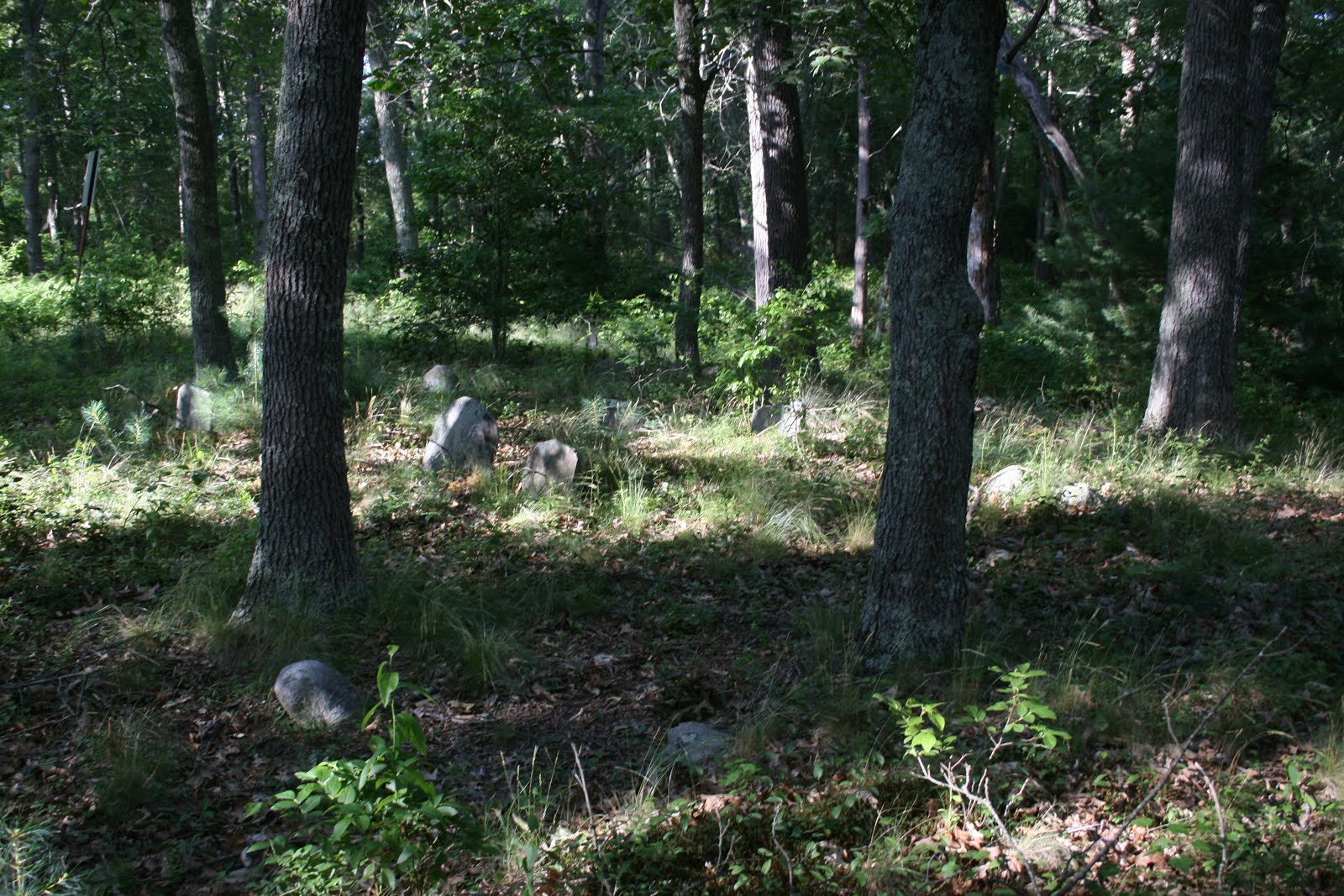
Here is a photo from the Tanner cemetery in Rhode Island. This is the burial site of my sixth great-grandfather, William Tanner and his wives and some of his family members. He died in 1735.


You can hardly see the grave markers. Here is a closeup of one of the markers.


The Tanner gravesite is located off of the third tee at the Laurel Lane Country Club in South Kingston, Rhode Island. It might help to understand the condition of the Tanner cemetery to know that the burials date from the early 1700s.

The existence of the photo of the Samuel Linton grave in the two large online cemetery database programs raises some interesting issues. Do we really need to get in our cars and drive to the cemeteries? In the case of the Tanner cemetery, neither of the large online websites have a record of this cemetery, however there is a record of the cemetery, the burials and the exact location on the Rhode Island Historical Cemetery Commission website. Here is a description of the gravesite from the website.
This burial ground is the oldest of three Tanner lots, located a thousand feet south of Laurel Lane, behind the green for hole number three of the Laurel Lane Country Club. It is 40 feet x 45 feet, in good condition, with no enclosure or historical cemetery sign. There are eighteen graves in this burial ground marked with fieldstones, six of which are crudely inscribed. James N. Arnold recorded this lot Nov. 10, 1880, his #233, “a short distance northwest from the above [SK 131] another yard of the same family in field without protection, rude stones.” He recorded nine inscribed and 18 uninscribed fieldstones, nine large and nine small [children], in what we have now divided into two burial grounds, SK129 and SK 130. The genealogy, William Tanner, Sr. of South Kingstown, RI and his Descendants by Rev. George C. Tanner (1910) has a plan of these three burial grounds on page 14 with the following text: This burial place of the early Tanners is on the original farm owned by William Tanner Sr., and in an open field near the ‘Great River’ [Usquepaugh River, aka Queen’s River] and a short distance from a walled grave yard [SK131]. The most north westerly grave is that of William Tanner, evidently, and marked with a rude granite field stone, with the simple letters, W. T. At the right are two graves, marked, M. T. and at the right of this, a second marked E. T. At the foot of these are four small graves, probably children of William Tanner, as the custom was to bury young children at the foot of their parents’ graves.” Eastward of these short graves are three graves, the middle one marked J. T., the one at the right with the marking indistinct, but may be J. T., that at the left, plainly marked S. T. There are undoubtedly the graves of John Tanner, son of William , and his first and second wife, Jean and Susannah.” Found, registered, and recorded by John Sterling & James Wheaton for a 2004 book on South Kingstown cemeteries. About sixteen paces west of the northwest corner of the walled enclosure and about twenty-three paces to the north are the graves of Josias Tanner, and at the right one marked A. T., Amy Tanner, and at the left of that marked J. T. one marked P. T., Phebe Tanner, wives of Josias [SK130].
Here is the book mentioned by the website.

Sterling, John E, James Lucas Wheaton, Cherry Fletcher Bamberg, and Rhode Island Genealogical Society. 2004. South Kingstown, Rhode Island Historical Cemeteries. Greenville, R.I.: Rhode Island Genealogical Society.

It should be apparent that the first step in preparing to visit a gravesite is to determine its location and accessibility. Cemeteries often have schedules when they are open to the public and you need to determine whether or not there are any supporting records available. Just getting in your car and driving to a cemetery may be an adventure, but it may also be very disappointing. Our trip to Rhode Island occurred before most of the information now online was available and the descriptions we had of the location of the cemetery were vague. Now the same cemetery is marked on a Google map with the exact coordinates. You should also realize that visiting the cemetery could turn out to be a once in a lifetime experience.

Tune in for the next installment.

Tuesday, March 15, 2016

What is an ethical genealogist?

I think I will return to the issue of "ethics" and the pursuit of genealogy. I am not sure we have adequate definitions for either of the two concepts. With respect to the term "genealogy," I have heard prominently reported comments that doing "family history" does not require one to be a genealogist as if the labels made a difference in the basic activities and skills involved. This type of statement is usually directed at the issue of the degree to which the skills needed for adequate research are necessary or required. I am reminded of the thousands of books, articles and other publications that employ the term "easy" or "for dummies" or whatever. We have our examples in the following:

Barratt, Nick. Researching Your Family History Online for Dummies. Chichester: Wiley, 2009. http://site.ebrary.com/id/10510430.

Chupurdia, Vickie. “The” Book on Genealogy: Easy Steps to Tracing Your Family Tree. Two Harbors, MN: Autumn Leaf Publishing, 2010.

Dieterle, Diane. Easy Genealogy. Mableton, Ga.: Roots Pub. Co., 1977.

Helm, Matthew, and April Leigh Helm. Genealogy Online for Dummies. Detroit: Thorndike Press, 2009.

Kyle, Noeline. How to Write and Publish Your Family Story in 10 Easy Steps. Sydney, N.S.W.: NewSouth Pub., 2011. http://search.ebscohost.com/login.aspx?direct=true&scope=site&db=nlebk&db=nlabk&AN=380107.

———. Writing Family History Made Very Easy. Crows Nest, NSW: Allen & Unwin, 2007.

Sipe, Karen V. Genealogy Made Easy. Mineola, N.Y.: Dover Publications, 1998.

Swanson, Wendy W. Family History & Genealogy: Easy Steps to Build Your Family Tree, 2014.

Szucs, Loretto Dennis. Family History Made Easy. Salt Lake City, Utah: Ancestry, 1998.

I am in no way denigrating these efforts at simplifying genealogy, I am merely pointing out that there is a distinct segment of the genealogical community that feel that there is an easy solution to what is, in reality, a very complex subject. At the other end of the spectrum, we have books with hundreds of pages of complex analysis of very limited genealogical issues. A good example is the very valuable reference book on English genealogy.

Herber, Mark D, and Society of Genealogists (Great Britain). Ancestral Trails: The Complete Guide to British Genealogy and Family History. Baltimore, Md.: Genealogical Pub. Co., Inc, 1998.

This book has 674 pages and I would observe that every single page is densely filled with information that is helpful in finding records and doing "genealogy" or "family history" in England.

When I attended law school, within a few hours of the first few classes I attended, I realized I had stepped off into a different world. The legal world of law as presented in a law school was so intimidating and complex that the dropout rate was noteworthy. Some students did not last the first full week. There are some subjects that just cannot be made easy or simple. Genealogy by its nature is difficult, challenging and complicated. All attempts to "simplify" genealogical research fail to explain or include the parts that are not simple and definitely not easy.

I am presently ploughing my way through thousands of early Mississippi deeds looking for the name of one ancestor for a friend. I have spent a solid three hours staring at the microfilm and I am not through the first half of the first of two long rolls of microfilm. I may not find anything I am looking for. How do I tell someone who needs to do a similar task that genealogy is easy?

Now, let's think about ethics. Most of the time when the subject of ethics comes up it is because someone is upset with some activity or attitude that they personally find objectionable. The term "ethics" like the term "genealogy" has no uniformly accepted definition. What I think is "ethical" or "unethical" is highly subjective, just as my definition and experience with genealogy is based on my own experience. In today's world there are two opposing views of the concept of ethical behavior. One side takes the position that person's ethics are determined by the situation (situational ethics) at the other end of this continuum, there are those who believe that ethics are immutable and very fundamental to human existence. Much of the time, the issues of ethics are mixed in with religious beliefs or the lack thereof.

In our current society we also have arbitrary rules of conduct imposed by organizations for their own benefit and conduct. What is and what is not ethical is defined by the usually self-appointed, governing board of the organization. These rules apply to professions, trades, and social organizations. Many times these rules are called "ethics" but they cannot be universally applied unless a person becomes a "member" of the particular organization involved. For example, the rules of professional conduct for attorneys do not apply to those who are not attorneys.

There are those who would like to impose their own views on the issue of ethics on the entire genealogical community. As we exist now, we have no such universally applied rules. Except for a very few and relatively small "professional" genealogical organizations, there are no commonly accepted rules of conduct for anyone professing and interest in family history or genealogy. Instead, the genealogical community is subject to the same level of ethics as the general population of the world.

For example, I personally think it is "unethical" to copy an entire pedigree without determining the accuracy of the entries. Obviously, there are millions of people who believe otherwise. We can also get into involved discussions of copyright law, plagiarism, dishonesty, fraud and other issues that are common in our society and certainly not absent from the genealogical community. But when we come right down to the heart of the subject, we have to realize that there is no separately defined, specific code of ethics that applies to genealogists as opposed to their role in the society at large. Unlike disbarred attorneys, we have no mechanism for excluding non-compliant, unethical behavior.

So far, genealogists have yet to agree on a common research standard or any other standard for that matter. Perhaps it is time to start talking more about ethics as the term applies to genealogy, but before we do, perhaps we need to establish or re-establish some ethical rule in the general population?

Here are some books on the history of ethics that you might find interesting.

Becker, Lawrence C., and Charlotte B. Becker. A History of Western Ethics. Psychology Press, 2003. 

Davidson, Arnold I. “Ethics as Ascetics: Foucault, the History of Ethics, and Ancient Thought.” The Cambridge Companion to Foucault 2 (1994): 123–48.

Irwin, Terence. “The Development of Ethics: A Historical and Critical Study,” 2009. http://philpapers.org/rec/IRWTDO.

MacIntyre, Alasdair. A Short History of Ethics: A History of Moral Philosophy from the Homeric Age to the 20th Century. Routledge, 2003.

Sidgwick, Henry. Outlines of the History of Ethics for English Readers. Macmillan, 1892.