Some people eat, sleep and chew gum, I do genealogy and write...

Saturday, September 30, 2023

A New Development in Family History:


 https://sites.google.com/view/livinghistoryai 

This is a new AI experience with a direct impact on relating family history. Here is a link to the introductory video. 


https://youtu.be/Lu3wX-M5I9Y?si=lbYqN-OiMKZs_P27

It may not be obvious but the main point of the website is to allow users to create their own narratives from their own ancestors. Here is a screenshot showing the services offered. 


The developer website is JonathanGibsonStudios.com. The website indicates that they are a partner with FamilySearch. 

https://jonathangibsonstudios.com/

Watch the videos and here is another immersive experience. 

https://wilfordwoodruffpapers.org/wilford-woodruff-ai-learning-experience


Right now, this only works on PCs and since I am Mac-based, I will have to figure out how to look at these links. Comments are appreciated. 

Wednesday, September 20, 2023

Some Practical Predictions About the Future of Genealogy


Genealogy has its boat anchor in the paper-based, Western European traditions that prevent the adoption of a revised methodology that would empower researches in ways that only now becoming vaguely perceptible. If the current tidal wave of artificial intelligence is going to affect genealogy, they we must start by acknowledging that genealogy is based on information and AI is nothing more or less that a newer way to manipulate and present information. Using AI in the context of genealogy should become pervasive and automatic. 

For example, here is a list of possible family structures from Bing Chat in addition to the nuclear family, extended family, and single-parent family.

Joint Family: In many South Asian countries, such as India, Pakistan, and Bangladesh, it is common for multiple generations of a family to live together under one roof. This arrangement often includes grandparents, parents, siblings, and their respective spouses and children.

Matrilineal Family: Some societies, such as the Minangkabau people of Indonesia, follow a matrilineal kinship system. In these families, descent and inheritance are traced through the female line, and property is often passed down from mother to daughter.

Patrilineal Family: Conversely, other cultures may follow a patrilineal kinship system, where descent and inheritance are traced through the male line. This is observed in many African societies, such as the Akan people of Ghana.

Bilateral Family: In bilateral kinship systems, such as those found in many Western societies including the United States, both the maternal and paternal sides of the family are considered equally important. Individuals maintain close relationships with relatives from both sides.

Blended Family: Blended families are formed when two individuals with children from previous relationships come together to form a new family unit. This structure is increasingly common in many parts of the world due to factors such as divorce and remarriage.

Same-Sex Parent Family: With increasing recognition of LGBTQ+ rights, same-sex parent families have become more visible and accepted in many countries. These families consist of same-sex couples raising children together through adoption, surrogacy, or other means.

Fictive Kinship: Fictive kinship refers to non-biological relationships that are considered family-like. This can include godparents, close family friends, or individuals who play significant roles in a person’s life without a blood or legal connection.

Bing. (2023, September 20). Re: Internationally, what are all the possible types and iterations of family biological, social, religious, cultural, and formal around the world? [Online forum comment]. Retrieved from https://github.com/microsoft/botframework-sdk/blob/main/README.md'

Can you think of a genealogical family tree program available today that can accamodate all of these variations? As long genealogy persists in being Western European based, any other advances will be superficial and inconsequential. As can be seen from the list below, AI will have to play a predominate role in order to move genealogy forward. 

1. DNA Testing

DNA testing has already revolutionized genealogy, allowing some individuals to trace their first few generations with unprecedented accuracy. In the future, we can expect these tests to become even more advanced and accessible. This could lead to the discovery of previously unknown familial connections and a more nuanced understanding of our genetic heritage. However, more remote ancestral relationships will continue to depend on accumulating related testing subjects. 

2. Digital Records

The digitization of records is another trend that will continue to transform genealogy. As more historical records are digitized and made available online, the issue will shift from whether or not the records you need are digitized to whether or not they are accessible. 

3. Artificial Intelligence

Artificial Intelligence (AI) holds great promise for genealogy. AI algorithms can analyze complex data sets much faster than humans, identifying patterns or connections that might be missed by human researchers. This could help genealogists uncover hidden links and piece together family histories more efficiently. Advances in genealogy using AI will also depend on access. 

4. Virtual Reality

Virtual Reality (VR) technology could offer a new way to engage with our ancestral past. Imagine being able to “visit” your ancestral homelands or experience historical events that shaped your family’s history in an immersive VR environment. This could bring family histories to life in a way that traditional research methods cannot.

5. Privacy Concerns

As genealogy becomes increasingly reliant on personal data, privacy concerns will likely come to the forefront. There will likely be ongoing debates and legislation about privacy protection and the ethical use of genetic information. Ensuring that genealogical research respects individual privacy rights will be a key challenge moving forward.

6. Health Predictions

The intersection of genealogy and health is another area set for growth. As our understanding of genetics advances, genealogical data could be used more frequently for predicting potential health issues and personalizing healthcare.

7. Cultural Reconnection

For displaced or diasporic communities, advanced genealogy could provide a means of reconnecting with lost cultural heritage and history. By tracing their roots, individuals can gain a deeper understanding of their cultural identity and heritage.

There are probably many more trends. Here is the citation to the above list. 

Bing. (2023. September 20). Write an article about Some Practical Predictions About the Future of Genealogy (Online forum comment) Retrieved from https://sl.bing.net/ilOS46CXn9o

Now some further comments about family structure. It seems to me that the real breakthrough in genealogy will occur once there is a way to show all of the possible interactions and relationships between individuals in a way that the relationships can be visualized. 
Monday, September 18, 2023

Registration is now open for RootsTech 2024


https://www.familysearch.org/rootstech/

RootsTech 2024 is open for registration. Here is a link to the in-person registration page. 

https://www.familysearch.org/rootstech/registration/in-person/

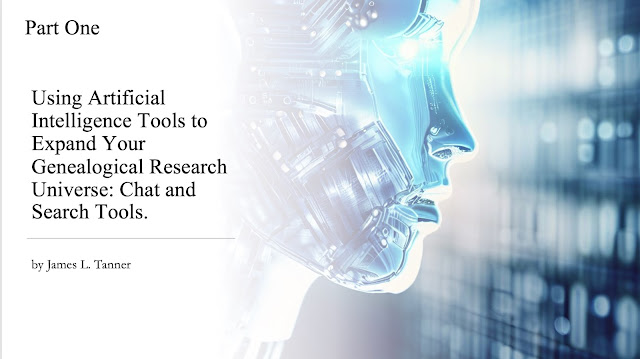
The price is  the same as it was last year. I have a three-part, live presentation, probably one on each day of the conference.


My topic for the three classes will be:


Each of the sessions will cover different uses of AI for genealogical research. More later when we have the actual schedule. 

Friday, September 15, 2023

FamilySearch Chat: Talking with Users in Real Time


https://www.familysearch.org/en/blog/new-familysearch-chat

This is an interesting blog post from the FamilySearch Blog. I don't think it is necessary for me to restate the blog but I would note that perhaps the people who developed this "new tool" and wrote the blog have a limited experience interacting with other FamilySearch Family Tree users. We frequently get written messages from people who are irate, using expletives, threatening, otherwise being rude and unreasonable. I don't really have any reason why I would want to talk to such people in real-time. I guess this does give families an alternative method of texting back and forth, but I don't see it replacing our existing text message groups on our phones or other text message programs such as Marco Polo. 

Speaking at RootsTech Early


https://www.youtube.com/live/bw28BSGqCyY?si=TsVOYOYgmHzEpzGO

You might get a surprise if you watch the video I did for RootsTech.org on 13 September 2023. The presentation was part of an all-day live broadcast with presenters every hour. The videos are now up on the FamilySearch.org YouTube Channel. The BYU Library Family History Center also broadcast the video on the same day. It was an interesting experience and think this is the first time one of my presentations has be broadcast by FamilySearch for a long time, if ever. 

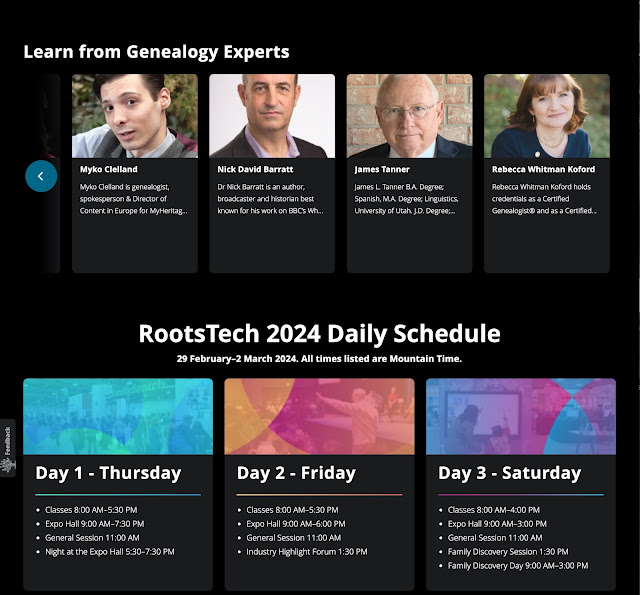
The RootsTech.org 2024 website will open officially for registration on 18 September 2023. I will be presenting a series of three live classes at RootsTech 2024 with the title of "Using Artificial Intelligence Tools to Expand Your Genealogical Research Universe." I don't yet know if all or any one of them will be broadcast online, but meanwhile I will be writing about the impact of AI and probably will have a few videos on the subject on the BYU Library Family History YouTube Channel. 

If you want to start now learning about what I think about the impact of all the new AI programs and how it is changing genealogical research, see this recent video. 


https://youtu.be/PlQK78VmpXE?si=hJli-qj9HVWyiiFd

Thursday, September 14, 2023

Announcing Heredis 2024


https://www.heredis.com/en/

For many years, Heredis has been a family tree software company that helps people discover their ancestors and create family trees. The software is used by genealogy enthusiasts and professionals worldwide. The newly released, Heredis 24 is a major European-based, desktop genealogy program that runs on both Apple and PC computers. The company is based in Montpellier, in the south of France. 

In 2014 the founder of the company sold his shares to the employees, who then took over the company and became each other's partners. It is owned by a SCOP, or Participative Cooperative Society. SCOPs are a type of worker cooperative where employees become partners and make decisions together. 

I have been acquainted with Heredis and had it on my computers for years. Each year, the company has been kind to offer me a free version of the updates. It has always been innovative and a program I often suggest it to those who want control over their own desktop programs as opposed to the online websites. Heredis is a visually lovely program compared to most. It offers a free demo version that allows you to create as many family trees as you like, with up to 50 members each. To create an extensive family tree, you'll need to upgrade to the full version.

The program has over 200 features so you can spend quite some time learning about all of them. One feature of the program that might surprise you is the ability to download a huge desktop family tree from the FamilySearch.org Family Tree. I would be careful going overboard with this feature due to the time the download may take and the amount of memory it may take up on your computer. You will also find that the program incorporates LDS ordinance information where available. 

If you have been working with genealogy programs for a while, you will appreciate some of the features such as the ability to directly search many online genealogy websites with on click for each individual in your database. 

The 2024 version also includes access to input census grids to enter everything while reading the Census, create ancestors and descendants' wheels up to 12 generations and now mixed wheel, a new feature 2024, create a family chronology, another new feature in 2024, and the ability to rename your media.

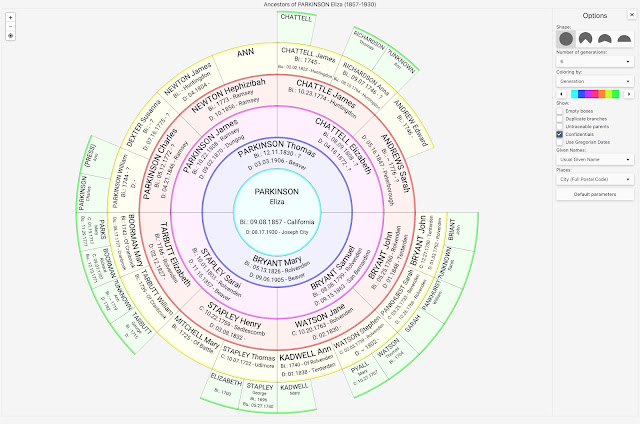
The Heredis Wheel feature is a visualization tool that allows you to display both the ancestors and descendants of a primary person in a circular chart1. Here are some key aspects of this feature:

Mixed Wheel: The mixed wheel lets you display both the ancestors and descendants of the primary person.

Zoom: You can zoom in and out using the + and – buttons. You can also hold down the CTRL key (Windows) or Cmd key (Mac) on your keyboard and zoom in/out using the mouse wheel.

Color Coding: The wheel displays a different color for each Ancestor and Descendant generation. You can select the desired starting color. It also allows you to show the male/female breakdown by selecting the color for men, women, and persons of unknown gender.

Export: You can export the wheel to PDF format for printing.

This feature provides a 360° representation of your family tree, making it easier to visualize and understand your genealogical data. Here is a screenshot of a family wheel. 


I could go on and on, but I suggest looking at the website https://www.heredis.com/ and downloading the free version to see what it can do for you. 

I might also add that the company offers a partnership to genealogy associations.

Monday, September 11, 2023

Growing Old in Genealogy


Once you get to a certain part of your life, you realize that there are no rationalizations that you are still in middle age or anything remotely resembling middle age; you are definitely old. When I started doing genealogical research about 41 years ago, I thought that everyone who did genealogy was "old." Now I realize that many of the people who are doing genealogical research are not old but there are quite a few of us who qualify for my early impression. When you get to this stage, you must admit that no excuses exist that a qualify you for any other category. 

Here are a few of symptoms of what it is like to be old and trying to do genealogical research. 

First of all, I realize that I can no longer work for 10 to 12 hours straight without a nap. There are also other physical reasons that long duration work does not happen so much any more. I also find that after working all day writing, creating presentations, answering questions, and either presenting the same presentations I create or acting as a consultant for the Salt Lake City, Utah FamilySearch Library all make me useless after about 8:00 pm. 

I also have come to depend on an extra pair of glasses for computer use. 

I find that my hearing aids must be in use all day, every day. 

I also seemed to have joined the pain-of-the day club. 

All this leads to a prioritizing of projects and an overall decrease in productivity. It also answers the question I am frequently asked about whether I ever sleep. Yes, I do. 

From time to time, I might comment on my experiences in growing old as a genealogist. Fortunately, I have access to a lot of electronic devices that me writing easier. Here is a short explanation about what it is like to grow old from our friend ChatGPT. 

Growing old as a genealogist can be a unique and rewarding experience, but it also comes with its own set of challenges and considerations. Here's a glimpse into what it might be like:

Accumulated Knowledge: One advantage of growing old as a genealogist is the accumulation of extensive knowledge and expertise in family history research. Years of experience can make you an invaluable resource for younger generations interested in their roots.

Family Legacy: Being a genealogist allows you to create a rich family legacy for your descendants. You can leave behind meticulously researched family trees and detailed histories that future generations can cherish.

Technology Changes: As you age, you may witness significant changes in genealogy research techniques and technology. Staying up-to-date with new tools and digital resources can be a challenge, but it's essential for the field's continued growth.

Preservation: Preserving historical documents, photographs, and artifacts becomes more critical as you age. You might dedicate more time to organizing and digitizing your collections to ensure they are accessible to future genealogists.

Community Involvement: Growing old as a genealogist can provide a strong sense of community. You may belong to genealogy societies or online forums where you can share your knowledge and connect with others who share your passion.

Health Considerations: Like anyone else, aging can bring health challenges. It's important to maintain your physical and mental health to continue your genealogy work. You might adapt your research methods to accommodate any physical limitations.

Teaching and Mentoring: Many older genealogists find joy in mentoring younger enthusiasts. Passing down your knowledge and skills to the next generation can be a fulfilling way to ensure your legacy lives on.

Reflecting on Ancestry: As you age, you may find yourself reflecting more on your own ancestry and family history. This introspection can add depth to your genealogical research and provide a personal connection to the past.

Legacy Planning: Planning for the future of your genealogy research is crucial. Consider documenting your methods, organizing your research materials, and designating a successor to carry on your work when you're no longer able.

In summary, growing old as a genealogist offers the opportunity to leave a lasting legacy, share your knowledge, and connect with a vibrant community. However, it also requires adapting to technological changes, preserving your research, and planning for the future to ensure your work continues to benefit future generations.

Well, I have to agree with the entire list. It is about as good a summary as I could write in less than a minute.