

OK, after this post, I will lay off posting about cemeteries for a while. But I did have a few more things to say. There are some important issues that need to be summarized that all genealogists should keep in mind when they think about cemeteries.
First of all, a cemetery is a specific geographic location. This may seem obvious, but when you think of cemeteries, if you do, you probably have a lot of cultural and social baggage that comes with your thoughts on the subject. But all sentimentality and other cultural artifacts aside, from a genealogical standpoint, a cemetery is a location where some information about our ancestors may be located. I am using the term "cemetery" to include all possible and conceivable burial locations. I suppose the term "grave sites" might be more inclusive, but the word "cemetery" will do.
Aside from the social and cultural ties associated with the burial location of an individual, absent any information that can be obtained from the grave markers or records associated with the cemetery or burial, the most important information about the cemetery is its location. In the event their are multiple burials, the next most important information concerns the arrangement and proximity of the graves. In both cases, the identity of the person buried in each location is also equally as important. So, we are looking primarily for the identity of the individuals buried, the arrangement and proximity of their graves and the overall location of the burial site. Any other information that can be obtained is a bonus.
Now, let's look at the majority of the records you might encounter. We immediately get into a chicken and the egg problem. If I happen to know where my ancestor is buried, I can find burial information. If I don't know have any idea where the ancestor died, how do I find a burial? So what good is it to have huge lists of cemeteries and burials? Searching by my ancestor's name is now much of a help in many cases. I have run across relatives who were buried with names that were either not their birth name or were the name they went by and not their "real" name at all. Having huge online gravesite lists is only partially helpful in these situations.
I think I will start with FindAGrave.com, the most popular and used online cemetery database. Let's see how helpful the program really is to a genealogical researcher. If I search for a cemetery without putting in its location, I will have to know the name of the cemetery. If I search by location, it gives me a long list of cemeteries. For example, if I search for the "St. Johns Cemetery," I get 565 responses. Not helpful. If I put in the state, then I get two choices. If I choose the one I am looking for in Apache County, Arizona, then I am shown the cemetery listing. There is a map of the cemetery location using Google Maps. But now, I have 1,599 interments to review. What it comes down to is that I may be able to find the cemetery, if I know its name, but when I look at the list of burials, unless I know how my ancestor was named at the time of death, I have to guess. In this case, there are 1,597 names in the list. Does this mean there are three unidentified graves? Do I know how many total people are buried in the cemetery? Does the number of interments equal the total number of burials? What if the cemetery has only been partially surveyed? All of these are unanswered questions.
If I start over again and search for a name, how do I know that is the name that was used on the burial marker? Let's suppose I do find my ancestor, I still do not know where he or she is buried and I certainly do not know if any family members are buried close by. In short, FindAGrave.com does not give me any of what I consider to be the crucial information concerning a burial. Now, I could go on and use BillionGraves.com for a comparison. But it would not be fair to FindAGrave.com to do so. Of course, BillionGraves.com gives me all three pieces of information I am seeking. It gives me the location of the cemetery, the exact location of the grave and the identity and proximity of all the surrounding graves. Both programs provide a photo of the grave marker, if there is one. Neither program provides any of the other records associated directly with the cemetery or grave, although BillionGraves.com does link to other websites with additional death information. What about all of the "memorial" information given in FindAGrave.com? This information is usually lacking any source citations or other details and falls into the category of user contributed information with about the same usefulness as online family trees without sources. Helpful, but not too reliable.
For a genealogist, these two programs provide substantial help in locating graves. But what about graves that are not yet recorded in either program? Genealogical researchers are on their own to identify and locate these burials. Granted, there are a huge number of books and other documents concerning burials, but it takes some considerable skill and a lot of map references and perhaps GPS coordinates to ultimately locate the cemetery and further skills to identify and catalog the burials. In some cases, there are narrative descriptions of the cemetery or burial site that aid the researcher. But the trick is finding these additional records.
What it boils down to is that locating burials is still genealogical research. The large online databases simplify the process in many, many cases, but there is still more work to be done even if you have a listing of the burial. There are a multitude of associated records that may be available about the death, the burial and the cemetery. I suggest that finding the grave is only the first of many challenges.
Subscribe To

 Posts
All Comments
Posts
All Comments
Sunday, April 10, 2016


Thursday, April 7, 2016
A Few Interesting Dates for Genealogists
Not too long ago, I was teaching a class of apparently average U.S. adults about genealogy and in conjunction with talking about the availability of certain types of records, I happened to mention 1861. I got a lot of blank stares and so I repeated my reference to the date. Still no response. So I asked more directly, what happened between the years 1861 and 1865. Still no glimmer of comprehension. I then asked bluntly about the U.S. Civil War. Finally, there was glimmer of recognition and a question, "Is that when the war happened?"
The United States War Between the States or Civil War is one of those events that should be firmly implanted in the genealogical mind (at least for those genealogists who have ancestors in the United States during that time period). In fact, every country in the world has similar dates and events. The importance of these events and dates is that they are accompanied with significant accumulations of records. This is one key to discovering a broader range of records about our ancestors. The key is transforming a moderate knowledge of local and national history into a method of finding information not contained in any of the more commonly used documents or records.
Usually, genealogists are exhorted to learn about their local and national history as a way to "get to know" their ancestors. History is stories and stories add interest. But I have a tendency to look at history from an additional and more practical standpoint. History produces records and records produce genealogy. Knowing when the U.S. Civil War occurred in crucial in alerting the researcher to the possibility of finding a military record or other associated type of record about an ancestor or an ancestor's family member. Likewise, valuable records such as those for draft registration can provide insights not present in some other types of records.
If you live in Canada, you have Canada Day, the celebration of July 1, 1867 when the British North America Act (presently known as the Constitution Act of 1867 ) created Canada. Australians have their Australia Day celebrated annually on January 26th, it marks the anniversary of the 1788 arrival of the First Fleet of British Ships at Port Jackson, New South Wales, and the raising of the Flag of Great Britain at Sydney Cove by Governor Arthur Phillip. In the United States we celebrate July 4th each year to commemorate the signing of the Declaration of Independence. I could go one with more examples, but suffice it to say, each country has it major, national holidays.
From a genealogical research standpoint, each of these dates mark a transition from one governmental system to another or to a change in settlement. As these changes occur, new records are created and older record types may disappear. Other dates that can directly affect genealogical research are connected with social changes. In Denmark, for example, there was a transition from the use of patronymic surnames to family surnames during the time period from 1826 to 1870. As a result of this change, it becomes increasingly more time consuming to do research during this time period to discover the names of an ancestor's parents, It becomes more difficult to consistently predict the surnames across generations.because some of the surnames were arbitrarily chosen.
One time, I ran across a family tree with a reference to the birth of my third-great-grandfather that had him born in Cottonwood, Utah in 1777. Unless you know that the first permanent European settlers reached Utah in 1847, you might not see anything wrong with a date in the 1700s. Likewise, I see many references to birth and death dates for individuals who lived in England in the 1400s. With the exception of a few royal lines, dates this early in England are extremely scarce. Likewise, I see that many online family trees date back with lines that purport to be traced back to Adam. The date given is usually 4000 B.C. This is an interesting date with a lot of baggage and seriously at odds with nearly every early dated ruin and artifact. Some considered this arbitrary date to be the basis for a conflict between science and religion. Regardless of your personal beliefs about the the date, its incorporation into genealogical research is just plain silly.
Whatever the purpose of researching your family history, there are simply no written records that are even arguably accurate that connect anyone in the present to anyone mentioned in the Bible. Whatever you want to call family trees that go "back to Adam." They are not genealogy. But the issue does bring up the subject of time limits for genealogical research. Just as the earliest genealogically significant records in Utah date no further into the past than 1847, all other types of records have a temporal termination. You cannot document any pedigree back further than the records were kept in any given part of the world.
Meanwhile, the dates of wars, natural disasters, plagues, political boundary changes and all sorts of other events in history have a direct bearing on genealogical records. The events can either engender the creation of additional records or destroy existing ones. When you know a little bit about history, you just might avoid spending a lot of time looking for records that aren't there or unproductively searching in the wrong places for records that exist somewhere else.
The United States War Between the States or Civil War is one of those events that should be firmly implanted in the genealogical mind (at least for those genealogists who have ancestors in the United States during that time period). In fact, every country in the world has similar dates and events. The importance of these events and dates is that they are accompanied with significant accumulations of records. This is one key to discovering a broader range of records about our ancestors. The key is transforming a moderate knowledge of local and national history into a method of finding information not contained in any of the more commonly used documents or records.
Usually, genealogists are exhorted to learn about their local and national history as a way to "get to know" their ancestors. History is stories and stories add interest. But I have a tendency to look at history from an additional and more practical standpoint. History produces records and records produce genealogy. Knowing when the U.S. Civil War occurred in crucial in alerting the researcher to the possibility of finding a military record or other associated type of record about an ancestor or an ancestor's family member. Likewise, valuable records such as those for draft registration can provide insights not present in some other types of records.
If you live in Canada, you have Canada Day, the celebration of July 1, 1867 when the British North America Act (presently known as the Constitution Act of 1867 ) created Canada. Australians have their Australia Day celebrated annually on January 26th, it marks the anniversary of the 1788 arrival of the First Fleet of British Ships at Port Jackson, New South Wales, and the raising of the Flag of Great Britain at Sydney Cove by Governor Arthur Phillip. In the United States we celebrate July 4th each year to commemorate the signing of the Declaration of Independence. I could go one with more examples, but suffice it to say, each country has it major, national holidays.
From a genealogical research standpoint, each of these dates mark a transition from one governmental system to another or to a change in settlement. As these changes occur, new records are created and older record types may disappear. Other dates that can directly affect genealogical research are connected with social changes. In Denmark, for example, there was a transition from the use of patronymic surnames to family surnames during the time period from 1826 to 1870. As a result of this change, it becomes increasingly more time consuming to do research during this time period to discover the names of an ancestor's parents, It becomes more difficult to consistently predict the surnames across generations.because some of the surnames were arbitrarily chosen.
One time, I ran across a family tree with a reference to the birth of my third-great-grandfather that had him born in Cottonwood, Utah in 1777. Unless you know that the first permanent European settlers reached Utah in 1847, you might not see anything wrong with a date in the 1700s. Likewise, I see many references to birth and death dates for individuals who lived in England in the 1400s. With the exception of a few royal lines, dates this early in England are extremely scarce. Likewise, I see that many online family trees date back with lines that purport to be traced back to Adam. The date given is usually 4000 B.C. This is an interesting date with a lot of baggage and seriously at odds with nearly every early dated ruin and artifact. Some considered this arbitrary date to be the basis for a conflict between science and religion. Regardless of your personal beliefs about the the date, its incorporation into genealogical research is just plain silly.
Whatever the purpose of researching your family history, there are simply no written records that are even arguably accurate that connect anyone in the present to anyone mentioned in the Bible. Whatever you want to call family trees that go "back to Adam." They are not genealogy. But the issue does bring up the subject of time limits for genealogical research. Just as the earliest genealogically significant records in Utah date no further into the past than 1847, all other types of records have a temporal termination. You cannot document any pedigree back further than the records were kept in any given part of the world.
Meanwhile, the dates of wars, natural disasters, plagues, political boundary changes and all sorts of other events in history have a direct bearing on genealogical records. The events can either engender the creation of additional records or destroy existing ones. When you know a little bit about history, you just might avoid spending a lot of time looking for records that aren't there or unproductively searching in the wrong places for records that exist somewhere else.
Book Matching Technology from MyHeritage revolutionizes genealogical research
As I have noted many times in the past, genealogical researchers have a tendency to ignore printed books. Every time I bring up the subject of books in a class the participants act as if I were an undiscovered world. Now, MyHeritage.com is solving the problem of researching books. Their newly introduced, exclusive Book Matching technology automatically finds matches for people in your family tree in their vast collection of almost 450,000 digitized historical books. It uses full semantic text analysis to compare books with family trees, bringing the researcher relevant excerpts when it finds narrative describing people in a MyHeritage family tree, with extremely high accuracy.
I wrote about the first, test, introduction of this amazing technology a short time ago, but now there is a significant expansion. Here is the press release which explains the entire process.
I wrote about the first, test, introduction of this amazing technology a short time ago, but now there is a significant expansion. Here is the press release which explains the entire process.
MyHeritage Releases Exclusive Book Matching Technology for Family History
MyHeritage users to automatically receive relevant excerpts from digitized books that reveal information about their ancestors and relatives
TEL AVIV, Israel & LEHI, Utah, April 7, 2016 — MyHeritage, the fastest-growing destination for discovering, preserving and sharing family history, has launched today a revolutionary addition to its suite of technologies: Book Matching. This innovation automatically researches users' family trees in historical books with high precision.
In April 2012 MyHeritage launched SuperSearch™, a search engine for historical records, which has since then grown to include 6.6 billion historical records, including birth, marriage, death and census records. By implementing its vision of enhancing genealogy with technology, MyHeritage then developed a line of unique and sophisticated technologies that automatically match the records from the search engine to the 32 million family trees uploaded by its users.
In December 2015, MyHeritage expanded its data collections to include digitized historical books, with an initial corpus of 150,000 books of high genealogical value. This collection was tripled last week to 450,000 books with 91 million pages. With a team of more than 50 dedicated curators, MyHeritage aims to add hundreds of millions of pages of digitized books to the collection each year.
In December 2015, MyHeritage expanded its data collections to include digitized historical books, with an initial corpus of 150,000 books of high genealogical value. This collection was tripled last week to 450,000 books with 91 million pages. With a team of more than 50 dedicated curators, MyHeritage aims to add hundreds of millions of pages of digitized books to the collection each year.
As of today, MyHeritage users will receive matches between profiles in their family trees and the books from this collection. The Book Matching technology analyzes the book texts semantically, understanding complex narrative that describes people, and matches it to the 2 billion individuals in MyHeritage family trees with extremely high accuracy. This breakthrough technology is the first of its kind, and is exclusive to MyHeritage.
Book Matching has produced more than 80 million matches, and this number will continue to grow as the collection grows and as the family trees on MyHeritage continue to expand. Book Matching is currently available for English books, and the technology is being enhanced to cover additional languages. In addition, de-duplication technology is being added in the next few weeks to remove duplicate books that have been scanned and OCRed more than once by different sources.
“No one has ever done this before," said MyHeritage Chief Technology Officer, Sagi Bashari. “Our Book Matching technology reads hundreds of thousands of books for you, every hour, comparing them to your family tree and pointing you to relevant excerpts about your ancestors with almost no false positives. MyHeritage is the first to offer full semantic text analysis in this way, and the genealogical breakthroughs speak for themselves. You will be amazed at the value of books for your research."
“I've personally seen what this new technology can do, using my own family tree,” said blogger and lifelong genealogist Leland Meitzler. “It found well over 500 books with information on my family, most of which I'd never seen before. All kinds of ancestors and relatives can now be added to my tree! To say that this new search technology changes everything would be an overstatement, but not by much.”
Genealogist James Tanner said: “This advanced technology from MyHeritage opens up a whole new world of research possibilities that were almost completely unavailable in the past. I have always valued the content of the older genealogy books because the people who wrote them were contemporaries with my ancestors. Being able to search these books on a large scale will change the way most of us have been doing genealogy and our attitude towards the books that have been there all along but were not searchable.”
Dick Eastman, of Eastman’s Online Genealogy Newsletter, summed up MyHeritage’s latest innovation: "MyHeritage Book Matching is like having a huge library at your fingertips, with a twist; there is a magical librarian who tells you exactly which books have information about your ancestors."
Book Matches are available at www.myheritage.com and are generated automatically for any family tree built on the website or imported into it. A Data subscription is required to view Book Matches.
About MyHeritage
MyHeritage is the world's fastest-growing destination for discovering, preserving and sharing family history. As technology thought leaders, MyHeritage is transforming family history into an activity that’s accessible and instantly rewarding. Its global user community enjoys access to a massive library of historical records, the most internationally diverse collection of family trees and groundbreaking search and matching technologies. Trusted by millions of families, MyHeritage provides an easy way to share family stories, past and present, and treasure them for generations to come. MyHeritage is available in 42 languages. www.myheritage.com
Wednesday, April 6, 2016
The Family History Guide now in all 4800+ Family History Centers

The free website, The Family History Guide, is now included on the FamilySearch portal in all 4800+ Family History Centers around the world. In addition, The Family History Guide is also available directly from FamilySearch.org by its inclusion in the Learning Center.
The Family History Guide is the first free, comprehensive, structured and sequenced instructional tool to address the topic of learning generally about family history research and specifically about a number of useful topics including the free FamilySearch.org website. In the short time since its initial release, it has become the "go to" place for Family History Consultants and anyone with an interest in improving their genealogical research skills.
Here is a short introductory video about the website:
Tuesday, April 5, 2016
Strategies for Locating the Unburied
What do you do to find the burial location of someone who died without being buried? Now, think about this question a little. There is no burial location for someone who wasn't buried. This includes the multitude of people buried "at sea." It also includes the huge number of people who are now and in the past were cremated. This points out a basic issue with genealogical research: you can't find what is not there. In fact, that is now going to become my second Rule of Genealogy. As I thought about it, I also discovered the Third Rule of Genealogy.
Here we are with the three rules I have so far:
First Rule of Genealogy: When the baby was born, the mother was there.
Second Rule of Genealogy: You can't find what's not there.
Third Rule of Genealogy: Everyone dies.
Over the years, I have talked to lots of people who have been searching for years without success for documentation of a specific event in an ancestor's life, i.e. birth record, death record, marriage record etc. The reality is that there may be no record. Births were not always recorded and likewise marriages and deaths may have never been officially recorded. If you find someone's marriage record, it is evident that they were born. The same conclusion can also be made about their death. It is true that records of these important events are helpful especially in differentiating one person with a similar name from another, but it is unfortunate when a researcher fixates on a particular event at the expense of doing broader research.
The any number of reasons why an ancestors burial location cannot be determined. Here are a few suggested issues:

Here we are with the three rules I have so far:
First Rule of Genealogy: When the baby was born, the mother was there.
Second Rule of Genealogy: You can't find what's not there.
Third Rule of Genealogy: Everyone dies.
Over the years, I have talked to lots of people who have been searching for years without success for documentation of a specific event in an ancestor's life, i.e. birth record, death record, marriage record etc. The reality is that there may be no record. Births were not always recorded and likewise marriages and deaths may have never been officially recorded. If you find someone's marriage record, it is evident that they were born. The same conclusion can also be made about their death. It is true that records of these important events are helpful especially in differentiating one person with a similar name from another, but it is unfortunate when a researcher fixates on a particular event at the expense of doing broader research.
The any number of reasons why an ancestors burial location cannot be determined. Here are a few suggested issues:
- The ancestor died at sea
- The ancestor was in the military and died in an unexpected location
- The ancestor war buried in a mass grave
- The ancestor was too poor to have a grave marker and was buried, if at all, in a paupers grave
- The ancestor was cremated
- The ancestor died on the Plains
- The ancestor wandered off and was lost and died
There are probably many more reasons, but they all add up to the same set of circumstances; a person's burial may not have been recorded.
During the past two or three hundred years, if you are interested in finding a death notice, the very first place to look is in a newspaper. Genealogists have a huge number of online, digitized newspaper websites, both subscription and free, that might contain mention of a death under circumstances where the person's body was never recovered and hence, there was no burial. Here is an example from the "The Scranton tribune., August 10, 1898, Page 7, Image 7:"
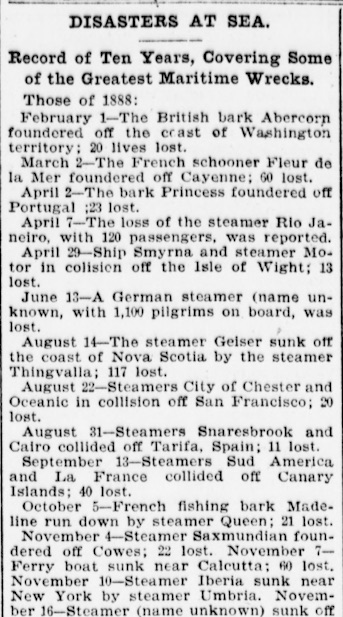
The entire article lists well over 100 major shipwrecks. This is only one example of the challenge. But this is the reason for the Third Rule of Genealogy. We can assume that after 110 years or so, that everyone is dead. There are very few reasons why some official mention of the death is crucial to identifying an individual. Do you know if one of your ancestors was or was not on one of the boats that sank at sea listed above?
The key to solving these types of missing document problems involves expanding your search to a wider selection of documents. Here is a list of alternatives places to look for death records from the FamilySearch.org Research Wiki with some of my own additions:
- Church records of deaths and burials
- City and County civil registrations
- Family Bibles and personal histories
- FamilySearch in the Catalog Search, Records Search, and Historic Books
- Google and other web site search sites, and don't forget to search Google Books
- Locating United States Vital Records
- Mortality Schedules is a census that includes people who died between June 1st through May 31st in the year prior to the federal census.
- Newspapers often listed articles about deaths
- Obituaries
- Online U.S. Death Indexes & Records
- Online records sites like FamilySearch.org, Ancestry.com, Fold3.com, WorldVitalRecords, Heritage Quest, MyHeritage.com, etc.
- Probate Records
- State Archives
- Submitted genealogies posted by others UsGenWeb, Genealogy links, Gengateway, Usgennet, FamGen, Rootsweb, Genealogy.com, Kindred Konnections,Ancestry.......
- Tombstones usually give birth and death dates
- Military records
- Prison records
- Maritime records including shipwrecks
- Diaries
This list could go on an list nearly every type of record imaginable. You never really know where a mention of a death may pop up. The more you learn about an individual and their family, the more likely it will be that you will find a record mentioning their death.
Monday, April 4, 2016
Spring Break Continues
Spring weather brings on the urge to travel and we have the tendency to go places where there are few or no practical Internet connections. So for the next week or so, we will be frequently off line.
You might want to take this time to review a few of my 4305 previous posts on Genealogy's Star. You could also review some of the over 2924 photos I have online on WalkingArizona.blogspot.com. You can also read a few of the 926 posts on my Rejoiceandbeexceedingglad.blogspot.com blog. It might take you more than a week just to browse through most of those posts.
Don't worry, I will return with a lot of new photos and more to say about genealogy, the world and whatever. I ready have several good ideas for blog posts.
You might want to take this time to review a few of my 4305 previous posts on Genealogy's Star. You could also review some of the over 2924 photos I have online on WalkingArizona.blogspot.com. You can also read a few of the 926 posts on my Rejoiceandbeexceedingglad.blogspot.com blog. It might take you more than a week just to browse through most of those posts.
Don't worry, I will return with a lot of new photos and more to say about genealogy, the world and whatever. I ready have several good ideas for blog posts.
And if we die...
In keeping with the cemetery stuff and the Alzheimer's stuff, I decided to expand a little further on the topic. Accurate data on mortality is abundantly available in the huge collection of online family trees. What we need is a major compilation of all the information and we can see the changes in moribundity and mortality rates for probably a thousand years or more. In the United States, this information is usually obtained from vital statistics accumulated from the death registration states during the last 100 years or so. Genealogical data is probably dismissed as being too undependable because, after all, genealogy is not an academic science. But with some care, it is likely possible to accumulate substantially accurate data from this assumed inaccurate genealogical data.
You can see the data accumulated by the Centers for Disease Control and Prevention, National Vital Statistics System in an article entitled, "Age-Adjusted Death Rates for Selected Causes, Death Registration States, 1900-32, and United States, 1933-98." Likewise, it would be a good idea for genealogists to understand the changing mortality rates. For example, see the following article.
Seriously, genealogists need to be aware of such things as the infant mortality rate in any given century and country and the overall life expectancy rate of a particular population and time. For example, the overall life expectancy of the average person living in England in the early modern era was about 30 years. If a person lived to the age of 21, their life expectancy increased to about 70 years. See Wikipedia: Life expectancy. It is not uncommon for genealogical researchers to accept as valid dates that are outside the normal range of mortality. This lack of awareness also extends to dates that are entirely unrealistic from the standpoint of reality. For example, mothers giving birth in early childhood and children born long after one or both parents have died. It may well be that some of these readily apparent errors are the result of transposition errors or similar typographical problems, but the persistence of these errors across generations in online family trees and the same errors copied from tree to tree, all indicate a lack of awareness on the part of the researchers.
Other factors that must be taken into consideration are the existence of epidemics and other natural disasters that can adversely affect mortality rates for relatively short periods of time. For example, the world-wide flu epidemic that is generally associated with the year 1918 resulted in the death of from 50 to 100 million people, approximately 3% to 5% of the world's population. All of us alive today had ancestors that lived through or died in this world-wide event. It is possible that unexplained deaths that occurred from 1918 to 1920 could have been caused by a flu infection.
One standard method of approaching the dates when children are born into a family when gaps of years are noted in the succession of children in a family is to assume that there are missing children who may have died in infancy. This is a rather safe assumption given the infant mortality rates across the world. If you are aware of the mortality rate for the time periods during the lives of your ancestors, you can plot all the ages on a graph and see if there are any days that are significantly outside of the norm. Any such outlying ages should then be re-evaluated and further supported by research. In short, genealogists should always maintain a sense of historical consistency and reality.
You can see the data accumulated by the Centers for Disease Control and Prevention, National Vital Statistics System in an article entitled, "Age-Adjusted Death Rates for Selected Causes, Death Registration States, 1900-32, and United States, 1933-98." Likewise, it would be a good idea for genealogists to understand the changing mortality rates. For example, see the following article.
Corsini, Carlo A. and Pier Paolo Viazzo ed., The Decline of Infant Mortality in Europe, 1800-1950, Four National Case Studies, United Nations Children Fund, International Child Development Center, “Hisper_decline_infantmortality.pdf.” 2016. Accessed March 31. http://www.unicef-irc.org/publications/pdf/hisper_decline_infantmortality.pdf.
Seriously, genealogists need to be aware of such things as the infant mortality rate in any given century and country and the overall life expectancy rate of a particular population and time. For example, the overall life expectancy of the average person living in England in the early modern era was about 30 years. If a person lived to the age of 21, their life expectancy increased to about 70 years. See Wikipedia: Life expectancy. It is not uncommon for genealogical researchers to accept as valid dates that are outside the normal range of mortality. This lack of awareness also extends to dates that are entirely unrealistic from the standpoint of reality. For example, mothers giving birth in early childhood and children born long after one or both parents have died. It may well be that some of these readily apparent errors are the result of transposition errors or similar typographical problems, but the persistence of these errors across generations in online family trees and the same errors copied from tree to tree, all indicate a lack of awareness on the part of the researchers.
Other factors that must be taken into consideration are the existence of epidemics and other natural disasters that can adversely affect mortality rates for relatively short periods of time. For example, the world-wide flu epidemic that is generally associated with the year 1918 resulted in the death of from 50 to 100 million people, approximately 3% to 5% of the world's population. All of us alive today had ancestors that lived through or died in this world-wide event. It is possible that unexplained deaths that occurred from 1918 to 1920 could have been caused by a flu infection.
One standard method of approaching the dates when children are born into a family when gaps of years are noted in the succession of children in a family is to assume that there are missing children who may have died in infancy. This is a rather safe assumption given the infant mortality rates across the world. If you are aware of the mortality rate for the time periods during the lives of your ancestors, you can plot all the ages on a graph and see if there are any days that are significantly outside of the norm. Any such outlying ages should then be re-evaluated and further supported by research. In short, genealogists should always maintain a sense of historical consistency and reality.
Subscribe to:
Posts (Atom)